
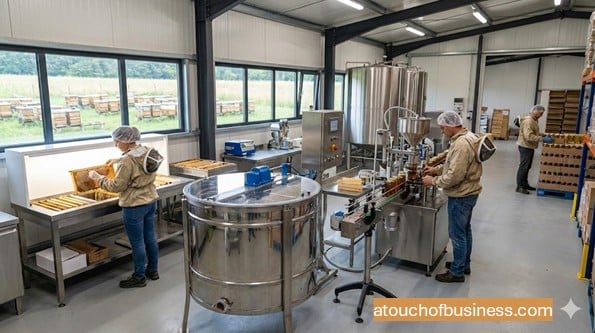
Honey Production Business Launch Plan: Steps to Follow
Honey Production Business Overview
You’ve probably done it. You pick up a jar of local honey, taste it, and think, “I could do this.” Then you picture a few hives in a quiet spot, some jars on a table, and a simple side business.
Now zoom in. You’re working with live insects, food packaging rules, and local rules that can change from one town to the next. That doesn’t mean you shouldn’t do it. It means you should start in the right order.
Before you commit to gear, bees, or a business name, make two decisions. First, decide if owning and operating a business is right for you. Second, decide if this specific business is the right fit.
Start with business start-up considerations. It helps you slow down and get honest about what you’re signing up for.
Next, get clear on pressure. Passion matters more than people admit. When challenges hit, passion helps you stay in problem-solving mode. Without it, many people start looking for an exit instead of solutions.
If you want a direct way to think about that, read why passion matters before you start.
Now ask yourself this exact question: “Are you moving toward something or running away from something?”
If you’re starting mainly to escape a job you hate or a tight financial spot, be careful. That kind of push can get you started, but it often isn’t strong enough to keep you going when the work gets uncomfortable.
Also think about readiness. Are you prepared for uncertain income, long hours, difficult tasks, fewer vacations, and full responsibility? Is your family or support system on board?
And do you have the skills to launch this the right way—or can you learn them? Can you secure funds to start and operate, even if sales take time to build?
One more step that can save you a lot of pain. Talk to owners in the same line of work, but only when they are not direct competitors. Only talk to owners you will not be competing against, like someone in a different city or region.
Here are a few smart questions to ask. What local rules surprised you once you placed your first hives? What part of your extraction and packaging setup took longer than expected? If you started over, would you begin with direct sales, wholesale, or both—and why?
To keep your perspective grounded, you can also read a business inside look. It’s a useful reminder that the day-to-day is never as simple as the idea.
What This Business Really Is
A honey production business centers on managing honey bee colonies and harvesting honey. In many cases, you also extract, strain, settle, and package honey for sale.
You’re not just “getting honey.” You’re setting up a small food packaging workflow and keeping your work area clean, organized, and consistent.
If you want an industry classification for forms, lenders, or applications, honey production is commonly listed under North American Industry Classification System code 112910 (Apiculture).
How You Can Earn Revenue
Most new producers start with packaged honey in jars or containers. Some add comb honey or creamed honey when they have a process they can repeat.
Some operations also sell bee-related products like beeswax or offer related services like pollination. Those options can change your equipment list and your local compliance needs, so it helps to choose your launch focus early.
Typical Customers
You can sell directly to customers who want local honey and like buying from a producer they can meet. That often shows up as farmers markets, farm stands, local delivery, or online orders.
You can also sell to retailers or food businesses that use honey as an ingredient. If you go this route, expect them to care about consistency, packaging, labeling, and reliable supply.
Solo Start or Larger-Scale Operation
This is one of those businesses that can start small. A solo owner can begin with a limited number of colonies, a basic extraction setup, and a simple sales channel like a market table or direct orders.
It can also grow into a larger operation with many apiary sites, a dedicated extraction and packaging space, more storage, more packaging volume, and staff to handle processing and fulfillment.
Your scale affects almost everything. It changes your startup budget, your space needs, your insurance needs, and the business structure that makes sense.
At a small scale, many owners begin as a sole proprietor and later form a limited liability company as the business grows and the risk exposure increases. At a larger scale, you may consider partners or outside funding and plan for paid help earlier.
Also decide if you’re doing this full time or part time. A part-time start can work, but you still have to meet the same rules and produce a product you can stand behind.
Pros and Cons to Think Through
This business can feel simple from the outside. But it has real responsibilities, and some are not optional.
Before you commit, weigh what you like about the work and what you may struggle with.
- Pros: You can start small and grow at your pace.
- Pros: You can choose sales channels that fit your personality, from direct sales to wholesale.
- Pros: You can build multiple product lines over time, once your basics are solid.
- Cons: You work with stinging insects and need a safety-first mindset.
- Cons: You may face local limits on hive placement, especially in residential areas.
- Cons: Packaging and labeling expectations can be strict, and you have to get them right.
- Cons: Your space needs matter. You need a clean workflow for extraction and packaging.
Essential Equipment and Supplies
Your equipment list depends on how many colonies you start with and how you plan to extract and package honey. Start with essentials and build from there.
As you read this list, remember the key rule: scale drives totals. The same core items apply, but volume changes how many you need.
Hive Components and Apiary Hardware
- Hive outer covers
- Inner covers
- Bottom boards
- Hive bodies (brood boxes)
- Honey supers
- Frames
- Foundation (wax or plastic)
- Entrance reducers
- Hive stands or pallets
- Queen excluders (if used in your system)
Safety and Bee Handling
- Bee veil
- Protective jacket or suit
- Gloves
- Hive tool
- Smoker
- Smoker fuel
Feeding and Basic Support Items
- Feeders (style depends on your setup)
- Food-grade containers for mixing and carrying feed (as needed)
Honey Harvest and Extraction
- Uncapping tools (manual or electric options)
- Uncapping surface or table
- Honey extractor
- Strainers or filters
- Food-grade settling tank or food-grade buckets with lids
- Bottling tank or gated bottling bucket
- Food-grade tools dedicated to honey handling
Packaging and Labeling
- Jars or containers in your planned sizes
- Lids that match your containers
- Labels suited to your container shape and surface
- Scale suitable for verifying net contents (as needed for your packaging approach)
- Cases or cartons for storage and transport (as needed)
Cleaning, Storage, and Workspace Basics
- Washable work surfaces
- Cleaning supplies dedicated to food-contact equipment
- Shelving for clean jars and finished product
- Covered storage to protect packaging from dust and pests
- Food-grade storage containers for bulk honey (if selling in bulk)
Transport and Site Setup
- Ratchet straps or tie-downs (for moving equipment)
- Basic tools for assembly and repairs
- Containers for carrying frames and supers during harvest
Once you have your draft list, gather pricing estimates so you can build a realistic startup budget. If you’re unsure about a specific item, ask an experienced producer in a different area what they started with and what they waited to buy.
Skills You Need to Launch
You don’t need to be an expert on day one. But you do need the basics before you place bees, harvest honey, and put a food product in a jar.
If you don’t have these skills yet, plan time to learn them or pay for help in the early stages.
- Safe hive handling and basic colony checks
- Understanding seasonal timing in your region
- Basic honey extraction workflow and clean handling
- Packaging and labeling basics for a food product
- Simple recordkeeping for batches, inventory, and sales
- Customer communication for your chosen sales channels
What the Work Looks Like Day to Day
Some days are outdoors and physical. You’re checking colonies, moving boxes, and staying aware of weather and timing.
Other days are all about process. You’re extracting, straining, settling, packaging, labeling, and storing product so it stays clean and consistent.
If you sell directly, you also spend time preparing orders, setting up for sales days, and handling customer questions. If you sell wholesale, you spend time coordinating packaging specs and delivery expectations.
Common Business Models
How you sell matters as much as how you produce. Your model affects packaging, pricing, and how much product you need ready at launch.
Pick one model to start, then expand once your workflow is stable.
- Direct-to-customer: Farmers markets, farm stand, online sales, local delivery
- Wholesale: Retail stores, specialty shops, and food businesses
- Mixed model: Direct sales for margins, wholesale for volume
- Expanded services: Pollination services or selling bees (adds complexity)
Red Flags to Watch Before You Commit
Red flags are not always dramatic. Often, they show up as missing answers you should already have before you spend real funds.
If you see any of these, pause and verify before moving forward.
- You can’t confirm local rules for keeping hives where you plan to place them.
- You don’t have a clean, workable space for extraction and packaging, and you’re hoping it “will be fine.”
- You plan to sell flavored or blended products without confirming labeling requirements for ingredients and product naming.
- You have no plan for storage of clean packaging and finished product.
- You haven’t tested demand, and you’re relying on enthusiasm instead of real buying behavior.
Step 1: Choose Your Launch Model and Product Focus
Start by deciding what you will sell in your first version of the business. Keep it simple. Packaged honey in a small set of jar sizes is the most common starting point.
Then choose how you will sell it. Will you start with direct sales, wholesale, or a mix? Your answer drives your packaging volume, labeling needs, and how much product you need ready before launch.
If you’re tempted to offer everything right away, slow down. A focused launch is easier to set up, easier to price, and easier to explain to customers.
Step 2: Verify Demand and Real Profit Potential
Before you buy bees or equipment, verify that people in your area actually purchase honey the way you plan to sell it. Look at farmers markets, local retailers, and online ordering patterns in your region.
This is also where you get serious about numbers. You’re not just proving sales exist. You’re proving the business can cover expenses and still pay you.
If you want a simple way to think about market behavior, review how supply and demand shows up in small business. Then compare that to what you see locally.
Step 3: Choose Apiary Sites and a Clean Packaging Space
Location matters, but not in the same way a storefront business thinks about it. Your first location decision is where your hives will live. You need access, permission, and a site that works for your schedule.
Your second location decision is where you will extract and package honey. That space has to support a clean workflow and protected storage for packaging and finished product.
If you are considering a dedicated space, or you want a simple framework for thinking through location choices, use this business location guide and adapt it to an apiary and packaging setup.
Step 4: Build Your Startup Cost Estimate and Gear List
Now you turn your equipment needs into a working list tied to your planned scale. Start with the essentials you need to place hives safely and extract honey with a basic workflow.
Then gather pricing estimates from suppliers so your budget is real. Don’t guess. Use actual prices for hives, protective gear, extraction tools, jars, lids, labels, and storage.
As you do this, remember that scale drives totals. A small start can be manageable. A larger start can require more space, more equipment capacity, and more funds up front.
If you want a clean way to structure your estimates, use a startup cost estimating guide and plug in your real numbers.
Step 5: Write a Business Plan You Can Actually Use
You don’t need funding to benefit from a business plan. You need clarity. A plan forces you to define your model, your products, your sales channels, your startup budget, and what “ready” looks like before you open.
It also helps you spot gaps early, like missing permits, missing space needs, or a pricing plan that can’t support your costs.
Use this business plan guide as a structure, then keep your first version simple and practical.
If you want help, this is a good time to build a small support team. You can learn more about that idea here: building a team of professional advisors.
Step 6: Decide How You Will Fund the Start
Funding is not just about buying equipment. It is also about staying stable while you build sales. You may need funds for packaging, licenses, insurance, and basic setup costs before you earn steady revenue.
A small start is often funded personally. A larger start may involve partners, outside funding, or financing—especially if you need a dedicated space or higher-capacity extraction equipment.
If you plan to pursue financing, review how business loans typically work and prepare your documents early.
Step 7: Choose a Business Name and Lock Down Online Basics
Choose a name you can use consistently on labels, a website, and business accounts. Then check availability in your state and in your online channels.
At a minimum, secure the domain and the social handles you plan to use. Even a simple website can help customers confirm who you are and how to place an order.
If you want a structured way to pick a name, use a guide to selecting a business name.
When you’re ready to build a basic site, start here: an overview of building a business website.
Step 8: Form the Business and Register for Taxes
Choose a legal structure that fits your risk level and your growth goals. Many small businesses begin as a sole proprietor and later form a limited liability company as they grow and want clearer separation and structure.
If you are going bigger from day one, or you are bringing in partners, talk to a qualified professional early so you form the business the right way.
Then register your business with your state, apply for an Employer Identification Number if you need one, and set up any required state tax registrations based on how and where you sell.
If you want a step-by-step guide for the basics, use how to register a business as your reference point.
Varies by jurisdiction
Beekeeping and food-related rules can change by state, county, and city. You don’t want assumptions here. You want confirmations from the right office.
Use this checklist to verify locally. Check your Secretary of State for entity formation and name rules. Check your state Department of Revenue for sales tax registration and product taxability. Check your city or county business licensing portal for general business license rules.
Then check your city or county planning and zoning office for home occupation limits, zoning verification, and whether a Certificate of Occupancy applies to your chosen space. If your state Department of Agriculture or local health department regulates food processing or food establishment permits in your area, confirm how honey extraction and packaging is treated where you live.
If you want questions to bring to the call, ask what approvals apply to extracting and packaging honey for sale, whether home-based production is allowed, and what labeling elements they expect to see on packaged product.
Step 9: Handle Licenses, Permits, and Food Labeling Basics
Now you build your compliance list based on your model and location. This usually includes business licensing, any required beekeeping registrations in your state, and the rules that apply to extracting and packaging honey for sale.
Labeling matters at launch because your label is part of your compliance. If you sell plain honey, the rules are simpler than if you sell products with added ingredients. If you add ingredients, you may need an ingredient statement, and your product naming must be accurate.
If you’re unsure, confirm labeling expectations before you print labels. It is easier to adjust your design now than to relabel product later.
Step 10: Set Up Banking and Basic Financial Tracking
Open a business account at a financial institution and keep your business and personal transactions separate. This makes taxes cleaner and helps you see the real health of the business.
Decide how you will track sales, expenses, and inventory from day one. If you don’t want to do the setup yourself, this is a smart place to pay for professional help and get it done correctly.
Step 11: Set Pricing and Choose Suppliers
Pricing is not just what competitors charge. It has to cover your costs, your time, your packaging, and the real effort it takes to produce and sell consistently.
Set a pricing structure you can explain in a sentence, then pressure-test it against your numbers. If the price can’t support your costs, you either adjust the model, adjust the channel, or adjust the scale.
For a framework, review pricing your products and services.
Then choose suppliers for hive equipment, bees, jars, lids, labels, and storage containers. Build relationships with suppliers you can reorder from easily, because consistency matters once you start selling.
Step 12: Get Insurance in Place
Insurance is part of launch planning because it protects you when something goes wrong. Start with general liability. It’s often required by markets, venues, and wholesale accounts.
Then add coverage that matches your real risks. That may include product liability, coverage for equipment and stored inventory, and commercial auto coverage if you use a vehicle for business deliveries or transport.
If you hire employees, workers’ compensation requirements depend on your state. Verify the rule before you hire anyone.
Use a business insurance guide to understand common coverage types and what questions to bring to an agent.
Step 13: Build Brand Identity Basics
You don’t need fancy branding to start. You do need consistency. Customers should see your label, your name, and your contact information and feel confident you are a real business.
Start with the essentials you will actually use at launch: a clean logo, label design, and basic business contact details. If you sell in person, you may also want simple business cards and clear signage for your table or stand.
Here are a few helpful references if you want structured guidance: corporate identity basics, what to know about business cards, and business sign considerations.
Step 14: Set Up Your Workspace and Pre-Launch Systems
Before you sell anything, set up your extraction and packaging workflow so it is clean and repeatable. Think in terms of surfaces, tools, and storage. You want packaging protected, finished product protected, and a clear flow from extraction to bottling to labeling.
Then set up the basics you need to run your first sales day. Decide how you will invoice, how you will accept payment, and how you will handle simple customer records for orders and follow-up.
If you’re starting solo, you can do most tasks yourself at first and hire later. If you’re starting at a larger scale, plan roles early so quality doesn’t fall apart when volume rises.
If you want guidance on staffing timing, review how and when to hire and decide what you can realistically handle alone.
Step 15: Run a Pre-Opening Checklist and Plan Your First Sales Day
Do a final compliance check before you sell. Confirm your business registrations, any local licensing requirements, and your labeling readiness. Make sure your jars, lids, labels, and storage are ready and clean.
Then plan how customers will find you. For direct sales, that may be a market table, a small online presence, and local outreach. For wholesale, that may be product samples, a clean sell sheet, and a clear ordering process.
If you are opening a physical retail space, plan a clear opening event and local outreach. You can use grand opening ideas as a guide. If you have a storefront, you can also review ways to get customers through the door.
The goal is simple. You want your first sales day to feel organized, compliant, and calm. That’s how you build confidence and repeat the process.
Quick Recap and Is This the Right Fit for You?
A strong start comes from doing a few core things well. Choose a focused product and sales model. Verify demand and prove the numbers can work. Pick workable sites and a clean packaging workflow. Then handle registration, insurance, labeling, and launch planning in a logical order.
This business tends to fit people who like hands-on work, can stay patient, and can follow a clean process. It also fits people who can handle responsibility without needing perfect conditions every day.
Do a simple self-check before you move forward.
- Are you willing to do physical, outdoor work and follow safety practices every time?
- Can you handle uncertain income early on while you build repeatable sales?
- Do you have a realistic place for hives and a clean place for extraction and packaging?
- Is your support system on board with the time demands and responsibility?
- Are you ready to learn the skills you don’t have yet, or pay for help where it matters?
If you can answer those with confidence, you’re not just excited about the idea. You’re preparing for the reality. And that’s the difference between a hobby that fades and a business you can actually build.
101 Tips for Operating a Profitable Honey Production Business
This section pulls together practical habits that affect profit, quality, and customer trust.
Use what fits your goals and ignore what doesn’t apply to your setup.
Bookmark this page so you can come back when you hit a new stage.
Work on one tip at a time and put it in place when the timing is right.
What to Do Before Starting
1. Decide what you will sell first (jarred honey, comb honey, creamed honey) and pick one primary sales channel so your setup stays focused.
2. Write down your “hive sites” plan early: who owns the land, what access you have, and what happens if you need to move colonies fast.
3. Verify state and local beekeeping rules before you place a single hive, especially if you are near neighbors or within city limits.
4. Choose where extraction and bottling will happen and confirm what your state or local office expects for that type of food handling space.
5. Sketch your workflow on paper: where “dirty” items enter, where honey is handled, and where clean jars and finished product are stored.
6. Build your equipment list around your planned colony count and your extraction volume, then collect real supplier quotes so your budget is based on facts.
7. Budget for packaging from the start (jars, lids, labels, cases) because packaging can become a repeat expense that surprises new owners.
8. Set up basic recordkeeping before your first harvest: batch notes, inventory counts, and a simple way to track sales and expenses.
9. Create a pricing worksheet that includes fees, packaging, travel, and your time so you can see if the numbers can actually support you.
10. Separate business and personal transactions from day one with a dedicated account so your bookkeeping stays clean and your taxes are easier.
11. Shop insurance before you commit to sales outlets; many markets and wholesale accounts ask for general liability proof.
12. Talk to experienced owners outside your area and ask what surprised them about rules, harvest timing, and packaging decisions.
What Successful Honey Production Business Owners Do
13. Keep a simple annual calendar for nectar flows, feeding windows, treatment windows, and harvest timing so your work is planned instead of reactive.
14. Standardize inspections with the same checklist each time, so you catch problems early and don’t rely on memory.
15. Track colony performance by yard and by colony so you know which locations and queens are paying off.
16. Treat packaging like a system, not an afterthought: reorder points, storage rules, and label version control keep you from scrambling.
17. Use batch or lot identifiers on every run so you can trace what went into which jars if a question comes up later.
18. Calibrate your measuring tools on a routine schedule (refractometer and scale) so quality and net contents stay consistent.
19. Protect honey quality by minimizing unnecessary heating and handling, because quality problems often start with rushed processing.
20. Build supplier relationships for both beekeeping gear and packaging so you can get replacements quickly during peak season.
21. Keep a “ready for sale” standard and stick to it, even when you feel pressure to fill orders.
22. Review your numbers monthly—sales mix, average price per jar, and costs—so you can adjust before problems compound.
Running the Business (Operations, Staffing, SOPs)
23. Write a short standard operating procedure for harvest day so everyone follows the same steps and you reduce mistakes under pressure.
24. Set up a dedicated “clean zone” for jars, lids, and labeling tools so packaging never touches sticky or dusty surfaces.
25. Keep honey-contact equipment non-porous and easy to clean, and retire tools that develop cracks or seams that trap residue.
26. Control moisture risk by checking frames before extraction and verifying moisture during processing so you don’t package honey that can ferment.
27. Give honey time to settle so air bubbles and fine debris rise, which improves clarity and reduces customer complaints.
28. Train anyone who handles honey to avoid introducing water into the process; small amounts of water can create big quality problems.
29. Store honey in food-grade containers with tight lids and keep containers off the floor to reduce contamination risk and packaging damage.
30. Keep your extraction space organized with “in” and “out” areas so harvested supers do not mingle with finished product storage.
31. Protect labels from humidity and temperature swings so they apply cleanly and stay readable during storage and transport.
32. Document your label elements and placement rules so every jar shows the same required information in the same places.
33. If you sell more than one variety or season, separate inventory by batch and label clearly so you don’t accidentally mix runs.
34. Build a “market day kit” checklist (signage, table supplies, payment setup, extra labels, clean towels) so you don’t lose sales to preventable gaps.
35. Use a consistent method to confirm net quantity in each jar size so customers get what the label promises.
36. Establish a simple sanitation routine before and after extraction that includes surfaces, tools, and storage shelves.
37. Keep lids and jars in closed cases until needed so dust and pests do not create a hidden quality issue.
38. Create a basic equipment maintenance schedule for extractors, gates, and filters so you catch wear before it becomes a breakdown during harvest.
39. If you hire seasonal help, define the three most important tasks in writing and train to those first before adding more responsibilities.
40. Assign one person to quality checks during bottling (fill level, lid tightness, label placement) so problems are caught immediately.
41. Use a simple reorder point for each packaging item (jars, lids, labels) so you never run out during the busiest weeks.
42. Keep a written process for handling returns or defects so your response is consistent and fair, not emotional.
43. Track your sales by channel (market, online, wholesale) so you can see which channel pays you best for your time.
44. Create a weekly “admin block” for invoices, receipts, and inventory updates so paperwork does not pile up and become a crisis.
What to Know About the Industry (Rules, Seasons, Supply, Risks)
45. Learn the difference between “honey” and “honey products” because adding ingredients changes how you label and describe what’s in the jar.
46. If you use a floral name (like clover) or a regional claim, be careful with how you describe it and avoid implying certainty you cannot support.
47. Understand that packaged food labeling has specific requirements, including ingredient statements when applicable and accurate product naming.
48. Net quantity statements matter; take them seriously because weights and measures enforcement can apply to packaged goods.
49. Know that state rules on licensing, inspections, and permitted facilities can differ, so “it worked for my friend” is not a legal standard.
50. Build your season plan around local nectar flows, not your preferred calendar, because weather and forage drive harvest timing.
51. Expect variability in yield year to year, and plan your finances so one weak season does not derail the business.
52. Use official agriculture statistics to understand long-term production and price trends, but avoid assuming past averages guarantee future results.
53. Learn common causes of colony loss in your area and build prevention into your calendar, because replacing colonies can become a major expense.
54. Manage pesticide exposure risk by knowing what is applied near your yards and communicating proactively with landowners and nearby growers.
55. Plan for theft and vandalism risk at remote yards with signage, visibility choices, and clear permission documentation.
56. Keep a plan for moving colonies if a site changes hands, neighbors complain, or forage conditions shift.
57. If you sell wholesale, understand that accounts may expect consistency across batches, which can be challenging when honey varies by season and location.
58. Avoid medical or disease-prevention claims in your marketing and labeling, because claims can create regulatory issues and customer disputes.
59. If you import bees or used beekeeping equipment, verify federal rules before purchasing so you do not accidentally violate restrictions.
60. Treat quality standards as a business tool: the clearer your quality target, the easier it is to train helpers and defend your pricing.
Marketing (Local, Digital, Offers, Community)
61. Start local and specific: choose a tight service area so deliveries, market schedules, and customer communication stay manageable.
62. Use a consistent product lineup and jar sizing so customers can reorder without confusion.
63. Write a simple “why this honey is different” statement based on facts (where you operate, what you sell, how you package), not hype.
64. Teach customers that crystallization is natural and provide a short, clear instruction card for how to warm honey gently.
65. Use high-quality photos of your jars, labels, and stand because customers often decide based on trust signals they can see.
66. Build a basic website page with your story, product list, and ordering instructions so customers can verify you are real.
67. Keep online listings accurate with your hours, pickup rules, and contact method so you don’t lose customers to confusion.
68. Use sampling strategically at markets, but control the process so it stays clean and doesn’t create a mess that hurts your presentation.
69. Collect customer emails ethically at point of sale and use them for simple updates like “harvest is bottled” or “market schedule this month.”
70. Offer a repeat-purchase path, such as a standing pickup day, a seasonal bundle, or a simple pre-order window that matches your production reality.
71. If you sell to retailers, bring a clear wholesale sheet that lists jar sizes, case counts, lead times, and payment terms.
72. Use consistent signage at markets with your product name, jar size, and price so customers can decide quickly without asking.
73. Tell customers what you do not do, too, such as “no added flavors” or “single-ingredient,” when that is true and relevant.
74. Build community relationships with local farm groups, extension events, and food-focused organizations so referrals happen naturally.
75. Track which marketing actions lead to real sales, not just compliments, so you spend time where it pays off.
Dealing with Customers (Trust, Education, Retention)
76. Make it easy for customers to reorder by keeping the same product names, label design, and ordering steps each season.
77. Answer common questions with simple facts: where your bees are kept, what varieties you sell, and how you package and store honey.
78. Be upfront about natural variability in color and flavor so customers see it as authenticity, not inconsistency.
79. Use clear language to explain crystallization and storage, because many first-time customers mistake crystallization for spoilage.
80. If someone asks for medical advice or health claims, redirect politely and keep your messaging focused on food quality and taste.
81. Set expectations about availability by season so customers do not assume you can supply unlimited honey year-round.
82. Build trust by handling problems quickly and consistently, even when the issue is small.
83. Keep your contact method simple—one email or one phone number—and respond on a predictable schedule.
84. Ask repeat customers what size and style they want next season, then use that feedback to plan packaging and inventory.
Customer Service (Policies, Guarantees, Feedback)
85. Write a short return and replacement policy and keep it visible where you sell so customers know what to expect.
86. Decide how you handle broken jars, lost shipments, and wrong orders before it happens so you can respond fast.
87. Keep a small “problem log” that tracks what went wrong and why, then update your process so the same issue doesn’t repeat.
88. Create a standard script for common concerns (crystallization, color changes, storage) so every customer gets the same clear answer.
89. If you sell online, confirm shipping rules, insulation needs, and delivery timing so product arrives clean and presentable.
90. Use customer feedback to improve labels and instructions, not to chase every preference that pulls you off your core model.
91. When you receive praise or complaints, record the pattern by product and channel so you can make changes that improve profit and trust.
Sustainability (Waste, Sourcing, Long-Term)
92. Reduce packaging waste by ordering jar sizes you can sell consistently and avoiding odd sizes that sit in storage.
93. Keep cappings wax clean and separate so you have the option to process beeswax later without contaminating it.
94. Use durable, reusable transport containers for market and harvest days to reduce breakage and replacement costs.
95. Choose storage and shelving that protects product from pests, heat, and moisture so you reduce spoilage and label failure.
96. Plan yard placement with neighbor relations in mind, because complaints can force you to move colonies and lose forage access.
97. Build a long-term replacement plan for high-wear equipment so you’re not forced into emergency purchases during peak season.
Staying Informed (Trends, Sources, Cadence)
98. Follow your state apiarist, state Department of Agriculture updates, and extension programs so you hear about rule changes and disease alerts early.
99. Review official honey and colony reports annually to understand broader trends that can affect prices, competition, and customer expectations.
100. Recheck labeling and packaging requirements when you introduce a new product or change jar size, because small changes can trigger new rules.
101. Keep a short “lessons learned” note after each season and update your calendar, checklists, and pricing worksheet while the details are fresh.
FAQs
Question: What permits or registrations do I need to start selling honey?
Answer: Requirements vary by state and city or county, so you need to verify business registration, any food-related approvals, and any beekeeping or apiary rules that apply where your hives sit.
Start by checking your state Department of Agriculture and your city or county business licensing portal for the exact list.
Question: Do I need to register my honey bottling or storage space with the Food and Drug Administration?
Answer: Some facilities that manufacture, process, pack, or hold food for consumption in the United States must register with the Food and Drug Administration, but there are exemptions that may apply depending on what you do and where you do it.
If you heat-treat honey (for example, to improve flow or slow crystallization), it can be considered food processing, and Food and Drug Administration facility registration requirements depend on whether your facility is required to register and whether an exemption applies.
Question: If I start on my farm, am I automatically exempt from Food and Drug Administration facility registration?
Answer: Not always, because exemptions depend on how your operation is defined and what activities you perform.
Use the Food and Drug Administration’s food facility registration guidance and the related questions and answers to confirm your specific situation.
Question: Can I extract and bottle honey at home?
Answer: It depends on local zoning and on your state’s food and agriculture rules for where extraction and bottling can occur.
Check your city or county planning and zoning office for home occupation rules and confirm food handling expectations with your state Department of Agriculture or local health department.
Question: What has to be on my honey label before I sell a single jar?
Answer: Labeling rules can apply to product identity, net quantity, and business identification, and the details depend on your exact product and claims.
If you sell a honey product with added ingredients, you generally need an ingredient list in descending order by weight.
Question: If I add flavors or other ingredients, can I still label it as “honey”?
Answer: Food and Drug Administration guidance distinguishes between pure honey and honey products with added ingredients, and the product name should not mislead.
If you add ingredients, treat it as a honey product and label it in a way that reflects what it is.
Question: Do I need a Nutrition Facts label on packaged honey?
Answer: Packaged foods generally require nutrition labeling unless an exemption applies, and small business exemptions can exist under certain conditions.
Confirm eligibility using Food and Drug Administration resources on small business nutrition labeling exemptions before you finalize labels.
Question: Do I need to collect sales tax on honey?
Answer: Sales tax on food products varies by state, and exemptions can differ based on product type and how it is sold.
Verify with your state Department of Revenue using their sales and use tax guidance for prepared foods and grocery-type items.
Question: Do I need my scale certified if I sell by weight?
Answer: Many states regulate commercial weighing and measuring devices used in sales, and enforcement is usually handled through a weights and measures program.
Check your state weights and measures office for requirements on device approval, testing, and inspection frequency.
Question: What insurance should I have before I sell at a farmers market or to a retailer?
Answer: Many markets and wholesale accounts require proof of general liability insurance as a condition of participation.
Product liability coverage is commonly discussed for packaged foods, and workers’ compensation rules can apply if you hire employees.
Question: What essential equipment do I need to start with a small number of hives?
Answer: You typically need basic hive components, protective gear, a smoker, and hive tools to manage colonies safely.
For extraction and bottling, plan for uncapping tools, an extractor, filters or strainers, food-grade containers, and packaging supplies.
Question: Where should I source bees, queens, and equipment to stay compliant?
Answer: Start with reputable domestic suppliers and confirm any state rules tied to moving live bees across state lines.
Federal rules also restrict certain imports, including used beekeeping equipment.
Question: What are the biggest startup cost drivers for this business?
Answer: The biggest drivers are usually the number of colonies you start with, your extraction and bottling capacity, and how much packaging you need on hand.
Costs also rise if you need a dedicated processing space, utility upgrades, or additional storage.
Question: How do I set prices that cover costs and still leave profit?
Answer: Build a cost-per-jar worksheet that includes packaging, labels, fees, travel, and your labor time.
Then compare margins by sales channel, because wholesale and direct sales often produce different results.
Question: What day-to-day workflow helps keep honey quality consistent?
Answer: Consistency comes from a repeatable process for harvesting, extraction, settling, bottling, labeling, and storage.
Keep clean packaging separate from sticky equipment and document each batch so you can repeat what works.
Question: How do I reduce the risk of fermentation in my packaged honey?
Answer: Moisture control is a key factor, and extension guidance often points to using a refractometer and avoiding extraction of uncapped or high-moisture frames.
Store honey in sealed, food-grade containers so it does not absorb moisture from humid air.
Question: What records should I keep for traceability and problem-solving?
Answer: Keep batch notes that connect harvest date, apiary location, extraction date, and the jars produced from that run.
Track where each batch was sold so you can respond quickly if a labeling or quality issue comes up.
Question: What metrics should I track monthly to manage cash flow and profit?
Answer: Track revenue by channel, gross margin per jar size, packaging cost per unit, and sell-through of finished inventory.
Also track colony replacement costs and your time spent per batch, because labor and colony losses can change your profit fast.
Question: When should I hire help, and what should I train first?
Answer: Hire when you can no longer harvest and bottle on time while keeping quality and safety standards consistent.
Train first on sanitation, bottling checks, label application, and inventory handling so quality stays stable.
Question: What are common first-year mistakes owners make?
Answer: Common issues include skipping local rule checks, printing labels before confirming requirements, and running out of jars or lids during peak season.
Another frequent problem is harvesting honey too early, which raises moisture risk and can create quality complaints.
Related Articles
- Egg Farm Startup Checklist
- Start a Chicken Farm
- Starting an Olive Oil Business
- Starting a Chocolate Business
- Dried Fruits Business FAQs
- How to Start a Coffee Roasting Business
- How to Start an Ice Cream Manufacturing Business
- Start a Composting Business
- Bonsai Tree Business
- How to Start a Bakery
- Start a Cookie Business
- Cake Decorating Startup Guide
Sources:
- eCFR: 21 CFR 101 4 Food, 21 CFR 101 7 Declaration
- Food and Drug Administration: Facility registration Q, Food facility registration, Guidance Industry Proper Labelin, Honey labeling guidance, Online Registration Food Facilit, Small business nutrition exempti
- Internal Revenue Service: Get employer identification numb
- Michigan State University: Producing Value Added Product Fa
- National Institute of Standards and Technology: Packaging Labeling
- Oklahoma State University Extension: Honey harvest methods
- U.S. Census Bureau: North American Industry Classifi
- U.S. Small Business Administration: Choose business structure
- University of Arkansas System Division of Agriculture: Beekeeping Arkansas
- University of Georgia Bee Program: Beekeeping Equipment Beekeeping
- USDA Agricultural Marketing Service: Extracted Honey Grades Standards
- USDA Animal and Plant Health Inspection Service: Honey Bees Bees
- USDA National Agricultural Statistics Service: Honey report