
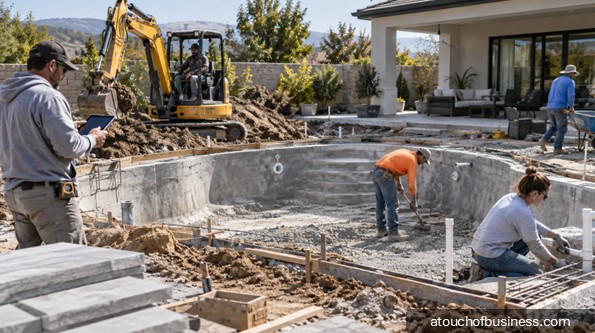
What to Expect From This Guide to Starting a Pool Construction Business
This guide walks you through the key decisions and practical steps involved in starting a residential pool construction company. The bullets below highlight selected areas, and the full article goes further.
Inside the guide, you will find:
- Startup steps: Follow 19 ordered steps, from checking your fit and local demand through funding, equipment, permits, and a pre-opening dry run.
- Common questions: Find answers on licensing, experience, fiberglass installs, commercial work, start dates, and winter building.
- Fit and red flags: Weigh lifestyle demands, cash flow gaps, seasonality, and liability before spending money, plus setup gaps to fix before opening.
- Local requirements: Learn how licensing, permits, inspections, and excavation safety rules vary by location and what to verify locally.
- Business model choices: Compare concrete, fiberglass, and vinyl liner pools, and decide which trades you handle or subcontract.
- Financial planning: Work through startup cost lists, operating capital, break-even logic, and funding before you commit to major purchases.
- Estimates and contracts: See what goes into estimates, payment schedules, change order rules, and contract terms.
Start by asking whether pool construction fits your strengths, schedule, and finances, since every later decision builds on that answer.
Pool construction contractors turn backyards into swimming spaces through excavation, plumbing, shell work, finishes, and inspections.
As an owner, you coordinate crews, permits, and payments on every build. This guide focuses on residential in-ground pools.
Work through the startup steps below in order, since licensing, funding, and permits depend on the choices that come before them.
Is a Pool Construction Business a Good Fit for You?
A pool construction business fits best when you can handle physical outdoor jobs and weather delays.
You also need to coordinate many trades and accept responsibility for a finished pool that stays in a customer’s yard for years.
Homeowners expect clear pricing, reliable scheduling, and a finished pool that passes inspection.
Ask yourself why you want this business.
Do you enjoy solving site problems, managing crews, and explaining a large project to nervous homeowners?
Pool construction income arrives in stages, and costs often come first.
Can your household cover living expenses through permit delays, weather delays, and slow seasons?
Consider whether family or household members will support long days and an unpredictable schedule.
Weigh the risk of failure honestly. Underpricing projects or running short of operating money can end a pool construction business.
You need estimating skill, comfort with contracts and plans, and steady customer communication.
Basic hydraulics and structural knowledge help you review plans and estimate accurately.
Startup costs, access to capital, and operating costs all need answers before you sign a contract.
Step 5 covers local demand and how you will reach customers at opening.
Red Flags Before You Start
Red flags before you start are conditions that should make you pause, change your model, or choose a different business.
Some red flags apply to you and your market, while others are built into pool construction.
Watch for these decision-stage warning signs:
- Licensing is blocked. You cannot meet experience, exam, or credential rules. Pause and confirm requirements, or gain experience under a licensed builder first.
- Demand is weak or competition is heavy. You see few pool permits or many established builders. Verify more, then consider a narrower model or another market.
- Site conditions limit your model. You face poor lot access, high groundwater, or difficult soil. Change your shell types or service area.
- Costs exceed your budget. You cannot fund equipment, insurance, and operating capital. Rent or subcontract to reduce risk, or reconsider.
- Margins are thin. Pricing cannot cover subcontractors, materials, overhead, and warranty. Pause until your pricing works.
- Cash flow has gaps. Payments arrive in stages while costs come first. Adjust your payment schedule or build more operating capital.
- Demand swings by season. Slow months still bring costs. Plan operating capital for them.
- Permits run slow. Review times vary and can stall projects. Verify local timelines before promising a start date.
- Safety demands are high. Excavations, heavy equipment, and electrical hazards are part of the job. Reconsider if you cannot supervise safety or hire someone who can.
- Insurance is hard to get. Get quotes before you commit.
- Reliable trades are scarce. Verify subcontractor availability before you sign a contract.
Pool construction also carries built-in industry conditions:
- Many trades: Different crews perform different phases, so you must schedule and oversee all of them.
- Concentrated liability: Risk gathers around excavation, plumbing rough-in, and the shell.
- Liability after handover: Covered plumbing and electrical defects can surface later and remain your responsibility.
- Layered rules: Pool projects touch building, electrical, plumbing, barrier, drain, excavation, and stormwater rules.
- Supply and labor swings: Shortages of materials and labor can stretch lead times and squeeze margins.
- Financing-sensitive demand: A pool is a large optional purchase, and many customers finance it, so backlogs can swing widely.
- Local saturation: Check builder density through public permit records if your building department offers them.
Step 1: Test Your Fit Against a Real Work Week
A pool construction owner splits each week between site visits and office tasks. Picture both before you commit.
A typical day can include:
- Morning site checks and crew coordination
- Midday customer meetings or estimates
- Afternoon permit follow-up, supplier orders, and invoicing
Your customers see only the finished pool. You carry the scheduling, inspections, and paperwork behind it.
Owner duties also include subcontractor coordination, progress invoicing, and warranty follow-up after handover.
Step 2: Talk to Owners Who Will Not Compete With You
Talk only to owners you will not compete against.
Pool builders in other markets and people who run landscape, patio, deck, or excavation companies make good contacts.
Prepare questions before each conversation.
Ask about cash flow, permit delays, warranty callbacks, subcontractor reliability, and what surprised them.
Each owner’s path differs, so compare several answers before you decide.
Step 3: Choose How You Will Enter the Business
You can start from scratch, buy an existing pool company, or join a manufacturer’s authorized-builder program.
Starting from scratch is the default path.
Buying an existing pool company is realistic. Ask the licensing board whether licenses, qualifiers, or bonds transfer with a sale.
Franchises are not a common route in this industry.
Manufacturer programs are the closest equivalent, mainly for fiberglass pools. Some require classroom and hands-on training.
Weigh budget, timeline, support needs, control, and risk tolerance before choosing.
Step 4: Define Your Business Model
Your business model starts with the shell types you build: concrete, fiberglass, or vinyl liner.
- Concrete (gunite or shotcrete): the most custom design and the longest build.
- Fiberglass: a pre-made shell, faster installation, and fewer design options.
- Vinyl liner: a timeline between the other two.
Decide between design-build and build-only projects. Design-build means you handle both design and construction.
Build-only means customers arrive with plans from someone else.
Decide which trades you perform yourself and which you subcontract.
Many new builders start by subcontracting specialties such as shotcrete and electrical.
Weigh license scope, insurance, supervision needs, and quality control before you self-perform any trade.
Customers judge the finished pool, so choose a model you can supervise consistently.
Step 5: Validate Local Demand and Find Your First Customers
Validate demand before you spend on equipment or a lease.
Study local supply and demand for residential in-ground pools in your service area.
Local checks to run:
- Ask the building department whether pool permit records are public, and use them to gauge builder activity.
- Count local pool builders and note the shell types they offer.
- Check soil, groundwater, lot access, and HOA rules that shape which pools you can build.
- Consider your climate and how long the building season runs.
- Ask how often local customers finance pool projects.
Identify your likely first customers. Homeowners with suitable lots are the main group.
Referral partners include landscape designers, home builders, and pool equipment retailers.
Define why customers would choose you, such as a specialty, communication, warranty terms, or schedule reliability.
Decide how you will reach your likely first customers at opening. Start with the referral partners on your list.
Step 6: Confirm Your Licensing Path Before You Spend Money
Confirm your licensing path first, because a blocked license can end the plan before you buy equipment.
Licensing varies by U.S. jurisdiction. Contact your state contractor licensing board before you sign contracts or take deposits.
- Some states use tiered pool licenses with exams and verified experience.
- Some states require a separate home improvement registration.
- Some states have no single statewide pool license, so local rules govern.
- Some licenses require a bond and proof of workers’ compensation.
Ask whether the license belongs to you, your business, or a qualifying person.
Learn how licenses and permits work in general, then confirm the pool-specific rules locally.
Consumer guides advise homeowners to ask for proof of a contractor’s license, so be ready to show yours.
Step 7: Set Up Your Legal Structure, Registrations, and Tax Accounts
Choose a business structure, register your business name, and get an EIN before you open a business bank account.
Check state and local tax registrations for your pool construction company.
Ask whether materials and labor are taxed differently in your state.
Register employer accounts if you plan to hire.
Step 8: List and Price Your Startup Costs
Build a complete list of what your pool construction model needs, then price each item locally with written quotes.
No single budget fits every pool startup. Your model, service area, and equipment choices change the total.
Startup cost categories to include:
- License application, exam, training, and credential costs
- Registration and legal setup
- Equipment purchases or rentals, and vehicles
- Insurance
- Software, office, and yard setup
- Operating capital
These drivers raise or lower your costs:
- Shell types offered, and whether you self-perform or subcontract
- New, used, rented, or already-owned equipment
- Service area size and travel distance
- Local permit and inspection requirements
- Number of employees
- Supplier minimums and lead times
Operating capital keeps payroll, subcontractors, materials, insurance, and fuel covered between customer payments.
Plan for slow seasons and for inspection or permit delays. Running out of operating money can close a startup.
Step 9: Test Profit Potential and Break-Even Logic
Test profit potential before you commit to equipment, leases, or hiring.
Start with your gross margin on a typical pool project, after subcontractors, materials, permits, equipment, and warranty reserve.
Work out how many projects per year cover your fixed overhead and pay you.
Include fixed costs builders often miss: insurance, fuel, equipment, office time, and warranty repairs.
Each project is large, so one underpriced job can damage your finances.
Test whether you can survive slow months, permit delays, and late payments.
If your break-even numbers only work with unrealistic project volume, change your model or pause.
Step 10: Line Up Funding, Banking, and Payment Systems
Explore funding options before you commit to equipment, leases, or inventory for your pool construction company.
Startup funding can come from savings, bank loans, equipment financing, and lines of credit. Federally backed loans through participating banks are another route.
Open a business bank account after registration and tax setup.
Pool projects bring staged payments, so plan how you will collect deposits, progress payments, and final payments.
Decide which payment methods you will accept, and set up an invoicing tool or merchant account.
Some builders partner with pool financing lenders so customers can finance projects. Compare loan terms and any fees you would bear.
Step 11: Set Up Your Office, Yard, and Storage
Decide where you will run the office and store equipment, trailers, and materials.
Check zoning and home-occupation rules for equipment storage and vehicle parking.
Review HOA or lease limits if you plan to work from home.
Step 12: Build Your Supplier and Subcontractor Network
Build a network of trades and suppliers before you sign your first contract, because pool projects depend on many crews.
Line up providers for these trades:
- Excavation
- Steel
- Plumbing
- Electrical
- Shotcrete or gunite
- Tile and coping
- Decking
- Interior finish
- Fencing
Add equipment distributors, material suppliers, and shell manufacturers if you will offer fiberglass.
Choose subcontractors on more than lowest bid. Verify each license and insurance certificate in writing before the project begins.
Ask suppliers about lead times, minimum orders, and delivery terms.
Homeowners notice when crews show up on schedule, so reliability matters as much as price.
Step 13: Decide What to Rent, Buy, or Subcontract
Many pool builders rent skid steers, mini-excavators, and concrete mixers for their first projects.
Track how often you use each machine before buying. Weigh expected use, financing, maintenance, and your project pipeline.
Equipment to consider by project need:
- Excavation: excavator or mini-excavator, skid steer, hauling truck or trailer, compaction equipment, dewatering pumps, and a laser or transit level.
- Trench safety: shields or shoring as needed, ladders, barricades, site fencing, and protective gear.
- Concrete pools: rebar tools, forms, spacers, vibrators, and finishing tools. Shotcrete or gunite equipment is often subcontracted.
- Plumbing and electrical: pipe tools, pressure-test gauges, and bonding materials. Local rules may require licensed trades.
- Fiberglass: lifting arrangements, often through a crane subcontractor, leveling gear, and backfill that meets manufacturer specifications.
- Vinyl liner: measuring and installation tools and wall support hardware.
- Vehicles: pickup or service truck, equipment trailer, and tie-downs.
- Office: estimating, job costing, scheduling, and accounting software, e-signature tools, phone, laptop or tablet, and photo documentation.
Step 14: Plan Insurance and Risk Coverage
Separate the insurance your state or licensing board requires from the coverage you choose for risk.
Review business insurance basics, then ask an agent who understands excavation and pool construction.
Coverage that may be legally required (verify locally):
- Workers’ compensation if you have employees
- Commercial auto where required
- Any coverage your licensing board requires
Coverage many contractors choose for risk:
- General liability
- Equipment coverage
- Materials in transit
- Equipment breakdown
Get quotes before you commit to equipment purchases.
Step 15: Build Your Estimating, Pricing, and Contract System
Build one estimating and contract system, and use it for every project so pricing and scope stay consistent.
Pool projects need design documents covering structural loads, hydraulic calculations, equipment sizing, and code compliance.
Ask your building department when an engineer is required.
Define scope, allowances, and exclusions in writing. State who is responsible for permits.
Decide how you will handle change orders. Some builders refuse them and price everything upfront, while others use a defined process.
Weigh customer trust, contract detail, and pricing discipline when choosing your change order approach.
Tie your payment schedule to construction phases.
Some states set required contract content and deposit rules. Check with your licensing board and consumer protection agency.
Include warranty terms, lien-related paperwork, and your license details in every contract.
The federal Cooling-Off Rule applies to certain sales made at a customer’s home or away from your place of business.
The Cooling-Off Rule requires written and oral notice of a three-business-day cancellation window, with refunds due within 10 business days of a valid cancellation notice.
Ask an attorney whether your sales process triggers the Cooling-Off Rule, and have your contract reviewed.
What customers will notice first:
- How quickly and clearly you respond to an inquiry
- Whether your written estimate spells out scope, exclusions, and payment schedule
- Whether you show proof of your license and insurance
- How you explain permits, inspections, and timing
- Whether your warranty terms are written down
- How tidy your crews leave the site each day
Step 16: Learn the Permit, Inspection, and Site-Safety Sequence
Permits come first, then utility locates, then excavation with a protective plan.
Many jurisdictions require building permits for pools past a set depth. Pool builds often add separate plumbing and electrical permits.
Typical inspection stages include steel before the shell, plumbing tests, bonding, and the final inspection. Ask the building department for its schedule.
Request utility locates before any digging:
- One-call laws set notice and waiting periods that vary by state.
- In some states, the law places the duty to request the locate on the contractor, even on private property.
- Mark your dig area with white paint or flags, then wait for utility responses.
- Utility owners do not locate private lines, so you may need a private locator.
- Request re-marks if marks are destroyed or the locate ticket expires.
Follow excavation safety rules:
- OSHA requires protective systems at 5 feet deep or more, unless the excavation is entirely in stable rock.
- Below 5 feet, a competent person decides whether protection is needed.
- A competent person inspects excavations daily and as conditions change.
Sites that disturb 1 acre or more, or smaller sites within a larger development plan, may need stormwater permit coverage.
A single-lot pool may fall below the permit threshold. Confirm with your state stormwater or environmental agency, since some states run their own programs.
Confirm pool-specific safety rules:
- Drain covers: The federal Virginia Graeme Baker Pool and Spa Safety Act requires drain covers to meet a Consumer Product Safety Commission standard. Its installation rules target public pools, but some states extend anti-entrapment rules to residential pools.
- Barriers: Local code sets fence and barrier requirements. Some jurisdictions follow a model barrier code.
- Electrical: National Electrical Code Article 680 covers pool bonding, grounding, and GFCI protection. Adoption and edition vary, and licensed electricians or plumbers may be required locally.
Step 17: Plan Hiring and Training
Decide who will supervise sites, coordinate trades, handle permits, and manage paperwork.
Identify who can serve as the excavation competent person.
Confirm construction safety training and any manufacturer training your model requires.
Set up payroll and workers’ compensation before anyone joins your crew.
Step 18: Set Up Business Identity Items
Finalize your business name, contact details, and payment information before opening.
Plan vehicle lettering and job-site signs. Post permits where local rules require.
Confirm where your license number must appear, such as on contracts.
Step 19: Run a Pre-Opening Dry Run
Walk one sample project from estimate to final inspection before you take a real customer’s deposit.
Test your contract, payment schedule, permit checklist, and scheduling process on paper.
Before your first project, confirm these items:
- License, registrations, and tax accounts
- Business structure and business name registration
- Business bank account open and payment methods tested
- Insurance in place, with certificates on file
- Workers’ compensation, if you have employees
- Contract, change order form, and payment schedule reviewed by an attorney
- Cancellation notice form, if your sales process requires it
- Permit and inspection checklist for your jurisdiction
- Written utility locate procedure for your team
- Excavation safety plan and a named competent person
- Stormwater requirements checked
- Supplier accounts open and lead times confirmed
- Subcontractor licenses and insurance verified in writing
- Equipment rented, bought, or scheduled
- Estimating and job costing tools tested
- Vehicle lettering and identity items ready
Business Plan
A business plan turns your startup decisions into one working document.
Follow a standard business plan format, then test every section against real local numbers.
Your pool construction plan should bring together:
- Your pool types, and whether you self-perform or subcontract
- Customer types and service area
- Startup cost list and operating capital
- Pricing method and expected gross margin
- Break-even logic
- Funding sources
- Licensing, permit, and insurance plan
- Pre-opening confirmation items
Break-even logic answers one question: how many projects must you finish to cover your fixed costs?
Calculate break-even with your own local costs, prices, and gross margin, not borrowed figures.
Payments arrive in stages, so map when money comes in against when costs go out.
Add a slow-month scenario. Test how long your operating capital lasts if permits stall or a customer pays late.
Opening-Day Red Flags
Opening-day red flags are setup gaps that can stall your first project or expose you to liability.
Fix these setup gaps before you sign a contract.
- A subcontractor cannot produce a valid insurance certificate.
- You cannot say which permits and inspections a project needs.
- Your estimate template omits design documents, code items, or permit responsibility.
- Your payment schedule collects less than each phase costs you.
- No utility locate procedure exists, or no one is named as the competent person.
- Drain covers, barrier plans, or bonding details are missing from your project checklist.
- Your payment methods are untested.
- Key suppliers cannot confirm lead times.
- Your sales process may trigger the Cooling-Off Rule, but you have no cancellation notice.
Frequently Asked Questions
Does a fiberglass pool skip licensing, permit, and inspection steps?
No. A pre-made shell still requires a contractor license, a building permit, and inspections where your jurisdiction requires them.
Excavation safety rules still apply, and installation must follow the manufacturer’s specifications.
Can you avoid getting a contractor license by hiring licensed subcontractors?
Usually not, where pool contracting is licensed.
The party who contracts with the homeowner generally needs an appropriate license, even when licensed trades build the pool.
Some states let other contractor classes contract for pool construction only when a licensed pool contractor performs it.
Confirm your situation with your state licensing board.
Can you start if you have no pool building experience?
Sometimes, but the path depends on your state.
Some states require documented experience under a licensed builder, a construction safety course, and an industry credential.
The Pool & Hot Tub Alliance Certified Builder Professional credential counts toward licensing requirements in some states.
Working for a licensed builder can help you document experience while you learn.
Can a residential pool builder bid on commercial or public pools?
Not automatically.
Public pools fall under different standards than residential pools.
Some states also use separate residential and commercial license classes. Ask your licensing board before you bid.
Should you order materials or promise a start date before the permit is approved?
No. Permit review times vary, and site access, utility locates, and HOA approvals can also delay a start.
Orders and start dates set too soon can leave crews idle and materials in storage.
Confirm permits, site access, locates, and approvals in writing before you give a customer a start date.
Can you build pools through the winter?
It depends on your climate.
In colder regions, frozen ground can make excavation difficult or impossible. Some builders shift crews to other work during winter.
Cold-weather builds may need special equipment. In workable climates, off-season installation presents fewer technical challenges.
Plan your operating capital around the months when you cannot dig.
Pool Construction Business Interviews: Advice from Industry Professionals
These interviews share firsthand perspectives from pool construction professionals on building a company, managing projects, developing technical expertise, hiring people, controlling growth, and serving customers.
Readers can use the advice to think through their market focus, training needs, financial controls, construction systems, staffing approach, and the level of technical knowledge required before taking on pool projects.
How Emerald Custom Pools Built a Fast-Growing Pool Company
Kyle and Stephanie Burns discuss growing Emerald Custom Pools from a home-based startup into a company with multiple divisions. Topics include forecasting, risk planning, job costing, financial accountability, hiring, training, service operations, remodels, retail, and new construction.
The interview is useful for understanding how business systems and financial discipline become increasingly important as a pool construction company adds employees, services, and locations.
How a Former SWAT Officer Built a Pool Construction Company
Obie Rodriguez explains how negative experiences with pool contractors led him to learn the trade, obtain his contractor’s license, and build Majestic Pool Construction. The conversation covers learning the business, building systems, delegation, expansion, leadership, customer transparency, and generating qualified leads.
This interview is useful for someone entering the field because it follows a transition into pool construction and shows how technical learning must eventually be supported by systems, leadership, marketing, and delegation.
Pool Builder Profile: Alexa Dal Pino
Alexa Dal Pino discusses growing up in her family’s pool construction company and taking on its leadership. She talks about combining established craftsmanship with modern approaches to design, construction, and technology while working on demanding projects in the Sierra Foothills.
The interview helps prospective pool builders see how local terrain, engineering demands, customer expectations, design skills, and construction knowledge can shape the type of projects a company is equipped to handle.
Raising the Standard in Pool Construction
Dragan Kostadinovic and Robert Moore of Beltway Pools discuss their path in the pool industry and the role professional education has played in their company. They cover construction planning, customer relationships, business systems, job-site details, and continued technical education.
This interview is useful for understanding why learning construction standards and developing repeatable processes can be important parts of building a professional pool construction operation.
Keith Zars – One on One with Pool Magazine
Keith Zars discusses how he entered the pool industry, challenges with hiring, defining a company’s market position, managing growth, training employees, controlling construction quality, and maintaining customer satisfaction. He also gives direct advice to people starting a pool business.
The interview is useful for thinking through specialization and growth. Zars stresses defining what the company will sell and which market it will serve instead of trying to serve every type of customer from the beginning.
Opportunities in Swimming Pool Renovations with Rick Chafey
Rick Chafey discusses adding pool renovations to a construction or service business. The conversation covers the knowledge and confidence required to propose renovation work, professional education, major renovation projects, contracts, and liability.
This interview is useful for understanding that renovation work requires more than identifying a sales opportunity. Builders also need construction knowledge, appropriate training, and an understanding of contractual and liability issues before expanding into this work.
Related Articles
- How To Start a Pool Service Business
- How To Start a Pool Cleaning Service
- How To Start a Deck Building Service
- How To Start a Landscaping Business
Sources:
- Pool & Hot Tub Alliance: Certified Builder Professional, PHTA-5 Inground Pool Standard
- ICC Digital Codes: APSP Standards Listing
- ANSI Webstore: Public Pool Standard Scope
- U.S. Consumer Product Safety Commission: Pool Spa Drain Covers
- OSHA: Subpart P Excavations, Trenching and Excavation Safety
- U.S. EPA: Construction General Permit FAQ, Getting CGP Coverage Waivers
- Federal Trade Commission: Cooling-Off Rule Overview
- 811 Before You Dig: 811 Excavator Information
- New York 811: Contractor Locate Responsibility
- EC&M: Pool Equipotential Bonding Rules
- Connecticut Department of Consumer Protection: Pool Spa License Requirements
- Contractors State License Board: Swimming Pool Construction Guide
- Gold Coast Schools: Residential Commercial Licenses
- NIP Group: State Pool Contractor Licensing, Start Pool Construction Company, Pool Construction Process Guide
- Blue Haven: Inground Pool Construction FAQs
- Atlantis Pools and Spas: Phases of Inground Pool Building
- Latham Pool: Become Independent Builder
- Landscape Management: Starting With Pool Installations
- Explore Industries: Fiberglass Installation Training, Off-Season Ground Conditions
- Thursday Pools: Fiberglass Pool Installation
- AQUA Magazine: State of Industry Builder Report
- Pool Magazine: Pool Industry Seasonality, Pool Construction Shortages
- Pool Pro Magazine: Tips for Rookie Builders, Winter Pool Building Advice