
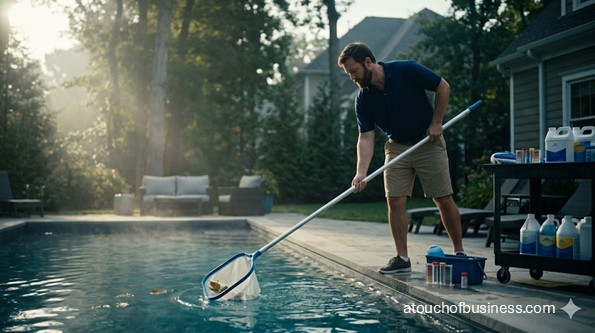
Start With Smart Pool Cleaning Service Setup Choices
A pool cleaning service provides pool cleaning, water testing, chemical balancing, debris removal, and basic care that keeps pools ready for use.
Pool cleaning businesses usually operate as mobile services. You drive to each property with poles, hoses, brushes, test kits, chemicals, forms, and safety gear loaded in your vehicle.
This business can serve private homeowners, vacation rental owners, property managers, homeowner associations, apartment communities, hotels, gyms, schools, clubs, and public pool facilities.
The operation sounds simple from the outside. In practice, it requires route planning, chemical knowledge, safe handling, clear service limits, and careful records.
A basic pool cleaning service may include:
- Skimming leaves and surface debris
- Brushing walls, steps, tile lines, and floors
- Vacuuming the pool
- Testing and balancing water chemistry
- Emptying skimmer and pump baskets
- Cleaning or backwashing filters
- Opening and closing seasonal pools
- Handling green pool cleanup when the service scope allows it
Be careful with the word service. Pool cleaning is not the same as pool construction, major repair, electrical work, plumbing work, leak repair, resurfacing, or heater installation. Those jobs may need different licenses, tools, insurance, and training.
Can You Commit to Running a Business?
A pool cleaning service can be a good fit if you like practical, outdoor work and do not mind repetition. You will spend a lot of time driving, lifting, testing water, brushing surfaces, handling chemicals, and working around customer properties.
Ask yourself whether owning a business fits you, not only whether pool cleaning appeals to you. Ownership adds pricing decisions, customer expectations, records, safety planning, taxes, insurance, and scheduling.
You also need to think about lifestyle. Pool routes often start early. Hot weather, rain, traffic, locked gates, pets, heavy debris, and poor water conditions can affect your day.
Strong reasons to start include a real interest in pool care, mobile service work, working on customer properties, and the value of keeping pools clean and safe. Staying interested in the business matters when the route becomes tiring or the day does not go as planned.
Weak reasons include status, prestige, or the image of being your own boss. Those reasons usually fade when you are dealing with chemical costs, route delays, unpaid invoices, and hard physical work.
Ask yourself this before moving forward: are you starting because you want to build this business, or because you mainly want to get away from a job, a boss, or financial problems?
Talk With Owners Outside Your Market
Before you invest in equipment, insurance, or supplies, speak with people who already own pool cleaning businesses. Only contact owners you will not compete with.
Look for owners in another city, region, or market area. Prepare real questions before you call. Ask about startup costs, route planning, chemical handling, pricing mistakes, customer expectations, seasonal slowdowns, and licensing surprises.
Those conversations matter because experienced owners have lived through the details. Their path may not match yours, but firsthand owner insights can help you avoid preventable startup mistakes.
Useful questions include:
- What did you underestimate before your first route?
- Which services did you wish you had delayed?
- What equipment did you replace quickly?
- Which local rules surprised you?
- How did route distance affect your pricing?
Check Local Demand Before Opening
A pool cleaning service depends on local pool density. If your area has too few pools, long drive times can make the route hard to price.
Look at the number of residential pools, seasonal pools, vacation rentals, homeowner associations, apartment pools, hotels, gyms, and public facilities in your target area. Then compare that demand with the number of existing pool service companies.
You are not looking for a perfect market. You are looking for enough demand to support the service area you can actually reach.
Local demand can be affected by:
- Climate and pool season length
- Number of backyard pools
- Neighborhood income levels
- Age of pools and equipment
- Water hardness and local chemistry issues
- Competition from existing pool routes
- Distance between likely service stops
If the area has weak demand or too much low-priced competition, the business may not be a good fit there. Spend time checking local supply and demand before you commit to equipment, insurance, and chemical inventory.
Compare Starting, Buying, and Franchising
You can start a pool cleaning service from scratch, buy an existing route or business, or explore a franchise if one fits your area and budget.
Starting from scratch gives you more control. It also means you must build the route, documents, pricing, supplier setup, and reputation from the ground up.
Buying an existing pool route may give you customer accounts, service history, and cash flow sooner. It can also carry hidden problems, such as underpriced accounts, poor records, long drive times, or customers who expect services you do not want to offer.
Franchising may provide systems, training, branding, and startup support. It may also reduce your control and add fees.
The best path depends on:
- Your budget
- Your timeline
- Your need for training and support
- Your comfort with risk
- Your desire for control
- Available businesses or routes for sale
If you are considering a route purchase, study the numbers closely. Buying a business already in operation can help, but only if the accounts, pricing, records, and service area make sense.
Choose Your Pool Cleaning Service Model
Your service model affects cost, licensing, tools, insurance, route planning, and risk. Keep the first version clear and simple.
A new owner may choose one of several models:
- Residential-only cleaning: usually the simplest starting point.
- Residential pool and spa service: adds hot tub or attached spa care.
- Seasonal opening and closing: useful in colder markets.
- Green pool cleanup: may require more chemicals, time, and skill.
- Commercial or public pool service: can add health-code, operator, and recordkeeping duties.
- Repair-focused service: may trigger contractor, plumbing, electrical, or specialty license rules.
Do not let the business drift into repairs by accident. A customer may ask you to replace a pump, wire a timer, fix a heater, or handle a leak. Those requests can move you outside basic cleaning.
Write your service limits before opening. That protects your pricing, schedule, insurance, and compliance setup.
Map the Workflow From Inquiry to Payment
A mobile pool cleaning business needs a clear workflow before the first paid job. This helps you avoid vague promises and bad estimates.
A simple startup workflow can look like this:
- Receive the inquiry and confirm the property location.
- Ask what type of pool, spa, filter, and service request is involved.
- Review the pool condition in person when needed.
- Decide whether the job fits your service scope.
- Prepare a written estimate or service agreement.
- Get approval before the service begins.
- Schedule the first visit.
- Complete the service checklist.
- Record water readings, chemical use, and visible issues.
- Send the invoice or collect payment.
This process keeps the service organized. It also helps you spot jobs that should not be accepted yet.
For example, a lightly green pool with basic algae may fit your scope. A pool with broken equipment, unsafe wiring, serious leaks, or structural damage may need a licensed repair professional.
Write a Business Plan for the First Stage
Your business plan does not need to be fancy. It should help you make decisions before spending money.
For a pool cleaning service, the plan should focus on your route area, services, equipment, startup costs, pricing, legal checks, supplier setup, and opening-readiness checklist.
Include these items:
- Target service area
- Residential or commercial service scope
- Services included and excluded
- Startup equipment list
- Chemical storage and transport plan
- Local license and permit checks
- Pricing method
- First-stage funding needs
- Supplier list
- Basic records and forms
Use the plan to test whether the business makes sense on paper. Putting your business plan together also helps you see missing pieces before they become expensive.
Know Your Customer Types and Expectations
A pool cleaning service may work with several customer types, but each one can change the setup.
Private homeowners often expect clean water, reliable visits, clear pricing, and notice when something looks wrong. Vacation rental owners may care about timing between guest stays. Property managers may want records and invoices that match their approval process.
Commercial and public pool clients can require more formal records, operator training, inspection awareness, and insurance. Do not treat them like private backyard pools.
Common customer groups include:
- Homeowners
- Seasonal pool owners
- Vacation rental owners
- Property managers
- Homeowner associations
- Apartment and condominium communities
- Hotels and motels
- Gyms, clubs, schools, and municipal facilities
Before opening, decide which customer types you are ready to serve. Then match your forms, pricing, schedule, insurance, and compliance checks to that choice.
Build the Skills You Need Before Launch
Pool cleaning is physical work, but the technical side matters just as much. Bad water chemistry can create complaints, damage, safety issues, and extra costs.
You should understand basic water testing, pool volume estimates, chemical dosing, sanitizer levels, pH, total alkalinity, calcium hardness, cyanuric acid, and salt systems.
You should also know the difference between common filter types:
- Cartridge filters
- Sand filters
- Diatomaceous earth filters
Other useful skills include route planning, customer property access, basic equipment observation, service documentation, and safe chemical handling.
If you plan to service public pools, check whether certified pool operator training is required in your area. Even when it is not required for residential work, training can help you avoid unsafe guesses.
Set Clear Service Limits Before You Price
Your pool cleaning service should have a written scope before you quote jobs. Without one, customers may expect repairs, chemicals, cleanup, and emergency service to be included.
Separate basic service from special in-depth services. A weekly cleaning visit is not the same as a green pool cleanup or seasonal opening.
Possible service categories include:
- Weekly pool cleaning
- Biweekly pool cleaning
- One-time cleanup
- Green pool recovery
- Filter cleaning
- Pool opening
- Pool closing or winterization
- Attached spa or hot tub care
Also state what is not included. That may include equipment repair, electrical work, plumbing work, leak detection, heater repair, resurfacing, and construction.
This is not just a customer issue. It affects licensing, tools, insurance, and whether you can safely operate the pool cleaning service.
Plan Your Territory and Route
Route planning can make or break a mobile pool cleaning service. A low-priced job far from the rest of your route can quietly erase your profit.
Start with a service area you can drive efficiently. Look at travel time, traffic, parking, property access, and the number of pools close together.
Route planning affects:
- How many pools you can service in a day
- How much fuel you use
- How much time you lose between stops
- How you price each account
- How quickly weather delays disrupt the schedule
A tight route is usually easier to manage than a wide route with scattered customers. Keep this in mind before accepting accounts outside your target area.
Prepare the Vehicle and Mobile Setup
Your vehicle is part of the business. It must carry tools, chemicals, test kits, safety gear, records, and supplies safely.
A pickup, van, or sport utility vehicle may work, depending on your tools, route size, and storage needs. The key issue is not appearance. It is whether the vehicle can support a full service day.
Your mobile setup may need:
- Secure tool storage
- Chemical bins or secondary containment
- Separation for incompatible chemicals
- Tie-downs
- Ventilation planning
- A place for wet hoses and tools
- A tablet, phone mount, or route clipboard
- A spill kit and first aid kit
Do not carry chemicals loosely in the vehicle. Chlorine products, acids, oxidizers, and other pool chemicals require careful handling and storage.
Buy the Right Startup Equipment
Start with equipment that supports your actual service scope. Do not buy repair tools for services you are not licensed or ready to perform.
Basic pool cleaning equipment often includes:
- Telescopic poles
- Skimmer nets
- Leaf rakes
- Pool brushes
- Tile brushes
- Vacuum heads
- Vacuum hoses
- Leaf traps
- Skimmer vacuum plates
- Replacement clips and adapters
You also need water testing tools:
- Professional liquid test kit or photometer
- Replacement reagents
- Sample bottles
- Salt test supplies for saltwater pools
- pH, sanitizer, alkalinity, calcium hardness, and cyanuric acid tests
- Pool volume worksheet or dosing calculator
For filters and basic equipment checks, prepare simple support items:
- Filter cleaning nozzle
- Backwash hose
- O-ring lubricant
- Common o-rings
- Pump baskets
- Skimmer baskets
- Basic hand tools
Only use electrical or plumbing tools if you are qualified and the service is allowed under local rules.
Set Up Chemical Safety Before the First Job
Pool chemicals are part of the business, but they are also one of the biggest risks. Treat chemical safety as a launch requirement.
You need labels, Safety Data Sheets, personal protective equipment, spill supplies, and a clear storage plan. Anyone handling chemicals should know what products can and cannot be stored together.
Plan for:
- Chemical-resistant gloves
- Safety goggles or a face shield
- Protective clothing
- Closed-toe footwear
- Portable eyewash supplies
- Spill cleanup materials
- Safety Data Sheet access
- Emergency contact information
Keep chlorine products, acids, and other incompatible chemicals separated. Store products in labeled containers and follow the product label.
If you hire employees, chemical training and hazard communication become even more important. Do not wait until after launch to build these habits.
Register the Business and Handle Taxes
Before opening, decide how the pool cleaning service will be legally set up. Your structure affects taxes, records, liability, and registration steps.
Common structures include sole proprietorship, limited liability company, partnership, and corporation. Many first-time owners compare an LLC and sole proprietorship before deciding.
You may need to:
- Choose a legal structure
- Register the business with the state
- Register a business name
- File a Doing Business As name if needed
- Apply for an Employer Identification Number
- Register for state tax accounts when required
- Set up employer accounts if hiring workers
Use state and local offices to confirm the exact steps. If you are still deciding on your legal setup, compare your options before registering the business.
Sales tax needs careful review. Some states treat services, chemicals, parts, or separately billed items differently. Do not assume the rule in one state applies to yours.
Handle Licenses, Permits, and Local Rules
A residential pool cleaning service may have fewer permit issues than a pool construction company, but you still need to verify the rules before opening.
Compliance should be clear and documented. Find out what applies to your exact service scope, location, vehicle use, storage plan, and customer type.
Check these areas:
- General business license: many cities or counties require one.
- Home occupation rules: important if you store tools, chemicals, or vehicles at home.
- Chemical storage rules: may involve zoning or the fire marshal.
- Public pool rules: may apply to hotels, apartments, gyms, schools, clubs, and municipal pools.
- Certified pool operator rules: may apply to commercial or public pool work.
- Pesticide applicator rules: may apply to certain products, depending on state rules and product use.
- Backwash and drain water rules: local sewer or stormwater rules may control discharge.
- Certificate of occupancy: usually not needed for a mobile owner-operator with no commercial space, but it may apply if you lease an office, warehouse, or storage location.
For a simple residential route, your main checks may be business licensing, tax registration, home storage, vehicle use, and discharge rules. For public or commercial pools, the compliance load can be much higher.
Use local licenses and permits as a planning topic, not an afterthought.
What to Ask Before Opening
Ask clear questions before you accept work. The right agency or professional depends on the issue.
- Ask the city or county licensing office whether a mobile pool cleaning service needs a local business license.
- Ask the zoning office whether home-based storage of tools, chemicals, and a service vehicle is allowed.
- Ask the fire marshal about pool chemical storage limits and separation rules.
- Ask the county health department what rules apply before servicing public or commercial pools.
- Ask the state pesticide agency whether any products you plan to use trigger applicator licensing.
- Ask the water, sewer, or stormwater office where backwash water and drained pool water may go.
- Ask the state revenue agency how pool cleaning services, chemicals, and parts are taxed.
- Ask an insurance professional whether your policy covers chemical use, customer property access, and business vehicle use.
Keep the answers in your startup file. If an agency gives you a rule, note the date, contact name, and what they told you.
Set Up Insurance and Risk Planning
Insurance is not just a formality for a pool cleaning service. You work on private property, near water, with chemicals, tools, vehicles, gates, pets, and equipment pads.
Some insurance may be legally required. Workers’ compensation can apply when you hire employees. Commercial auto rules depend on your vehicle use and state requirements.
Other coverage may not be required by law, but it can still be important for risk planning.
Common coverage to discuss includes:
- General liability
- Commercial auto
- Tools and equipment coverage
- Business property coverage for stored supplies
- Pollution or chemical liability endorsements
- Umbrella liability
- Workers’ compensation if hiring employees
Do not assume a personal auto policy covers business route work. Also ask whether chemical damage, pool staining, property damage, or gate access issues are covered.
Review insurance coverage for the business before your first service visit.
Plan Startup Costs and Funding
Startup costs for a pool cleaning service can vary widely. A lean owner-operator with a suitable vehicle may spend much less than someone buying a vehicle, commercial storage, software, and a larger chemical inventory.
Main startup cost categories include:
- Business registration
- Local licenses or permits
- Training or certification
- Vehicle purchase, lease, repair, or setup
- Cleaning tools
- Water test kit and reagents
- Initial chemicals
- Personal protective equipment
- Spill kit and safety supplies
- Insurance
- Software and payment processing
- Forms and basic business identity items
- Storage space if home storage is not allowed
Cost drivers include the vehicle, service scope, route size, local rules, insurance, training, storage, and whether you serve residential or commercial pools.
Funding options may include savings, equipment financing, a vehicle loan, a credit line, or a small business loan.
Do not use debt to cover an untested route. First prove that the service area, pricing, and startup costs make sense.
Set Prices Before You Accept Work
Pricing a pool cleaning service requires more than guessing a monthly fee. You need to account for time, chemicals, fuel, distance, water condition, and service scope.
Common pricing methods include:
- Flat monthly service price
- Per-visit price
- Weekly maintenance package
- Seasonal opening price
- Seasonal closing or winterization price
- First-time cleanup price
- Green pool recovery price
- Separate filter cleaning fee
- Separate chemical charge
Key pricing factors include pool size and volume, filter type, debris load, attached spa, water condition, saltwater system, service frequency, and route distance.
Decide whether chemicals are included or billed separately. Including chemicals can simplify billing, but it can also hurt margins when a pool needs extra treatment.
Take time setting your prices. Bad pricing is one of the easiest ways to make a full route unprofitable.
Prepare Banking, Bookkeeping, and Payments
Keep business transactions separate from personal ones from the start. This makes taxes, records, deposits, and expenses easier to track.
Set up:
- A business checking account
- A payment processor
- Invoice templates
- Expense categories
- Mileage tracking
- Chemical inventory tracking
- Sales tax tracking if required
- Customer account records
Expense categories should include chemicals, fuel, vehicle costs, tools, insurance, software, testing supplies, safety gear, licenses, and training.
Before opening, make sure you can send an invoice, accept payment, record the income, and match the payment to the service visit.
Set Up Suppliers and Inventory
A pool cleaning service needs dependable access to chemicals, tools, replacement parts, test reagents, and safety supplies.
Supplier setup matters because running out of reagents, chlorine, o-rings, baskets, or filter supplies can interrupt the route.
Possible suppliers include:
- Pool chemical wholesalers
- Pool equipment distributors
- Local pool supply stores with trade pricing
- Safety supply vendors
- Vehicle storage or upfit vendors
- Software providers
- Insurance professionals familiar with mobile service businesses
Request Safety Data Sheets for chemicals. Keep product labels available and use chemicals only as directed.
Do not overbuy chemicals before you know your route. Storage rules, shelf life, safety, and cash flow all matter.
Create Your Forms and Service Documents
Good documents protect a new pool cleaning service from confusion. They also make the business look organized before you have a long history.
Prepare these items before opening:
- Service agreement
- Scope-of-work checklist
- First-visit pool condition form
- Water chemistry log
- Chemical use log
- Filter cleaning record
- Photo documentation process
- Customer authorization for draining, backwashing, or special work
- Incident or spill report form
- Vehicle inspection checklist
The service agreement should state what is included, what is excluded, how chemicals are handled, how special services are approved, and how payment works.
For public or commercial pools, records may need to be more formal. Ask the local health department before accepting those accounts.
Prepare Basic Business Identity Items
A mobile pool cleaning service does not need a full office to look ready. It does need clear identity items that support trust, payment, and property access.
Prepare:
- Legal business name
- Doing Business As name if needed
- Business phone number
- Business email address
- Domain name
- Simple contact page
- Invoice template
- Basic service cards or business cards
- Vehicle identification if required locally
- Required license display if your jurisdiction requires it
These are not advertising campaigns. They are basic opening-readiness items that help customers know who is entering their property and how to contact you.
Keep the name, invoice, email, and service agreement consistent. That reduces confusion at payment time.
Decide Whether to Hire at Launch
Many pool cleaning services start as one-person businesses. That can keep startup costs lower, but it also limits capacity.
Hiring adds payroll, training, supervision, workers’ compensation checks, scheduling, driving rules, chemical safety, and quality control.
Before hiring, prepare:
- Written service steps
- Chemical handling rules
- Vehicle rules
- Customer property access rules
- Water testing standards
- Incident reporting steps
- Payroll and employer accounts
An untrained helper can create risk quickly. Pool chemicals, gates, pets, customer property, and water chemistry leave little room for vague instructions.
Understand the Day-to-Day Reality
A typical day in a pool cleaning service starts before the first pool. You load tools, check chemicals, review the route, and make sure the test kit and safety gear are ready.
At each stop, you may unlock a gate, inspect the pool, skim debris, empty baskets, test water, brush, vacuum, add chemicals, check the filter area, record readings, take photos, and secure the property.
Then you drive to the next stop and repeat the process.
At the end of the day, you may restock chemicals, rinse tools, update invoices, save photos, review notes, and store chemicals safely.
This snapshot is not meant to be a full operating manual. It is a reality check. The operation is mobile, physical, repetitive, and detail-driven.
Run a Pre-Opening Test
Before the official opening, test the whole process. A small mistake in the office can become a larger problem in the field.
Do a mock route with your vehicle loaded. Check whether the poles, hoses, chemicals, test kit, spill kit, forms, and payment tools are easy to reach.
Test these items:
- Vehicle loading
- Chemical separation
- Route timing
- Water testing process
- Chemical dosing calculation
- Photo documentation
- Invoice creation
- Payment collection
- Service record entry
- Tool cleanup and storage
If the test run feels messy, fix it before customers are involved. Opening before the setup is ready can create avoidable damage, delays, and trust problems.
Launch Readiness Checklist
Use this checklist before accepting a job. Keep it practical and specific to a mobile pool cleaning service.
- Service scope is written.
- Repair and installation limits are clear.
- Target service area is mapped.
- Local demand has been reviewed.
- Business structure is selected.
- Business name is registered if required.
- Doing Business As filing is complete if needed.
- Employer Identification Number is obtained if needed.
- State tax registration is checked.
- Local business license is checked or obtained.
- Home storage rules are verified.
- Chemical storage rules are checked.
- Pool water discharge rules are checked.
- Public pool rules are checked if serving commercial accounts.
- Insurance is active.
- Vehicle is ready and organized.
- Cleaning tools are stocked.
- Test kit and reagents are ready.
- Chemicals are labeled and stored safely.
- Safety Data Sheets are available.
- Personal protective equipment is stocked.
- Spill kit is ready.
- Supplier accounts are active.
- Service agreement is ready.
- Water chemistry log is ready.
- Invoice and payment system are tested.
- Mock route has been completed.
Main Red Flags Before You Start
Some problems should make you pause before opening a pool cleaning service. These are not small details. They can affect launch cost, route profit, safety, and legal exposure.
- Too few pools in the target area
- Long drive times between likely accounts
- Short pool season with high fixed costs
- Heavy competition and low local pricing
- No clear service limits
- Offering repairs without checking licensing
- Entering public pool cleaning without checking health department rules
- Weak chemical safety setup
- No plan for storing chlorine, acid, and other chemicals safely
- No plan for backwash or drained water rules
- No business vehicle insurance review
- Vehicle too small or poorly organized
- No supplier access for chemicals and replacement parts
- No records for readings, chemical use, or pool condition
- Poor water chemistry knowledge before taking accounts
- Pricing that ignores travel time, chemicals, and fuel
If several of these red flags apply, slow down. Fix the weak points before you open.
Startup Questions to Answer
These questions help you test whether your pool cleaning service is ready to launch.
- Do I need a special license? It depends on your location and service scope. Basic residential cleaning may be different from public pool service, repairs, plumbing, electrical work, or pesticide application.
- Can I start from home? Possibly, but you need to check home occupation rules, vehicle parking, chemical storage, and fire-code concerns.
- Should I serve commercial pools? Only after checking health department rules, operator training, records, insurance, and inspection requirements.
- What should I buy first? Start with a suitable vehicle setup, cleaning tools, test kit, chemicals, personal protective equipment, spill kit, forms, and payment tools.
- Should chemicals be included in the price? That is a pricing decision. Including them is simple, but separate billing may protect you from unusual water conditions or chemical price changes.
- Can I transport pool chemicals? You can transport chemicals for business use, but quantity, packaging, separation, and safety rules matter.
- Can pool water go into the street? Do not assume that. Local sewer and stormwater rules control backwash and drain water.
- Do I need employees at launch? Not necessarily. Hiring adds payroll, training, supervision, safety, insurance, and scheduling responsibilities.
- What records should I keep? Keep service agreements, water test logs, chemical use logs, filter cleaning notes, photos, invoices, incident reports, and supplier records.
- What makes the business hard to price? Pool size, water condition, debris, filter type, route distance, chemicals, attached spas, and one-time cleanup affect the price.
Final Thought Before Opening
A pool cleaning service can look simple because the service happens in backyards and around familiar equipment. The startup process is more serious than that.
You need enough local demand, a clear route, safe chemical handling, proper tools, written scope, local compliance checks, realistic pricing, and payment readiness.
Start with the service you can perform well and legally. Keep repairs, commercial pools, and complex jobs out of the launch plan until you have verified the rules and built the skill to handle them.
That is how you give the business a stronger start.
Advice From Pool Service Owners
One of the best ways to understand a pool cleaning service is to listen to people who have already worked in the business. These interviews can help you see the real issues behind route planning, pricing, customer expectations, chemical handling, training, hiring, and the difference between residential and commercial pool work.
Use these resources as practical background, not as a replacement for local licensing, tax, insurance, or safety advice. Rules can vary by state, county, and city.
- Business Breakdown With Pool Care SMB Expert Tim Ryan: Part 1
- How To Run a Pool Service SMB With Tim Ryan: Part 2
- Uber Driver to 7-Figure Exit in 3 Years
- Dakota Sweeney: Starting Her Own Pool Service Business
- Running a Legitimate Commercial Pool Business With Dustin Anderson
- Javier Payan of Payan Pool Service
- Pool Cleaning and Maintenance Franchise Starts From the Ground Up
- How a Small-Town Pool Cleaner Built a Mobile Pool Care Business
Related Articles
- Starting a Pool Service Business
- How To Start Your Aquarium Maintenance Business from Scratch
- How To Start a Gutter Cleaning Business
- Start a Pressure Washing Business
- How To Start a Window Cleaning Business
- Starting a Lawn Care Business
- How To Start a Sprinkler Installation Service the Right Way
- Start a Plumbing Business
- How To Start a Handyman Business
- How To Start an Irrigation Business
- How To Start a Duct Cleaning Business
Sources:
- U.S. Small Business Administration: Register Your Business, Apply for Permits, Get Business Insurance, Federal and State Tax IDs
- Internal Revenue Service: Get an EIN, Self-Employed Tax Center, Estimated Taxes
- Occupational Safety and Health Administration: Hazard Communication
- Centers for Disease Control and Prevention: Pool Chemical Safety, Model Aquatic Health Code, MAHC Tools and Training
- U.S. Environmental Protection Agency: Pesticide Registration, What Is a Pesticide, Pool and Spa Equipment
- Pipeline and Hazardous Materials Safety Administration: Materials of Trade
- U.S. Census Bureau: NAICS 561790
- U.S. Department of Labor: Workers’ Compensation
- Pool and Hot Tub Alliance: Certified Pool Operator, CPO Courses
- IBISWorld: Pool Cleaning Industry, Business Count Statistics
- PoolPro Magazine: Caring About Carrying
- AQUA Magazine: Pool Service Vehicle
- In The Swim: Pool Cleaning Equipment
- ServiceTitan: Startup Cost Breakdown
- Entrepreneur: Pool-Cleaning Service
- HomeGuide: Start Pool Cleaning
- Insureon: Pool Cleaner Insurance Costs
- California Department of Tax and Fee Administration: Sales Tax Annotation