
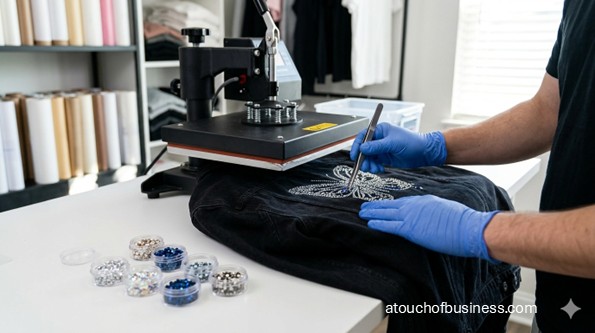
How to Start a Rhinestone Business That Customers Trust
Rhinestone Business Startup With Better Order Flow
Search Engine Description: Learn how to start a rhinestone business with clear order flow, realistic setup choices, and a better sense of what customers expect.
WordPress Excerpt: Thinking about starting a rhinestone business? This article shows how customer expectations shape your workflow, product choices, and the early decisions that help you open with fewer surprises.
SEO TAGs 2
H1: Rhinestone Business Planning Around Customer Demand
H2: What to Expect From a Home-Based Rhinestone Business
WordPress Excerpt:
Business Overview
A rhinestone business usually starts as a small custom studio that designs and sells decorated goods such as shirts, hoodies, tote bags, transfers, and simple decal-style items. In a home-based setup, you are not opening a walk-in shop. You are building a clean, repeatable process for design, proofing, production, packing, and delivery.
Your first customers are often people who want something personal and visual. They may be ordering spirit wear, birthday shirts, bridal items, reunion apparel, dance or cheer pieces, or custom names and phrases. They care about style, finish quality, clear communication, and whether the final item looks the way they pictured it.
A rhinestone business can also branch into wholesale transfers or event work, but that changes the equipment, storage, and order flow. For a home-based launch, it usually makes more sense to keep the offer tight and the workspace simple.
Right Fit
A rhinestone business can be a good fit if you enjoy detail work, patience, visual design, and hands-on production. It is a better match for someone who likes precise work than someone who wants fast, loose, high-volume output from day one.
You also need to ask whether business ownership itself fits you. Can you handle deadlines, customer questions, revisions, and the quiet pressure of being responsible for every order? Passion matters because you will spend a lot of time doing repetitive steps, not just the fun creative parts. If you want a deeper look at passion for the work, think about whether you will still care about this business after the first rush of excitement wears off.
Ask yourself this once and answer it honestly: “Are you moving toward something or running away from something?” Starting a rhinestone business only to escape a job, financial pressure, or status anxiety can push you into a launch before you are ready.
Before you commit, talk only to owners you will not compete against. They should be in another city, region, or market area. Use that time to ask the questions you really need answered. Those owners are in a rare position to give you practical answers based on real work. Their path will not be identical to yours, but firsthand owner insight can show you problems and patterns you would not see from the outside.
Pick The Offer
A rhinestone business needs a clear opening offer before you buy tools. The fastest way to create confusion is to launch with shirts, tumblers, transfers, decals, bulk team orders, and one-off custom work all at once.
Start with one lane. You might open with finished apparel only. You might focus on custom transfers. You might keep it even tighter and sell name-and-number designs for team and event orders. Your service mix affects the software you need, the blanks you keep in stock, how much storage space you need, how proofs are handled, and how quickly you can turn work around.
Keep the creative side practical. A strong portfolio matters, but so do revision limits, scope boundaries, and delivery rules. If a customer wants “something sparkly and cute,” that is not enough. You need a real brief, a clear proof process, and firm approval before production starts.
Know The Customer
A rhinestone business works best when you know exactly who you want to serve first. A parent ordering a birthday shirt is different from a dance team coordinator. A one-piece custom order is different from a repeat school or event order.
Your early customers are usually looking for style fit and reliability more than low price alone. They want to know what you make, what you do not make, how custom changes are handled, and when the order will be ready. That means your product photos, sample designs, color choices, and order form need to do a lot of work for you.
Look at the demand in your area and online before opening. Search for local spirit wear sellers, custom apparel shops, and rhinestone transfer sellers. Notice where the market looks crowded and where it looks weak. If you need help thinking through demand, review local supply and demand with your specific offer in mind.
Choose The Structure
Your rhinestone business needs a legal structure early because that decision affects taxes, paperwork, and how you separate personal and business activity. Most first-time owners compare sole proprietorship and limited liability company options first. If you want a plain-language starting point, look at choosing your legal structure before you file anything.
You also need a business name that is actually usable. Check state naming rules, check whether you need a doing-business-as filing, and search the United States Patent and Trademark Office database before you build your brand around the name. A single-member limited liability company may still be treated as a disregarded entity for federal income tax purposes unless it elects corporate treatment, so do not assume the name of the structure tells you everything about taxes.
If you need an employer identification number, get it directly from the Internal Revenue Service. The application is free. Do not pay a third party for something the Internal Revenue Service already provides.
Check The Home Setup
A home-based rhinestone business has to fit your house as well as your goals. You need room for a design station, a cutting area, a pressing area, stone storage, blank inventory, packing supplies, and finished orders waiting to ship.
Do not ignore the local side. Zoning and home-occupation rules can matter even when the business seems small. Customer pickup, extra deliveries, signs, parking, outside storage, and nonresident helpers may change what is allowed. If you are weighing the tradeoffs of starting a business from home, think about privacy, storage, household disruption, and whether you really want strangers coming to your address.
Certificate of occupancy is not usually the main issue for a simple home launch, but it can come up if you change the use of space or make building changes. That is a local building question, not something to guess about.
Handle Taxes
Your rhinestone business may be creative, but the tax side is still part of the startup work. If you operate as a sole proprietor or a single-member limited liability company taxed that way, you will usually be dealing with self-employment tax, income tax, and estimated tax payments if you expect a profit.
If you sell taxable physical goods, you also need to check seller registration and sales tax rules with your state revenue department. If you bring in employees, state employer accounts and federal employment tax rules come into play. Keep this clean from the start. A simple recordkeeping system is easier to build before orders pile up than after.
Build The Brand
A rhinestone business depends on presentation. Your brand does not need to be elaborate, but it does need to look intentional. That means a usable business name, a matching domain if possible, consistent profile images, product photos that show sparkle clearly, and a style that looks the same from listing to listing.
Portfolio quality matters here because customers are buying a visual result. Show the kind of work you want more of. If you want team orders, show team orders. If you want bridal shirts, show finished bridal pieces. Weak sample images make even solid work look uncertain.
Your order form is part of the brand too. It should gather names, sizes, garment color, design choice, deadlines, proof approval, and any wording exactly as the customer wants it. That one document can prevent a lot of confusion later.
Create The Workflow
A rhinestone business feels manageable when the steps are clear. Inquiry should lead to brief. Brief should lead to quote. Quote should lead to proof. Proof should lead to approval and payment. Only then should production begin.
That order matters because custom work can spiral when the customer changes direction halfway through. Decide before launch how many revisions are included, what counts as a new design, when rush work is allowed, and what happens if the customer stops responding. Unclear scope is one of the fastest ways to lose time and money in a creative business.
This is also where your delivery standards belong. Are you shipping only? Are you offering porch pickup? Are group orders packed by name, by size, or as one bundle? A home-based rhinestone business feels much more professional when these details are settled before the first real rush.
Buy The Core Tools
A rhinestone business usually opens with a short list of equipment, not a room full of machines. The core setup often includes a computer, design software, a compatible cutter for rhinestone template work, template material, transfer tape, a brush or placement tool, a heat press, storage bins, scales, and packing supplies.
Design software matters because you need to create, edit, and manage artwork cleanly. A cutter matters because many rhinestone workflows depend on custom templates for accurate placement. A heat press matters because hotfix stones are designed to bond with heat on suitable materials. That is a very different startup from simply hand-gluing stones onto random surfaces.
Keep your first tool list tied to your opening offer. If you are launching a home-based rhinestone business with finished apparel and transfers, you do not need storefront fixtures or a large automated production system. Buy for the work you are actually opening with.
Test Every Material
A rhinestone business should not sell untested combinations. Stones, blanks, adhesives, pressure, temperature, and pressing time all affect the final result. What works on one shirt may fail on another if the fabric or finish is different.
Run tests on every blank type you plan to sell. Keep notes on the material, the press settings, and the final result. Check alignment, adhesion, and appearance after cooling. For apparel, do your own wash testing before you make promises to paying customers.
This is one of the most important reality checks in the entire launch. A pretty sample that fails after one wash is not a real product yet.
Line Up Suppliers
Your rhinestone business will rely on a small group of dependable suppliers. That usually includes sources for stones, blank garments, template material, transfer tape, shipping supplies, and any packaging inserts you want to use.
Think carefully about how much inventory you want to hold. Keeping every possible color and size of stone can eat space and cash fast in a home setup. Many owners do better by choosing a controlled opening range and expanding later only after real demand shows up.
If you plan to import materials directly, check whether the product category has any extra federal requirements. In most cases, a general import license is not needed, but some goods can still fall under agency review depending on what they are.
Set Your Prices
A rhinestone business needs pricing that reflects design time, proofing, production, blanks, stone count, packaging, and the real time it takes to complete the order. Custom work that looks simple can still take a long time once revisions, layout, and setup are included.
Your price can change based on whether you are selling a finished garment or a transfer only, whether the design uses multiple colors or sizes, whether the blank is included, and whether the order is a single custom piece or a repeat group design. If you want a broader guide to setting your prices, keep your own workflow in front of you while you do it.
Do not underprice early just to get orders. That often brings the wrong customers, creates rushed work, and leaves no room for rework, packaging, or shipping surprises.
Set Up Payments
A rhinestone business should open with business banking and payment handling already in place. Open a business bank account once your formation documents and tax information are ready. Then choose how customers will pay you, whether through your own checkout, a marketplace, invoice links, or another card processing option.
Keep the checkout setup realistic. If your rhinestone business sells through an online store or marketplace, the processing time you publish needs to match what you can actually do. Federal delivery rules require a reasonable basis for your shipping promise, and marketplace settings such as processing profiles and ship-by dates should match your real production pace.
Separate business transactions from personal ones from the start. It makes taxes easier, keeps records cleaner, and gives you a clearer view of whether the business is actually working.
Cover The Risks
A rhinestone business can look simple from the outside, but risk still shows up in familiar places. Insurance is one of them. Review your homeowner or renter policy, then look at what business coverage may be appropriate for equipment, inventory, liability, and product-related claims.
Rights issues matter too. Do not assume you can decorate any phrase, logo, team name, or popular brand reference just because a customer asks for it. Names and logos can raise trademark problems. A home-based rhinestone business should also slow down before offering children’s items, because children’s product labeling rules can apply, and small decorative parts raise obvious safety concerns.
Hiring
A home-based rhinestone business usually opens as a one-person operation. Not typically applicable: hiring before launch, because most owners can test the offer, build the workflow, and learn the real order pace without employees.
If you do expect help right away, treat that as a bigger launch. You would need payroll setup, employer accounts, training, and a workspace that can handle another person without disrupting the household.
Plan The Launch
A rhinestone business needs a simple launch plan, not a grand marketing campaign. Start with a polished portfolio, a clear offer, honest processing times, and a few sample pieces that represent your best work. Presentation quality matters more than volume at this stage.
Your first marketing goal is clarity. Show what you make, who it is for, how custom ordering works, and when orders need to be placed. Good product photos, short videos of the sparkle in normal light, local networking, and a clean online storefront will do more for an early launch than trying to be everywhere at once.
If you are opening with custom work, spell out the deadlines. Event customers care a lot about timing. A missed birthday or team deadline can damage trust much faster than a minor design issue.
Daily Work
A rhinestone business usually starts the day with messages, quotes, and proof updates. Then the work shifts into design edits, template cutting, stone placement, pressing, quality checks, packing, and shipping.
In a home-based setup, you also have the small tasks that keep the business from getting messy: putting stones back in the right bins, checking blank inventory, printing labels, updating order status, and making sure business activity is not taking over your entire house. That is the real day-to-day picture, not just the creative highlight moments.
If you are not sure you have the mix of design sense, follow-through, and organization this business requires, spend some time reviewing the essential business skills that support owner-run work.
Watch The Red Flags
A rhinestone business should pause before launch if any of these warning signs are showing up. You have not checked whether home-based use is allowed. You have no tested production settings. Your order form is vague. Your samples do not clearly match the kind of work you want to sell. You are relying on rush orders before your process is stable.
Another warning sign is weak positioning. If your answer to “what do you make?” changes every day, customers will feel that uncertainty. The same goes for blurry pricing, open-ended revisions, and casual promises about turnaround.
Pre-Opening Check
A rhinestone business is much easier to launch when you have a short final check instead of trying to remember everything in your head. Use a list and verify each item before you open the doors, even if those doors are just your website and your shipping station.
- Business name chosen, checked, and registered where required.
- Legal structure selected and tax identification handled.
- Home-based use reviewed with local zoning or home-occupation rules.
- Workspace set up with separate areas for design, cutting, pressing, storage, and packing.
- Core equipment installed and tested.
- Supplier accounts or buying sources ready for stones, blanks, template material, and shipping supplies.
- Product photos finished and matched to the offer you are actually launching.
- Order form ready with proof approval, personalization details, and deadline fields.
- Prices, deposits, revision limits, and cancellation terms written clearly.
- Business bank account and payment processing in place.
- Processing times and shipping settings based on real production tests.
- Insurance reviewed for the business activity and any stored inventory or equipment.
- Children’s items and branded content reviewed more carefully before listing.
- Soft test orders completed from inquiry to final delivery.
When your rhinestone business can pass that list without excuses, you are much closer to a clean launch.
FAQs
Question: Can I start a rhinestone business from home?
Answer: Yes, many rhinestone businesses start from home. You still need to check local zoning, home-occupation rules, and whether customer pickup, signs, or extra deliveries change what is allowed.
Question: Do I need an LLC to start a rhinestone business?
Answer: No, you do not have to form a limited liability company to start. Many owners begin as sole proprietors, but your legal structure affects taxes, liability, and paperwork.
Question: Do I need an EIN for a rhinestone business?
Answer: Not always. You often need an Employer Identification Number if you form certain entity types, hire employees, or need it for banking or tax setup.
Question: Do I need a business license for a home-based rhinestone business?
Answer: Maybe. License rules depend on your state, city, county, and the exact activity, so check your local business licensing office before opening.
Question: Do I need to check zoning before I open?
Answer: Yes. A home-based rhinestone business can still run into zoning or home-occupation limits, especially if customers visit, pickups happen at the house, or storage starts to spread.
Question: Do I need a sales tax permit if I sell rhinestone shirts or transfers?
Answer: Often yes if you sell taxable physical goods, but the rules are state-based. Check your state revenue department before you take paid orders.
Question: What insurance should I look at before opening?
Answer: Review your home policy first, then look at business coverage for equipment, inventory, liability, and product-related claims. If you hire employees, extra insurance rules may apply.
Question: What equipment do I need to start a rhinestone business?
Answer: Most home-based owners start with a computer, design software, a compatible cutter, template material, transfer tape, a heat press, stone storage, and packing supplies. Your tool list changes if you sell finished apparel, transfers only, or both.
Question: Do I need special labels if I sell decorated shirts?
Answer: You may. Federal apparel labeling rules can apply to textile products, and care labeling becomes more important if you manufacture or import the finished apparel you sell.
Question: Are children’s rhinestone items riskier to sell?
Answer: Yes, they need extra care. Children’s products can trigger tracking-label rules, and decorative parts deserve a closer safety review before you list them.
Question: How should I set prices when I first start?
Answer: Build your price from the blank item, stones, labor time, design time, packaging, selling fees, and a cushion for mistakes or rework. Do not guess from what other shops charge if your process is slower or more custom.
Question: What is a good daily workflow for the first month?
Answer: Keep it simple: inquiry, brief, quote, proof, approval, payment, production, quality check, packing, and shipment. That order helps control revisions and keeps you from making unpaid custom work too early.
Question: Should I hire help before I open?
Answer: Usually no for a small home-based launch. It is often better to test demand and refine your process first, because hiring adds payroll, training, and legal setup.
Question: How should I handle processing times when I first open?
Answer: Be conservative and use real test runs to set them. Federal rules require a reasonable basis for your promised shipping time, and marketplace settings should match what you can actually produce.
Question: What basic policies should I have before launch?
Answer: Have clear rules for proof approval, revision limits, deposits or payment timing, turnaround times, custom wording, and remake situations. A rhinestone business gets messy fast when those basics are vague.
Question: How should I market a rhinestone business in the first month?
Answer: Start with strong sample photos, a clear offer, and a narrow target such as spirit wear, event shirts, or custom names. Early marketing works better when people can tell right away what you make and how to order it.
Question: How much cash should I keep for the first month?
Answer: Keep enough to cover blanks, stones, packaging, shipping, software, listing fees, and at least a few remakes or delays. Early sales can be uneven, so a small cash cushion helps you keep orders moving.
51 Practical Tips for a Rhinestone Business
These tips walk you through the startup side of a rhinestone business in the order most first-time owners need it.
They focus on home-based launch decisions, legal basics, equipment choices, pre-opening setup, and the final checks that should happen before you take real orders.
Before You Commit
1. Make sure you like detail work before you spend money. A rhinestone business rewards patience, careful placement, and repeatable work more than fast creative bursts.
2. Judge the fit by the daily work, not the finished photos. You will spend time proofing names, cutting templates, sorting stones, pressing samples, and packing orders.
3. Be honest about why you want to start. If you are only trying to escape a job or financial pressure, you may rush into a setup that is not ready.
4. Talk to owners you will not compete with. Pick people in another city, region, or market area and ask what went wrong early, what sold first, and what they would cut from the launch plan.
5. Check whether you are comfortable working from home. A rhinestone business can take over your tables, shelves, and privacy faster than many first-time owners expect.
6. Build basic owner skills before launch. You need clear quoting, file organization, simple bookkeeping, and the discipline to follow a process every time.
Demand And Profit Validation
7. Start with one clear customer group. Team orders, birthday shirts, bridal apparel, and transfer-only sales all behave differently, so pick the group you want first.
8. Search local and online competitors before you name your offer. You need to see whether the market is crowded with low-price sellers or missing a cleaner, narrower option.
9. Validate demand with real examples, not guesses. Show sample designs to likely customers and ask which product they would actually order first.
10. Compare custom work with repeatable work before launch. A single personalized shirt can take much longer to quote and proof than a design you can sell again.
11. Run a simple break-even check on your first product line. Include blank goods, stones, transfer materials, design time, packing, selling fees, and a cushion for rework.
12. Do not copy another seller’s prices without timing your own process. Your real cost depends on how long your cutter, template, pressing, and packing steps take in your setup.
Business Model And Scale Decisions
13. Pick a narrow opening offer. Finished apparel, custom transfers, and decal-style items can all fit a rhinestone business, but trying to launch all three at once usually creates confusion.
14. Decide whether you want to sell finished goods, transfers, or both. That choice changes your equipment list, storage needs, and how much quality control you must do before shipping.
15. Keep your opening line small enough to test. A short list of proven products is easier to photograph, price, stock, and explain to first customers.
16. Set clear revision rules before you accept custom work. Creative businesses lose time fast when customers keep changing names, wording, or layout after the proof stage.
17. Decide if you will ship only or also allow pickup. Home pickup can help sales, but it can also create privacy, zoning, and scheduling issues.
18. Match your launch scale to your space. A home-based rhinestone business works best when the product line fits your shelves, bins, press area, and packing station.
Legal And Compliance Setup
19. Choose your legal structure before you register the business. Sole proprietorship and limited liability company options affect taxes, paperwork, and personal liability.
20. Check your business name before you brand anything. Search state records and the United States Patent and Trademark Office database before you order labels, packaging, or signs.
21. File a doing-business-as name if your state or local rules require it. This often applies when you use a name that is different from your own legal name or entity name.
22. Get an Employer Identification Number (EIN) if your structure, hiring plan, bank, or tax setup requires one. Apply directly through the Internal Revenue Service instead of paying a filing service for that step alone.
23. Confirm whether you need a state sales tax registration before taking orders. A rhinestone business often sells taxable physical goods, so this step matters in many states.
24. Check your city or county for a local business license. A home-based business can still need local approval even when there is no storefront.
25. Verify home-occupation and zoning rules before you set your launch date. Customer visits, signs, parking, extra deliveries, and nonresident helpers can change what is allowed.
26. Review labeling rules if you sell decorated apparel. Federal textile and care-label rules can apply when you manufacture or import clothing.
27. Slow down before listing children’s items. If your products are intended for children, tracking-label and small-parts rules deserve a separate review before launch.
Budget, Funding, And Financial Setup
28. Build your startup budget from real categories. Include filings, equipment, software, blanks, stones, transfer materials, packaging, shipping supplies, and a cash cushion.
29. Keep your opening inventory lean. Too many stone colors, sizes, and blank styles can tie up cash and fill your home before you know what actually sells.
30. Separate business and personal transactions from day one. Open a business bank account as soon as your documents are ready so your records stay clean.
31. Pick a payment setup before launch. Decide whether you will use a marketplace, your own checkout, invoice links, or card processing through a payment service.
32. Plan for uneven cash flow in the first month. Some orders will come in clusters, while supply purchases and shipping costs often hit before payout clears.
33. Use borrowed funds carefully. Do not finance a large tool list until you know which products and order sizes your rhinestone business will really support.
Location, Equipment, And Setup
34. Give the business a dedicated work area, even if it is small. You need separate zones for design, cutting, stone handling, pressing, storage, and packing.
35. Buy tools for your first product line, not your future wish list. A home-based launch usually needs a computer, design software, a compatible cutter, template material, transfer tape, a heat press, and storage bins.
36. Check that your chosen rhinestones and transfer materials work with your method. Hotfix products depend on heat application and suitable base materials, so random mixing can cause failure.
37. Leave room around the heat press for safe use. A crowded setup makes it harder to handle garments, control heat, and avoid damage to nearby household items.
38. Set up storage by color, size, and order status before launch. That saves time and lowers the chance of mixing stones or grabbing the wrong blank during production.
39. Keep your file system clean from the start. Save customer proofs, approved artwork, and production versions in a simple naming system you can follow when orders stack up.
40. Test every blank type you plan to sell. Fabric, finish, and treatment can change how well stones bond and how the finished product holds up.
Suppliers, Systems, And Pre-Opening Setup
41. Line up backup suppliers before you open. A single missing blank shirt or stone color can delay an order when you are still building trust.
42. Ask suppliers what documents they need for wholesale pricing. Some will want resale or tax paperwork before they open a business account.
43. Create a standard order form before the first sale. It should collect garment details, color, wording, sizes, deadline, proof approval, and payment status.
44. Write your proof and revision process in plain language. Customers should know when production starts, how many changes are included, and what counts as a new design.
45. Set your processing times from test runs, not optimism. Federal delivery rules require a reasonable basis for the shipment time you advertise.
46. Run several full practice orders before launch. Go from inquiry to proof to pressing to packing so you can catch weak spots while the stakes are low.
Branding And Pre-Launch Marketing
47. Build a small but polished portfolio. Show the exact kind of rhinestone work you want more of instead of posting every experiment you make.
48. Make your offer easy to understand at a glance. A first-time visitor should know whether you sell finished apparel, custom transfers, team items, or another narrow specialty.
49. Use photos that show sparkle and placement clearly. Poor images make even good work look uncertain, especially in a visual product business.
Final Pre-Opening Checks And Red Flags
50. Pause the launch if you have not confirmed legal basics, tested your materials, and set written policies. A rhinestone business should not open on assumptions about zoning, labels, shipping times, or product durability.
51. Do a last review of your opening promise. If your product line, turnaround, pricing, and workspace still feel messy, tighten the offer before you go live instead of hoping the market will sort it out for you.
A rhinestone business is easier to launch when you keep the first version focused, legal, and testable.
If you get the setup right before opening, you give yourself a much better chance of starting with clean orders, clear promises, and fewer avoidable problems.
Learn From People Already In The Business
One of the fastest ways to sharpen your plan is to learn from people who already work in bling, custom apparel, and decorated products.
The resources below can help you think more clearly about niche choice, pricing, branding, workflow, hiring, and the mistakes that can slow down a new rhinestone business.
- ColDesi: Episode 34 – All About the Bling Business with Tracy Rogerson — A bling-focused interview on the rhinestone and spangle business, including trends, equipment, and where the opportunity is.
- ColDesi: Episode 33 – 5 Critical Mistakes That Can Destroy Your Bling Business — A useful listen if you want to spot common early problems before you spend too much or build bad habits.
- Apple Podcasts: Bling Entrepreneur Talks with Jill Lee — A bling-centered podcast that touches on marketing, networking, charging your worth, and the early lessons that come with trial and error.
- 2 Regular Guys: Pricing Advice Every Decorator Should Know — A strong interview for new decorated-apparel owners who need help thinking about pricing, profit, and getting set up the right way.
Related Articles
- Starting a Screen Printing Business
- Starting a Vinyl Decal Business
- Start a T-Shirt Business
- Start an Embroidery Business
- Start a Jewelry Business
- How To Start a Mug Printing Business
- How To Start Your Promotional Products Business
- Start a Bridal Boutique
- How To Start a Button Making Business
- Starting a Fashion Accessories Store From Scratch
- Start a Handbag Manufacturing Business
- Starting a Makeup Artist Business the Right Way
Sources:
- CPSC: Tracking Label Business, CPSC Labeling Requirements
- Etsy Help: Set Processing Times Ship
- FTC: Mail Internet Telephone Order, Clothing Textiles, Clothes Captioning Complying Care
- IRS: Business Structures, Get Employer Identification Number, Self Employed Individuals Tax, Single Member Limited Liability
- Preciosa: Application Manual Hotfix 2019
- SBA: Pick Your Business Location, Choose Your Business Name, Register Your Business, Apply Licenses Permits, Open Business Bank Account, Get Business Insurance, Microloans
- Silhouette America: Silhouette Heat Transfer Rhinestones, Silhouette Studio Advanced Design
- Stahls’: Getting Started Vinyl Cutter
- USPTO: Trademark Basics