
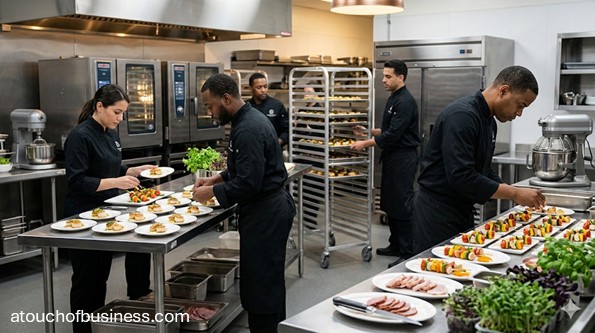
What to Expect From This Guide to Starting a Catering Business
This guide walks you through the key decisions and practical steps involved in starting a catering business. The bullets below highlight selected areas, not everything included.
Inside the guide, you will find:
- Startup steps: Work through kitchen setup, demand checks, costs, pricing, funding, registration, insurance, and supplier setup in a practical order before your first booking.
- Business fit: Check whether the pressure, schedule, and uneven income of catering match your life before you commit.
- Daily reality: See what a typical day involves, including the parts owners often enjoy and the parts they find hard.
- Financial planning: Plan operating capital, break-even logic, and a business plan that connects your costs, funding, and pricing.
- Local requirements: Learn which health, licensing, tax, and zoning questions to raise with local agencies, since rules vary by location.
- Industry interviews: Learn from caterers describing how they started, found kitchen space, and handled challenges along the way.
- Common questions: Get answers on home kitchens, kitchen agreements, minimum orders, part-time starts, needed experience, and choosing between weddings and corporate clients.
Start with how a catering business works and what the job asks of you.
Catering Business Startup Guide for Your First Booking
Business Overview
As a caterer, you prepare food for events and deliver it, serve it on-site, or both.
Some caterers stick to drop-off orders. Others staff the event, handle setup, and manage service from start to finish.
Decide first what you want to sell. A simple drop-off offer can limit equipment needs.
Full-service events can pull you into staffing, rentals, travel, and venue rules quickly.
Lock in where food will be prepared and stored, because that choice can control your permits and inspection path.
Your kitchen choice also affects how much you’ll spend before your first event.
Is a Catering Business a Good Fit for You?
You’ll be responsible for everything that touches food, timing, payments, and customer expectations.
Start with an honest check: is owning a business a good fit for you, and is catering a suitable business for you?
Write down what you actually enjoy.
Do you like planning, prep work, and event pressure, or do you hate last-minute changes and tight deadlines?
Now check your staying power. Passion doesn’t replace planning, but it can keep you calm when problems show up.
For a deeper look at persistence, read how passion affects business follow-through.
Ask yourself this once, and answer in plain language: “Are you moving toward something or running away from something?”
If your only reason for starting is to escape a job, chase status, or fix financial stress overnight, you’re more likely to force bad decisions.
Be realistic about tradeoffs. Income can be uneven.
Some weeks are quiet, then a big event lands and your hours stretch long.
You’ll also carry the full responsibility if something goes wrong.
Before you commit, talk to real owners you will not compete against.
Only contact caterers in a different city, region, or service area.
Use inside advice from real business owners as your guide for what to ask and how to listen.
Try a few fit questions like these:
- What part of catering takes more time than most people expect?
- Which service style causes the most stress: drop-off, staffed events, or cooking on-site?
- What would you do differently before your first paid event?
- Which costs surprised you most: kitchen access, transport, rentals, or insurance?
For a broader personal check, review points to consider before starting a business and compare that list to your actual situation.
Red Flags Before You Start
These warning signs can mean you should pause, change your model, or reconsider starting a catering business.
Treat each warning sign as a reason to verify more before you commit money.
Pause and investigate if any of these apply:
- Kitchen access: In many places, caterers need a health department-approved facility. If you can’t find one at a workable cost and distance, change your model or reconsider.
- Uneven demand: Catering demand is often seasonal and uneven. If one customer type or one season would carry your whole calendar, test other customer types before you commit.
- Cash timing: Food, labor, and rentals are often paid for before the final invoice is paid. If you can’t cover that gap, delay opening until you can.
- Time pressure: Events run on fixed times, and late food can ruin an event. If deadline pressure wears you down, consider a simpler drop-off model or a different business.
- Crowded drop-off market: Some restaurants also offer drop-off catering. If simple drop-off orders are already common near you, know why customers would choose you.
A Day in the Life of Running a Catering Business
A typical day splits between client contact, food production, and running or delivering events.
Your day often starts with checking inquiries, answering emails, and confirming event details with clients.
Production time follows, whether you are ordering ingredients, prepping food, or packing for upcoming events.
On event days, you often cook or serve in locations that are unfamiliar.
After service, cleanup and loading out can stretch the day long.
Between events, you handle ordering, budgeting, and recordkeeping.
Client communication and problem-solving also fill the gaps, from planning details to last-minute changes.
Your calendar shifts with the seasons. Weddings cluster in some months, while company events and holiday parties fill others.
What owners often enjoy:
- Variety and room to be creative, since each event brings a new setting and menu
- The satisfaction of pulling off an event that goes smoothly
- Building relationships with clients as you guide them through an event
What owners often find hard:
- Long days on your feet, with evening, weekend, and holiday events
- Juggling cooking with emails, client meetings, and calls in the same day
- Time pressure and demanding clients at events with fixed start times
- The business side of catering, which some owners find harder than the cooking
Does that mix of cooking, client contact, and long event days fit the life you want?
Choose Your Catering Model and Service Style
Decide how you will deliver the service: drop-off catering, staffed on-site service, corporate meal delivery, or a mix.
Your delivery model is not just branding. It changes your workflow, your equipment, and your risk profile.
Write down what “done” means for you. If you only drop off food, you may avoid staffing and certain rentals.
If you stay on-site, plan for service timing, setup constraints, and cleanup expectations.
If you pick the wrong model for your schedule, you’ll feel it during your first busy week.
Pick Your Best-Fit Customer Types
Choose the customers you want to build around.
Catering often serves corporate offices, weddings, venues, schools or faith organizations, private parties, nonprofits, and even film sets.
Make a short list of who you want first, not forever. A focused start keeps decisions simpler, from packaging to delivery radius.
Next, match your service style to the buyer. Corporate clients may care about reliability and clear invoicing.
Weddings may push hard on timing and presentation.
Define Your Food Offer and Event Scope
Draft a starting offer you can execute with confidence. Keep it tight enough that you can prep, hold, transport, and serve without guessing.
Choose whether you’ll do mostly hot items, mostly cold items, or a mix.
Hot and cold holding needs can drive equipment choices quickly, so don’t delay this decision.
Decide how you’ll handle dietary needs and allergens.
You don’t need a perfect allergen system on day one, but you do need a clear way to capture requests and communicate limits.
Confirm Your Legal Kitchen and Storage Setup
In many places, catering prep must happen in an approved facility unless a narrow home-food rule applies.
Pick where food will be prepared and stored from these options:
- A permitted commissary or commercial kitchen
- A leased facility you control
- A client or venue kitchen, if the job allows it
Call your local health department and ask what permit category applies to catering in your area.
Ask what the health department expects for off-site service and transport, since that can change your approval path.
Secure the space before you buy major equipment. A kitchen choice that fails inspection can strand your budget.
Before you sign a kitchen agreement, settle your legal structure, which a later step covers.
Validate Demand Before You Spend Big
Confirm that enough people will pay for what you plan to offer.
Start with your chosen customer types, then look at how crowded those segments are in your service area.
Ask for real signals. Collect inquiries, request event details, and test whether buyers accept your minimums and service area.
If demand is thin, adjust your offer before you commit to contracts and equipment.
A weak demand picture turns every other decision into a gamble.
Write Down Your Startup Budget and Cost Drivers
List your startup cost categories and circle the big levers.
In catering, the largest swings often come from kitchen access, equipment ownership versus rentals, travel logistics, and service style.
Build your planning list around categories like these:
- Business setup fees
- Permits
- Kitchen deposits
- Compliance upgrades for a leased space
- Major equipment
- Smallwares
- Packaging
- Vehicle needs
- Initial inventory
- Software
- Branding
- Insurance
- Professional help
- Working capital
Then stress-test your budget: what changes if you land a larger event than expected, or if a venue requires extra insurance documents?
Plan Your Essential Equipment and Service Gear
Buy gear to match your service model, not your wish list.
A drop-off operation can often open with fewer items than full-service events.
Even drop-off catering needs reliable hot and cold control and safe transport.
Confirm what your inspector expects for food equipment standards in your area.
In many jurisdictions, equipment standards and certification expectations show up during permitting and inspection conversations.
Use an organized build list so you don’t forget critical pieces that create last-minute chaos.
Start with categories like these and expand only as your offer expands:
- Temperature And Holding: hot holding equipment, cold holding approach, food thermometers
- Transport: insulated carriers, hot boxes, sturdy transport containers
- Service Gear: chafers, cambros, serving utensils, basic service setups you will provide
- Prep And Smallwares: sheet pans, knives, cutting boards, speed racks
- Packaging: containers, tamper seals where used, labels where used
- Cleaning And Sanitation: approved cleaners and sanitizers, labeled storage for chemicals
- Delivery Support: vehicle fit for your delivery method and secure storage during transport
Decide What You Will Own Versus Rent
Choose what you’ll own and what you’ll rent for your first events.
Rentals can reduce upfront spending, but they can also introduce lead times, deposits, and availability risk.
List the items that commonly land in rental conversations, like hot boxes, chafers, linens, and serviceware.
Decide what you can rent reliably in your area without risking a missed event.
If you skip the own-versus-rent decision, your quote process will feel shaky and your event prep will get messy.
Set Up Pricing and a Quote System
Pick a pricing method that fits the way you sell.
Catering commonly uses these pricing methods:
- Per-person pricing
- Per-item or platter pricing for drop-off
- Per-event packages
- Cost-plus approaches for more complex jobs
Decide how you’ll handle add-ons like staffing, rentals, delivery or travel, setup, and cleanup.
Put these add-ons into your quote template before your first inquiry so you don’t negotiate from scratch every time.
Before you publish prices, verify how your state and local tax rules treat prepared food, catering charges, delivery fees, and rentals.
Talk to your state tax agency and ask what must be shown on invoices.
Check Profit Potential and Break-Even Logic
Catering earns a profit only when each event leaves enough after direct costs to cover your fixed bills and still pay you.
Break-even is the point where your total revenue equals your total costs, with no loss and no gain.
To estimate it, divide your monthly fixed costs by what each event leaves after direct costs.
Fixed costs stay the same no matter how many events you book, such as kitchen access, insurance, and loan payments.
Direct costs rise with each event, such as food, packaging, rentals, extra staff, and travel.
Run the math with your own local costs and draft prices, then refine it after you finish the pricing step above.
For more on estimating profit, read how to estimate profitability and revenue.
Check these pressure points before you commit:
- Small events can cost nearly as much in setup, labor, and travel as larger ones.
- Food and labor are often among your largest costs, so small pricing errors add up.
- Slow months still carry fixed bills.
- Seasonal swings can leave some months short of break-even.
If your numbers only work with a perfect calendar, change your offer or service model before you buy equipment.
Plan Your Operating Capital
Set aside operating capital to cover ingredients, labor, rentals, and fixed bills until clients pay in full.
Catering costs often hit before the final payment arrives, so your cash has to carry each event.
Start by listing your monthly fixed bills. Then ask how many slow weeks your cash could cover if bookings stall.
Deposits and clear payment timing reduce how much you front for each event, but they don’t replace a cash cushion.
Use your own local costs to set an operating capital target, and include it in your funding plan.
Choose Your Funding Path and Spending Order
Decide how you’ll fund your startup costs and first orders.
Common funding paths include:
- Owner savings with staged buying
- Small business loans backed by the Small Business Administration
- Microloans through intermediaries
- Equipment financing
- Credit-based options
Before you apply, ask each lender or investor which documents they require.
Pull your costs, funding, pricing, and break-even work together in the Business Plan section below.
Write a spending order that protects you.
Cover permits, kitchen access, and the equipment needed to deliver your first offers with food held at safe temperatures.
Save the “nice-to-have” upgrades for after you’ve proven demand.
When funding is tight, avoid locking yourself into a service model that forces staffing and rentals too soon.
Pick a Legal Structure and Register the Business
Choose a business structure that matches your risk and plans. Catering can involve vehicles, off-site service, and contracts, so take the decision seriously.
Talk with an attorney and a tax professional before you sign kitchen, venue, or vendor agreements.
If you form a limited liability company or corporation, file with your state’s business filing office, often the Secretary of State.
Some states also require an assumed name or “doing business as” filing if you operate under a name other than your legal or registered name.
Once your name is locked, use it consistently on contracts, invoices, and vendor accounts.
Get Your Tax Accounts in Place
Apply for an employer identification number through the Internal Revenue Service.
Even if you start solo, you may need an employer identification number for banking, vendor accounts, or certain filings.
Register for sales tax or similar state tax accounts if your state requires it for prepared food sales.
Don’t guess on sales tax, because catering tax treatment can differ from other types of food sales.
If you plan to hire, set up your employer accounts before your first payroll. That often includes state unemployment insurance and state withholding accounts.
Set Up Business Banking and Payment Systems
Open a business bank account and keep business money separate from personal money.
Many banks ask for formation documents, an employer identification number, and ownership identification, though the exact list varies by bank.
Your registration and employer identification number come from the two steps above, so you can open the account now.
Set up a clean payment flow before you take deposits.
Choose how you’ll invoice, accept card payments, track deposits, and handle refunds and cancellations.
Test your full payment loop end-to-end. A payment system that fails during a booking creates avoidable damage to trust.
Plan Licenses, Permits, and Inspections by Level of Government
Build a simple compliance list grouped by federal, state, and city or county.
Keep each item short and specific so you can actually complete it.
Grouping rules by level of government keeps you from mixing rules from different places.
A permit in one county may not match the next county, even if the business looks the same.
Here are common items to place on your list and how to verify them:
- Local Health Permit: Contact your county or city health department and search “food establishment permit catering” plus your county name.
- Local Business License: Use your city or county licensing portal and search “business license” plus your city or county name.
- Zoning And Home Occupation Rules: Call planning and zoning and search “home occupation” plus your city name if any part of the business touches your home address.
- Certificate Of Occupancy: If you lease a commercial space, ask the city building department what is needed for a certificate of occupancy before you sign or build.
- State Sales Tax Registration: Use your state Department of Revenue site and search “sales tax registration catering prepared food.”
- Employer Registration: If you hire, use your state labor or workforce agency site and search “employer registration unemployment insurance.”
Decide How You Will Handle Packaged Food and Labels
Decide whether you will sell packaged items beyond a standard catered order.
Packaged items can include boxed meals with labels, packaged desserts, or bottled sauces.
If you package and label food for sale, federal labeling and allergen rules can apply.
Use the Food and Drug Administration’s labeling and allergen guidance to learn what triggers labeling expectations.
Don’t wait until the week of an event to invent a labeling approach. That delay can create compliance and customer communication problems.
Handle Meat and Poultry Edge Cases if You Go Beyond Typical Catering
You may need to check whether federal meat and poultry oversight applies if you produce certain meat or poultry products beyond food-service preparation.
Most catering work looks like food-service preparation.
Use the Food Safety and Inspection Service retail guidance as a starting point.
If your offer feels like “manufacturing for resale,” pause and ask a qualified regulator or advisor before you invest.
A small change in what you sell can move you into a different rule set.
Build Your Insurance and Risk Plan
Separate what is legally required from what clients and venues commonly require.
Start with requirements tied to employment and vehicles, then layer in coverage that protects your contracts.
Often legally required:
- Workers’ compensation when you have employees, based on your state’s rules
- Auto insurance required to legally operate a vehicle, with business use disclosed to your insurer
Commonly requested or recommended: general liability coverage and certificates of insurance for venues or corporate clients.
Many venues ask for proof even when the law doesn’t.
Ask venues what proof of insurance they require before you quote a job. A surprise requirement later can block a booking.
Set Up Suppliers and Vendor Accounts
Open the vendor accounts you’ll need to produce and deliver your first events.
Common vendor types include:
- Broadline food distributors
- Specialty suppliers
- Packaging and disposables suppliers
- Ice suppliers
- Rental partners for service gear and linens
Gather your business documents before you apply.
Many suppliers ask for basic business information and a billing method, and some set minimum orders that vary by supplier.
Confirm lead times for rentals and special-order ingredients. A missing item can force a last-minute scramble during event week.
Create Your Client Paperwork Pack
Write the documents you will use for every booking. Use simple language and stick to what you can deliver consistently.
At minimum, prepare a client agreement, an event worksheet, and a proposal or quote template that can show add-ons clearly.
Include these terms in your paperwork:
- Deposit rules
- Cancellation terms
- Date change rules
- Minimum headcount policies
- How you handle last-minute changes
If your paperwork is vague, you’ll spend your first season negotiating under pressure.
Build Your Brand Basics and Digital Footprint
Lock your business name, domain, and social handles before you announce anything.
Use a matching email address tied to your domain so inquiries look professional from day one.
Keep your first website simple: your service style, your offer list, your service area, and a clear inquiry form.
Add photos as you can, but don’t delay opening while you wait for perfection.
If you want a deeper check, revisit the earlier business start-up considerations and compare them to your current setup list.
Plan Your Physical Setup and Storage Needs
Set up your workspace to support safe prep and easy packing. Think about how food moves from prep to holding to transport without confusion.
Decide where ingredients, smallwares, and packaging will live.
If your kitchen access includes storage, confirm what you’re allowed to store on-site and how access works day-to-day.
Define what must be true for a clean load-out. If you can’t find gear quickly, you’ll bleed time just before delivery.
Design a Simple Inquiry to Delivery Workflow
Write down your workflow in plain steps. You’re building repeatable actions, not a complicated system.
A basic flow can look like this:
- An inquiry comes in
- You collect event details
- You send a quote
- You take a deposit
- You confirm the schedule
- You order ingredients and rentals
- You prep and pack
- You deliver or serve
- You close the invoice
Stress-test your workflow against a busy-day reality. If one step is unclear, that’s where errors will cluster.
Decide Whether to Hire Help or Stay Solo
Many caterers start solo, especially with drop-off orders. Staffing often becomes more common once bookings grow or when you move into on-site service.
Decide what you can handle alone and where you need help.
Serving an event, driving, and handling setup at the same time can create obvious weak points.
If you plan to hire, set up employer registrations first and don’t make job offers until you understand payroll requirements in your state.
Plan How Customers Will Find You
Choose a small set of channels that match your customer types.
If you want weddings or venues, learn what it takes to be included as an approved vendor and what proof venue managers require.
If you want corporate offices, build an outreach plan that starts with clear service options and a simple quote process.
Make it easy for an office manager to get a dependable answer.
When you need a reminder on asking smart owner questions, revisit the owner-conversation tips earlier in this guide.
Run a Test Event and Fix the Weak Spots
Do a controlled test cook and simulate transport and setup.
Time the prep, check whether hot and cold items hold their temperatures, and confirm your packing plan works.
Test your payment flow, too: send an invoice, take a payment, issue a receipt, and confirm your cancellation and refund steps are clear.
Small failures during testing protect you from big failures when a real client is watching.
Know the Responsibilities You Will Carry at First
Expect your first weeks to split between planning and executing.
You’ll be answering inquiries, writing quotes, confirming event details, lining up suppliers, and building repeatable prep and packing habits.
You’ll also spend time on compliance tasks like permits, inspections, and keeping your kitchen access and storage rules straight.
Add travel planning, loading, delivery timing, and cleanup to the list if you do on-site service.
If this workload sounds exhausting, pause and re-check your fit before you commit.
A Sample Pre-Opening Day
You start the day by checking inquiries and sending two quotes using your template.
Then you call the health department to confirm your permit category and ask what they expect for off-site service and transport.
Next you visit your kitchen space, measure storage, and test-pack your transport containers and hot holding setup.
You finish by opening a vendor account, confirming rental lead times, and tightening your event worksheet so you collect the correct details every time.
That kind of day isn’t glamorous, but it builds stability before your first real event tests you.
Pre-Opening Checklist for a Catering Business
Use this checklist before you accept your first full booking.
Keep it simple and confirm each item is done, not “almost done.”
Here’s what should be ready:
- Business Setup: business structure filed if needed, employer identification number obtained, business bank account active
- Tax Setup: state sales tax registration handled if required for prepared food, employer accounts set up if hiring
- Permits And Approvals: health permit path confirmed, inspections scheduled or completed as required, local business license handled where required
- Kitchen Access: commissary or commercial kitchen agreement signed, storage rules understood, access schedule confirmed
- Insurance Proof: required coverage in place for employees and vehicles, certificates available for venues or clients when requested
- Equipment Setup: refrigeration and hot holding approach tested, thermometers ready, transport containers ready, sanitation supplies ready
- Supplier Setup: core vendor accounts opened, rental partners identified, lead times confirmed
- Payments: invoicing and card processing tested, deposit rules and refund process written
- Paperwork: client agreement, event worksheet, and proposal template ready
- Brand Basics: domain and email set up, inquiry form live, social handles secured
- Test Run: a controlled test cook and transport simulation completed
Re-read the earlier point on passion and persistence, then compare it to your real schedule and energy.
Business Plan
Draft your business plan as you complete the earlier steps.
Finish it once your costs, funding, pricing, and break-even numbers are in place.
A catering business plan turns your startup decisions into one working document.
Lenders and investors often ask for a detailed plan, but requirements differ, so ask each one what they need before you apply.
Cover these points in your catering plan:
- Your service model and food offer, including drop-off, staffed service, or both
- Your customer types and the demand you’ve validated in your service area
- Your kitchen, permit, and inspection path
- Your startup costs, equipment, and own-versus-rent decisions
- Your pricing method, minimums, and deposit and cancellation rules
- Your funding sources and the operating capital you’ve set aside
- Your break-even logic and how slow stretches affect it
- Your insurance, staffing plan, and supplier setup
Lenders and investors compare expected costs to projected revenue, so keep your cost, pricing, and break-even figures consistent.
Treat break-even as an estimate and update it as you collect real quotes and supplier terms.
For a full outline, read how to write a business plan.
Opening-Day Red Flags
Watch for warning signs that can derail your opening. Most are fixable, but they need action before you take money.
Look for red flags like these:
- You have no clear legal kitchen plan, or your permit path is still guesswork.
- Your offer requires staffing and rentals, but your quotes don’t include those costs as line items.
- You can’t explain how you’ll keep food hot or cold during transport and setup.
- Your deposit and cancellation rules are missing or unclear.
- You rely on a single supplier with no backup for key items.
If any of these show up, fix them before you open. Waiting turns them into last-minute emergencies.
Frequently Asked Questions
Question: Can I cook from home if I want to start catering?
Answer: Often not, because many locations require catering food to be made in a permitted facility.
Cottage food rules usually cover only low-risk foods that don’t need refrigeration, and many catering menus fall outside them.
If your state has cottage food rules, confirm that your products and sales channels fit those limits before you spend money.
Question: Do I need a commissary or commercial kitchen agreement before I apply for permits?
Answer: Often, yes, because the permit path can depend on where food is prepared, stored, and washed up.
Confirm the order of steps with your local inspector so you do not get stuck in the middle.
Question: How do I set minimum orders without scaring people off?
Answer: Base minimums on what it costs you to prep, pack, and deliver, not on what competitors post online.
Minimums protect your schedule and cash when small orders would otherwise take as much setup time as large ones.
Question: Can I start a catering business while working a full-time job?
Answer: Yes. Catering can be run part-time, which lets you build experience and equipment as bookings grow.
Expect event work to fall on evenings and weekends, so your available time sets the limit.
Part-time operation doesn’t change what you must verify, including permits, kitchen access, and insurance.
Question: Do I need culinary school or restaurant experience to start a catering business?
Answer: Usually no formal culinary degree is required, but you do need a business license and an approved kitchen.
Some places also require food safety certification, so ask your local health department what applies to you.
Many caterers still gain experience first by working for an established caterer or taking on small events.
Question: Should I focus on weddings or corporate events first?
Answer: It depends on your service style and schedule, because each customer type fills a different part of the calendar.
Weddings tend to cluster in certain seasons, while company events and holiday parties fill other months.
Caterers that depend heavily on corporate accounts can struggle when company spending drops.
Interviews With Catering Business Owners
Hear working caterers describe how they got started and what they learned along the way.
Jerry Baker of The Food Matters
Jerry Baker built a wedding catering business with his wife and business partner. This interview covers how they started and how he set fees.
He also describes moving into off-site catering with rented vans and lots of ice.
Kathleen O’Neill and Mary Rembelski of Canapé Cart
Kathleen O’Neill and Mary Rembelski turned a catering hobby into a full-time business. They needed a licensed kitchen to take corporate parties.
They explain how they found kitchen space and how they handle event-day crises.
Ben Arnold of Corporate Caterers of Wichita
Ben Arnold owns Corporate Caterers of Wichita. In this chamber of commerce podcast transcript, he describes how he began catering.
He started with a business plan and a small amount of basic equipment.
Dan Nowak of Tall Guy & A Grill
Dan Nowak founded Tall Guy & A Grill, a catering operation for weddings, parties, and corporate events.
He discusses how the business has evolved and shares tips for people considering the catering profession.
Joy Wallace of Joy Wallace Catering & Design
Joy Wallace founded Joy Wallace Catering & Design. She discusses how she got started and how menus have changed.
She also covers building a strong team and what she looks for in an employee.
Related Articles
- How to Start a Meal Prep Business
- Starting a Food Truck Business
- How to Start a Bakery
- Start a Barbecue Business
- Cake Decorating Startup Guide
- Wedding Venue Startup Guide
- Start a Cookie Business
- Starting a Concession Stand
- How to Open a Breakfast Restaurant
- Starting a Dinner Theatre
- Start a Delicatessen
Sources:
- IRS: Get Employer ID Number
- SBA: Register Business, Licenses and Permits, Business Bank Account, Startup Cost Planning, Write Business Plan, Business Insurance
- FDA: Food Code, State Food Codes, Food Labeling Guide, Food Allergies, Food Equipment Standards
- USDA FSIS: Retail Guidance
- NSF: Food Equipment Standards
- National Agricultural Law Center: Cottage Food Laws
- BLS: Food Service Managers
- UF/IFAS Extension: Cottage Food Overview
- Georgia Department of Agriculture: Cottage Food FAQ
- Chron Small Business: Catering Operation Challenges, Starting a Catering Business
- The Princeton Review: Caterer Career Profile
- Entrepreneur: Starting a Catering Business
- Black Enterprise: Catering Dream Business
- CareerExplorer: Caterer Training Requirements
- Four Magazine: Day in the Life Interview
- Informi: Event Caterer Interview
- Fundi Connect: Catering Chef Interview
- The Courier: Catering Owner Interview
- Insights Innovation Economy: Catering Owner Interview
- Valley News: Holiday Catering Demand
- VerticalIQ: Caterer Industry Profile
- Stripe: Catering Pricing and Payments
- Nowsta: Catering Cost Metrics
- Metro Times: Called to Cater Interview
- Wichita Chamber of Commerce: Ben Arnold Podcast Transcript
- OnMilwaukee: Dan Nowak Podcast
- BizBash: Joy Wallace Podcast