
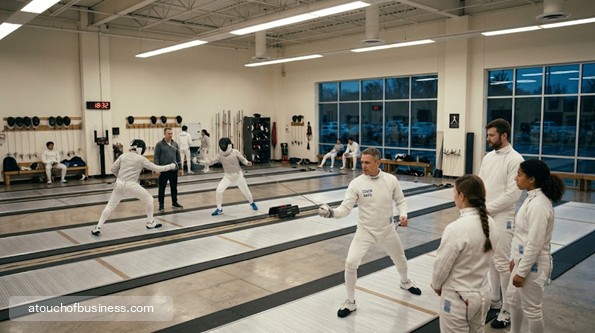
What to Expect From This Guide to Starting a Fencing Club
This guide walks readers through the key decisions and practical steps involved in starting a fencing club, from testing personal fit and local demand to planning the facility, finances, operations, and opening.
The highlights below show several areas covered in greater depth throughout the article.
Inside the guide, you will find:
- Startup roadmap: Follow an ordered path from evaluating the idea through business planning, facility setup, staffing, systems, enrollment, and opening.
- Industry interviews: Explore founder and coach experiences covering recruitment, club culture, operations, equipment routines, branding, and ownership demands.
- Startup FAQs: Find practical answers about coaching credentials, USA Fencing membership, space, loaner gear, insurance, break-even timing, permits, and weapon choices.
- Fit and demand: Assess your fencing background, income tolerance, workload, coaching access, local interest, competition, and realistic membership potential.
- Financial planning: Work through fixed costs, revenue sources, pricing structure, break-even enrollment, slow months, operating capital, and coach-dependency risks.
- Facility and equipment: Review space dimensions, lease concerns, buildout needs, fencing strips, scoring systems, loaner gear, armory supplies, and inspection routines.
- Opening requirements: Check registration, zoning, occupancy, insurance, staff screening, waivers, software, payments, test classes, safety measures, and opening-day red flags.
Begin with an honest look at whether the demands, costs, and responsibilities of running a fencing club fit your situation.
Starting a Fencing Club
Running a fencing club means operating a dedicated training facility where you teach one of the world’s oldest Olympic sports — foil, épée, and sabre — through group classes, private lessons, and supervised practice.
It’s a sport built on precision, strategy, and physical discipline, and the best fencing clubs are built the same way.
The path from idea to open club is real work. You need a specific kind of space, a significant equipment investment, sport-specific compliance requirements, and enough enrolled members to cover fixed costs before the operation sustains itself.
This guide walks you through every major startup decision in the right order.
Is This Business Right for You?
Most successful fencing club owners come from the sport itself — as former competitors, coaches, or both.
Fencing is technically demanding. Without direct experience, it’s difficult to evaluate equipment condition, teach as a backup, recognize safety problems, or earn the trust of competitive families.
That doesn’t mean you need an Olympic résumé. But you need enough fencing knowledge to run the operation credibly — or a head coach whose expertise you fully trust, and a solid plan if that coach leaves.
Ask yourself honest questions about the business side, too.
Can your household manage several months of reduced or unpredictable income while membership builds? Fencing is a niche sport. Enrollment ramps slowly in most markets, and fixed costs begin on day one of your lease.
Are you prepared to be the coach, the administrator, the equipment manager, and the enrollment coordinator simultaneously — at least at first?
Business ownership in this sport rewards people who love the work and understand that the operational demands go well beyond the strip.
Before you spend money, talk to fencing club owners in non-competing markets and ask for time. Prepare specific questions: How long did it take to reach break-even enrollment? What did startup actually cost versus what you expected? What would you do differently?
Their answers will shape your plan in ways no article can.
You can also explore a structured entry path. Buying an existing fencing club or applying to the USA Fencing Club Incubator Program are both real options, covered below.
Red Flags Before You Start
Some warning signs should stop you before you sign a lease or spend serious money.
No local fencing interest — and no plan to build it. If there’s no existing fencing community in your area, you’re not capturing demand — you’re creating it from scratch. That takes time and capital. Verify there’s a realistic pool of interested families before committing to a facility.
No suitable facility at a workable rent. Fencing clubs need specific space: long floor runs, high ceilings, and room for multiple strips side by side. In high-rent markets, suitable spaces may not be available at a rent level your projected membership can support. Price your facility options before you build a business plan around enrollment assumptions.
No qualified coach and no plan to find one. You can’t open a fencing instruction program without a coach. Qualified, credentialed fencing coaches are hard to find in most markets. If you can’t identify one before you sign a lease, delay the launch.
Insufficient capital to reach break-even enrollment. The gap between opening day and the month your membership covers all fixed costs can last six months to a year or longer. If you can’t fund that period, the business will likely close before it stabilizes. Calculate your break-even enrollment number before making any major commitments.
An existing club already serves your market. A second club in a small fencing market is a high-risk entry. Differentiation is possible — different weapons, different competitive levels, different demographics — but it requires a clear reason for families to choose you instead.
Standard insurance may not cover you. General sports and fitness liability policies sometimes exclude weapon sports. This is a documented problem for fencing clubs specifically. Confirm that any policy you consider explicitly covers fencing activities before you rely on it.
Two structural realities apply regardless of how well you execute.
First, fencing is a genuinely niche sport. The total participant pool in any given market is smaller than mainstream youth sports, and your enrollment ceiling reflects that.
Second, the combination of facility lease, strip infrastructure, scoring equipment, and loaner gear creates a high fixed-cost operation. Many fencing clubs run on thin margins — and that’s a feature of the model, not a problem that determination alone can solve.
Step 1: Assess Your Fit and Motivations
Do a genuine self-assessment before you invest time or money in planning.
Do you have enough fencing background to coach, evaluate equipment, and earn respect from competitive families? Or do you have a qualified coach committed to the project? If the answer to both is no, your entry path needs to change before anything else does.
Evaluate your financial position honestly. Startup requires capital before the first student walks in — facility deposit, buildout, equipment, and operating reserves. Then enrollment builds slowly.
Can you sustain personal living expenses during that period? This is a real pressure point for sports business owners, and it deserves a direct conversation before you commit.
Think about the daily reality of running a facility. You’ll be scheduling classes, inspecting equipment, managing memberships, renewing compliance certifications, and answering parent inquiries — on top of teaching. The operational load is heavier than most people expect.
Step 2: Talk to Fencing Club Owners
Find owners of established clubs in markets you won’t compete with — different cities or regions — and ask for a conversation.
Prepare your questions in advance. Ask how long it took to reach steady enrollment, what startup actually cost versus what they budgeted, and what they’d do differently on the facility search, equipment procurement, and first-year pricing.
These conversations are some of the most valuable pre-commitment research you can do. Experienced owners have navigated the facility challenges, the compliance setup, and the enrollment ramp-up you’re about to face.
Reach out through the USA Fencing community, local division networks, or AskFRED — the platform used by the fencing community for tournament management and club resources.
Step 3: Research Local Demand and Competition
Start with the USA Fencing Find-a-Club directory. Identify every club operating within reasonable driving distance of your intended location.
If no clubs exist nearby, determine why. Has the market never supported one, or is it genuinely underserved? Look at population density, the concentration of youth sports families, proximity to private schools or academically competitive communities, and whether there’s any existing fencing awareness to build from.
If clubs already operate in the area, map their weapons, age focus, competitive level, schedule, and pricing. Understand what gap, if any, you could realistically fill.
Talk to parks and recreation departments, school athletic coordinators, and youth sports organizations. Gauge how many families might enroll in a beginner fencing program within 12 to 18 months of opening.
Your local demand research needs to produce a realistic enrollment estimate before you commit to a lease. If you can’t get to a number you believe in, you can’t build a plan around it.
Step 4: Define Your Business Model and Club Type
The model decisions you make here determine your facility size, equipment investment, staffing structure, and pricing — so make them deliberately.
Recreational or competitive — or both? A recreational club focuses on beginner programs and community participation. A competitive club trains athletes toward regional and national events, requires more coaching depth, and attracts a smaller but more committed membership base. A combined model is common but requires more resources to run well.
Which weapons at launch? Starting with foil only is the most common approach for new clubs. Foil is where nearly all beginners start. Adding épée and sabre later — once enrollment is established — reduces your initial equipment and staffing requirements. Launching all three weapons at once demands more from your coaching team and your budget.
Which age groups? Youth programs in the Y8 through Y14 age categories typically generate the most sustained membership for new clubs. Adult programs attract smaller numbers but can support higher per-lesson pricing. A mixed program is the most common structure for established clubs.
USA Fencing membership — yes or no? Joining USA Fencing as a member club is the expected path for any club intending to train competitive fencers or host sanctioned events. The membership includes general liability insurance coverage for club activities involving USA Fencing members — a significant benefit for any club working with minor athletes. Independent recreational clubs that don’t intend to compete or host events can operate without it, but the insurance gap is a serious consideration.
Step 5: Consider Your Entry Path
Most fencing clubs are started from scratch. That gives you control over location, culture, and model. It also requires the most capital upfront and the longest road to break-even enrollment.
Buying an existing club is worth investigating. An existing club may come with enrolled members, loaner equipment, a facility lease, and an established reputation. The critical due-diligence question is whether members will stay after a sale — fencing club membership is often built around loyalty to a specific coach, not to the facility. If the selling coach leaves with the ownership transfer, expect attrition.
The USA Fencing Club Incubator Program is a structured option for qualified applicants. It pairs aspiring club owners with Fencing Ventures for business setup support — legal entity formation, branding, facility search, and capital assistance. Applications are accepted in cohorts throughout the year. Verify current availability and eligibility requirements directly at usafencing.org/club-incubator.
A traditional franchise model isn’t typical for fencing clubs in the United States. The Incubator is the closest structured partnership option available through the national governing body.
The right entry path depends on your capital position, your timeline, your available coaching talent, and whether any viable clubs are currently for sale in your market.
Business Plan
Build your plan around the numbers that matter most: how many enrolled members does your club need to cover all fixed monthly costs?
Start by listing every monthly fixed cost. Include facility rent and utilities, coach compensation, USA Fencing club dues, insurance, club management software, equipment maintenance, and any loan payments on startup capital. That total is your break-even floor.
Then map your revenue model. Fencing clubs typically earn from monthly membership fees, private lesson packages, group class fees, equipment rental, enrollment fees, and eventually tournament hosting revenue.
Private lessons carry the highest margin per hour. Group classes scale enrollment volume but earn less per student. A realistic plan includes both.
Divide your fixed monthly cost by your net revenue per student to get your break-even enrollment figure. That number tells you whether your market and your pricing can realistically support this business.
Account for the slow months. Youth sports businesses typically see enrollment dip over summer and around school breaks. Your plan needs enough operating capital to carry those dips without disrupting the facility or the staff.
Identify a single-point-of-failure risk early. If your club’s private lesson revenue depends entirely on one coach and that coach leaves, your main income stream disappears. Plan for coaching depth or contractual protections — notice periods, non-solicitation clauses — from the start.
Use your plan to organize the key decisions: facility size, weapons offered at launch, class schedule, pricing structure, and operating capital needed before break-even. For guidance on pricing your programs, see Pricing Your Products and Services. For a realistic look at profitability planning, see Estimating Profitability for a New Business.
Step 6: Register the Business and Establish Your Legal Identity
Choose a legal structure before anything else. Most fencing club owners form a limited liability company (LLC) for personal liability protection. Review your options at How to Choose a Business Structure.
Register your entity with your state’s Secretary of State or equivalent office. Then obtain a federal Employer Identification Number (EIN) from the IRS — required for hiring, business banking, and most entity types.
If your club name differs from your legal entity name, register a doing-business-as (DBA) name. Confirm your intended club name isn’t already in use in your state. Run a basic trademark search before committing to a name with regional or national reach.
Obtain a general business license from your city or county. Requirements vary — check with your local clerk’s office or business licensing department.
Set up a basic business identity before you start reaching out to potential members: a website domain, a contact email address, and a consistent club name that matches your legal filings.
Step 7: Find and Evaluate a Facility
This step is harder and slower than most people expect. Budget more time for it than you think you’ll need.
A fencing strip is 14 meters long — approximately 46 feet. Each end requires a safety zone of approximately 2 meters. One strip plus safety clearance requires a room length of roughly 18 meters, or about 59 feet. You also need ceiling height sufficient for active lunges and overhead movement. Low ceilings disqualify a space entirely.
Plan for the number of strips you need at launch. Most operating clubs run two to four strips simultaneously during peak class times. Space requirements multiply accordingly.
Candidate space types to consider:
- Industrial flex spaces and large open commercial suites
- Former retail spaces with open floor plans
- Warehouse or light-industrial units with appropriate ceiling height
- Shared athletic facilities such as YMCAs or community centers, which reduce capital requirements but limit schedule control and branding
Verify zoning before signing anything. A sports instruction or recreation use designation may be required in the zone where you want to operate. Check with your local planning or zoning department before entering serious lease negotiations.
Confirm that the space can receive a certificate of occupancy for your intended use. If the prior tenant used it as an office or retail store, you may need a change-of-use permit and inspections before you can legally open to the public.
Evaluate the full facility experience: parking availability, ADA accessibility, restrooms, and HVAC capacity. Fencing generates significant body heat. A facility without adequate ventilation becomes uncomfortable fast — and that affects the member experience from day one.
Negotiate your lease terms carefully. Push for a free-rent buildout period so your lease payments don’t begin before the facility setup is complete. Align the lease length with your break-even timeline. Include exit provisions if enrollment doesn’t materialize.
Step 8: Secure Permits, Licenses, and Insurance
Don’t open to the public until all of these are in place.
General business license. Required by most cities and counties. Obtain it from your local clerk or business licensing office.
Zoning clearance. Confirm your intended use is permitted in your commercial zone. Some jurisdictions require a conditional use permit for recreation or sports instruction uses.
Certificate of occupancy. Required when occupying a commercial space for the first time, changing its use, or completing tenant improvements. Your local building department issues it after any required inspections. Don’t open until this is in hand.
Building permits for improvements. Installing fixed flooring, running electrical for scoring equipment, or making structural changes typically requires permits. Pull them before construction begins.
USA Fencing club membership and insurance. Enrolling in USA Fencing’s member club program activates the general liability coverage administered through Gallagher Affinity. This policy covers fencing activities organized and supervised by the club for participants who hold individual USA Fencing membership. It does not cover club-owned property and equipment, and it does not cover non-members beyond a short trial period. Verify current coverage terms at usafencing.org/insurance.
Supplemental insurance. Standard sports and fitness general liability policies sometimes include weapon-sports exclusions. Work with an insurance broker who has experience placing fencing club coverage to confirm your policy explicitly covers fencing activities.
If you plan to serve non-members, run summer camps, or conduct school programs, you’ll likely need a separate policy for those activities.
Some states require workers’ compensation insurance when you hire employees. Requirements vary — check with your state’s labor or insurance department before your first hire.
For a broader overview of business insurance needs, see Business Insurance.
Step 9: Build Out the Facility
Once your lease is signed and permits are in hand, configure the space for fencing.
Install your fencing strips (pistes). Metallic aluminum overlay systems are required for electric scoring — the conductive surface integrates with scoring machines and is necessary for competitive instruction. Specialty rubber flooring is an option for beginner-only practice areas. The surface must allow controlled foot sliding while gripping securely under weighted movement.
Run electrical conduit and outlet placement to support scoring machine reels and floor cable connections. If this requires new wiring, work with a licensed electrician before the flooring goes down.
Set up dedicated zones for each function: active strips, a footwork and warmup area, an armory and repair station, equipment storage organized by size, and a waiting area for parents and observers.
Lighting matters. Adequate overhead illumination directly over the strips is important for referee visibility, student safety, and the overall professionalism of the facility.
Stock a first aid kit and mount it in a visible location. Post emergency contact information and exit routes in the training area. Install fire extinguishers per local code requirements.
Assess whether to install an AED — automated external defibrillators aren’t universally required by law for commercial sports facilities, but they’re strongly recommended as standard safety practice. Verify local AED requirements with your municipality.
Step 10: Procure Equipment
Your equipment list covers two categories: the club loaner fleet that beginners use before purchasing their own gear, and the scoring and armory equipment that runs the facility.
Club loaner fleet essentials:
- Fencing masks — foil (with conductive bib), épée (non-conductive bib), and sabre (fully conductive) — in multiple sizes for youth and adults
- Fencing jackets in multiple sizes, minimum 350N protective rating for club use
- Plastrons (underarm protectors) in multiple sizes
- Gloves for the weapon hand; sabre gloves must be 800N-rated for competition
- Knickers (fencing breeches) in multiple sizes
- Chest protectors — required for women, recommended for all minor athletes
- Weapons: foil for beginners; épée and sabre sets if launching a multi-weapon program
- Body cords, mask cords, and lames (conductive jackets for foil and sabre target area)
Scoring and electric equipment per active competitive strip:
- One scoring machine per strip
- Two reels per strip
- Floor cables connecting reels to the scoring machine
- Ground cables for conductive metallic piste strips
Armory tools and supplies:
- Blade-straightening tools, tip testers, and spring scales for tip pressure testing
- Spare tips, tip springs, screws, and blades for all weapons
- Multimeter for testing lame and mask wire conductivity
- Spare body cords, mask wires, guards, and handles
- Allen wrenches, screwdrivers, and blade tape
For domestic USA Fencing use — local clubs and sanctioned competitions — standard 350N-rated protective clothing meets the requirements. FIE-rated equipment at the 800N level is required only for FIE-sanctioned international events. Verify current USA Fencing equipment rules before purchasing.
Source from established U.S. fencing suppliers. Plan for lead times — metallic piste strip systems and scoring equipment can take several weeks to arrive. Order early.
Establish a pre-session equipment inspection protocol before you open. Check blade tips, mask mesh integrity, bib conductivity, and elastic straps before every class. Document it. Equipment inspection logs are both a safety practice and a liability protection measure.
Step 11: Hire and Credential Coaches
Define the coaching structure before you open. Will you teach personally, hire a head coach, or do both? Each path has different cost, risk, and operational implications.
All coaches working for a USA Fencing member club must hold USA Fencing Coach membership. That membership requires SafeSport training completion and a background screen through NCSI — the approved screening vendor. Club owners, administrators, and other adults with routine access to minor athletes must also complete this screening through the +CheckEd or +Coach add-on to their USA Fencing membership.
SafeSport training details: The core course consists of three modules and must be completed before any adult has contact with minor athletes. SafeSport training must be renewed annually. Background screens are valid for two years. Processing typically takes 3 to 10 business days — factor that into your hiring timeline.
Coach certification from the U.S. Fencing Coaches Association (USFCA) isn’t required by USA Fencing for member club coaches, but it matters to competitive families. USFCA certification levels — Assistant Moniteur, Moniteur, Prévôt, and Maître (Fencing Master) — reflect progressive technical competency. A head coach with USFCA credentials adds credibility when recruiting competitive athletes.
USA Fencing member clubs can post open coaching positions for free through the club manager portal at member.usafencing.org.
Before onboarding any coach, draft employment contracts or independent contractor agreements. Misclassifying a coach as an independent contractor when they function as an employee creates tax and labor liability. Include notice periods and, where appropriate, non-solicitation clauses to protect the club’s membership if a coach departs.
Step 12: Set Up Club Operations and Payment Systems
Open a business bank account as soon as your EIN and entity registration are in place. Keep business transactions completely separate from personal finances from the beginning.
Set up payment processing before the first enrollment. You need both in-person credit and debit card capability and an online payment method for recurring monthly membership billing.
Club management software is essential before you open. At even a small fencing club — multiple class levels, private lesson scheduling, membership billing, waiver collection, and family account management — manual tracking breaks down quickly.
Real-world fencing club operators consistently cite this as a foundational tool, not an optional one. Choose a platform that handles scheduling, memberships, recurring payments, and digital waivers in one place.
Prepare participant waiver and liability release forms before you take your first student. Have them reviewed by a licensed attorney familiar with sports law in your state. Waivers are a standard and necessary risk-management document for a contact sport that involves weapons.
Common pricing structures include:
- Monthly membership fee covering group classes and open fencing sessions
- Private lessons priced separately per session or in packages
- Drop-in floor fees for non-members at open fencing
- One-time enrollment fee for new members
- Equipment rental fees for loaner gear during beginner programs
Register your club with your local USA Fencing Division before opening. USA Fencing operates through geographic divisions that manage local sanctioning, events, and communication. Find your division at usafencing.org/divisions and contact them early — some divisions have their own procedures and timelines that affect your ability to host or participate in local events.
Step 13: Build Pre-Opening Enrollment and Prepare for Launch
Don’t wait for opening day to start building enrollment. Begin taking signups before the facility is ready.
USA Fencing offers trial memberships that allow beginners to participate for up to 90 days while they decide whether to continue. This lowers the barrier to a first visit and keeps the insurance coverage in place for trial participants.
Plan your class schedule in full before opening: days, times, levels, and age groups. A typical launch schedule might include a beginner youth program, a beginner adult program, and one or two intermediate class slots. Publish the schedule before you open so prospective members can see exactly what they’re signing up for.
Reach out to local schools, parent-teacher associations, parks and recreation departments, and youth sports organizations. Youth programs in the Y8 through Y14 age categories are typically the fastest path to stable enrollment for a new club. Those families are already organized around after-school activities, and fencing fits that structure well.
Run at least one test class or open house with invited participants before the official opening. Use it to verify that your equipment works correctly, your scoring machines function with fencers in full electric gear, your class flow makes sense, and your staff is prepared. Identify and fix problems before paying members experience them.
Step 14: Open the Facility
Before the first official class, confirm every item on your pre-opening checklist is complete.
All permits and your certificate of occupancy are in hand. USA Fencing club insurance is active. All coaches and staff have completed SafeSport training and background screening. Every piece of equipment has been inspected and documented. Your club management software is live. Payment processing is tested. Waivers are ready for every student.
On the facility side: emergency contact information is posted, the first aid kit is stocked and visible, fire extinguishers are installed, and exit routes are marked. The strips are grounded and tested. The scoring machines work.
The member experience begins the moment someone walks through the door. Clear signage, a clean waiting area for parents, organized equipment storage, and a professional armory station all contribute to the impression your club makes on day one.
Launch with the discipline the sport demands — and your members will notice.
Opening-Day Red Flags
These are the problems that derail launch day and the first weeks of operation.
Equipment not tested in full electric configuration.
Scoring machines, reels, floor cables, body cords, and lames need to be tested together — not individually. A component that works in isolation may fail during a class. Test the complete circuit on every strip before the first student arrives.
SafeSport or background screen not complete for a coach.
A coach who hasn’t completed SafeSport training and received a cleared background screen result is not permitted to work with minor athletes under USA Fencing’s FenceSafe program. Don’t begin operation until every coach working with minors has a confirmed clearance. Background screen processing takes up to 10 business days.
Insurance certificate not yet received.
Your landlord may require a certificate of insurance before you open. USA Fencing member clubs can obtain a certificate of insurance through the club manager portal. Have it in hand before opening day — not in process.
Waivers not signed before participation.
Every participant needs a signed liability waiver before stepping on the strip. Set up a digital or paper waiver process that is completed during enrollment — not on the day of the first class.
Facility not ready for real use.
Parents arrive with students and find incomplete buildout, missing signage, no waiting area, or an unstocked first aid kit. These details signal disorganization and erode trust immediately. Walk through the facility as a first-time visitor before opening day and fix what doesn’t look ready.
Class flow not tested.
A fencing class involves equipment checkout, warmup, footwork drills, instruction on the strip, and equipment return and inspection. If you haven’t run through this sequence in practice, the first real class will be disorganized. Use your open house or test class specifically to identify flow problems.
Frequently Asked Questions
Do I need to be a certified fencing coach to open a fencing club?
There’s no federal or state government license specifically required to open a fencing club as a business owner. However, coaches at USA Fencing member clubs must hold USA Fencing Coach membership, which requires SafeSport training and a background screen.
USFCA coach certification — Moniteur, Prévôt, and Maître levels — isn’t required by USA Fencing, but it matters to competitive families and reflects genuine technical competency. Verify current coaching requirements at usafencing.org/coaches.
Does my club need to join USA Fencing?
No — you can operate an independent recreational club without USA Fencing membership. But joining activates the general liability insurance coverage included with club membership, eligibility to host sanctioned events, and access to FenceSafe compliance tools.
For any club working with minor athletes or training competitive fencers, the insurance coverage alone makes membership essential. Verify current terms at usafencing.org/membertypes-club.
What is the minimum space I need?
A standard fencing strip is 14 meters long, with 2-meter safety zones at each end — roughly 59 feet of usable length per strip. Ceiling height must allow active fencing movements without restriction.
You also need space for equipment storage, a warmup area, a waiting area, and an armory station.
The actual minimum depends on how many strips you plan to run simultaneously. Verify strip layout requirements for sanctioned tournament use at the USA Fencing support portal.
What loaner equipment does the club need to supply?
You need enough loaner gear to outfit a full beginner class simultaneously: masks, jackets, plastrons, gloves, weapons, and chest protectors (required for women, recommended for all minors).
For electric and competitive instruction, add body cords, mask cords, lames, scoring machines, and reels. Students in beginner programs typically purchase their own gear after committing to the sport. Factor the full cost of the loaner fleet into your startup planning.
Can participants join without USA Fencing membership?
Yes, for non-sanctioned recreational training. USA Fencing’s club liability insurance covers only participants with individual USA Fencing membership. Non-members can participate under a trial membership valid for up to 90 days.
For programs serving non-members beyond the trial — camps, school programs, demonstrations — the club’s USA Fencing policy doesn’t provide coverage. Separate insurance is needed for those activities.
Confirm current trial membership and insurance terms at usafencing.org/membership.
How long does it take to reach break-even enrollment?
It depends on your fixed costs, pricing, and local market. In markets without prior fencing awareness, expect a ramp-up of six months to a year or more before reaching stable enrollment.
Calculate your break-even enrollment number before you sign a lease — divide your total fixed monthly costs by your net revenue per student. Undercapitalization during the ramp-up period is one of the most common reasons fencing clubs close.
Do I need a special permit to run a fencing club?
There’s no fencing-specific commercial license at the federal level. You need standard business requirements: entity registration, EIN, general business license, zoning clearance for a sports instruction use, and a certificate of occupancy for your commercial space.
Some jurisdictions classify sports instruction as a special use requiring a conditional use permit.
Verify with your local city or county business licensing and zoning offices — requirements vary by U.S. jurisdiction.
Can I start with just one weapon instead of all three?
Yes — and it’s a common approach for new clubs. Starting with foil only reduces your equipment inventory, simplifies coaching staffing, and lets you establish beginner enrollment before expanding.
Most fencers start with foil regardless, so a foil-only launch serves the most likely first customers. Expand to épée and sabre as enrollment builds and demand for additional weapon instruction becomes clear.
Advice From Fencing Academy Founders and Coaches
Olympic Coach Igor Gantsevich on Building Dynamo Fencing Club
Igor Gantsevich explains how he started with school outreach and developed Dynamo Fencing Club into a large organization with multiple locations and a substantial coaching team.
The interview is useful for understanding student recruitment, staffing, community building, club culture, and the patience required to grow a fencing program.
Interview With Coach Giacomo Fanizza About Managing a Fencing Club
Giacomo Fanizza discusses organizing a fencing academy, coaching students, preparing for competitions, maintaining equipment, and establishing productive coach-student relationships.
The conversation can help a prospective owner think through daily club operations, coaching standards, equipment routines, and the student experience.
More Than Just a Fencing Club: South Bay Fencing Academy
Owner and head coach Matteo Gallo explains his target market, program range, club culture, business goals, and the personal demands of running a fencing academy.
His answers are useful for defining your customers, structuring programs for different age groups, and considering how club ownership may affect your personal life.
Interview With Fencing Club Founders Samson Lee and Cheryl Lim
Samson Lee and Cheryl Lim discuss moving from competitive fencing into coaching, creating their own brand, running an academy, and spending much of their time at the club.
Their experience provides a practical look at the commitment involved, the value of clear branding, and the lifestyle demands of operating a fencing club.
Misha Mokretsov: Founding the New York Fencing Academy
Founder and head coach Misha Mokretsov talks about establishing his academy, finding its first students, serving local families, and overcoming challenges while developing the club.
The interview can help you consider how community connections, customer demographics, coaching expertise, and specialization may influence a new fencing club.
Interview With Berks Fencing Club Founder Jon Weaver
Jon Weaver describes how a local newspaper article helped attract interest, how he recruited another founder, and why the club concentrated on teaching beginners.
His story offers useful ideas for testing local demand, finding collaborators, promoting a new club, and creating an accessible program for inexperienced students.
Related Articles
- How To Start a Dojo
- How To Start a Boxing Gym
- How To Start a Kickboxing Gym
- How To Start a Rock Climbing Gym
- How To Start a Yoga Business
- How To Start a Pilates Studio
Sources:
- USA Fencing: Start a Club, Club Membership Types, Club Incubator Programs, FenceSafe Policies, SafeSport Training Requirements, Club Insurance Program, Tournament Safety Compliance, Fencing Divisions
- USA Fencing Zendesk: Strip Requirements
- USFCA: Fencing Coach Certification
- SportNgin: USA Fencing SafeSport FAQs, USA Fencing Insurance FAQs
- TeamUp: Open a Fencing Club
- Prieur USA: Complete Fencing Equipment List
- Fencing.Club: Fencing Gear Safety Levels
- Great Mats: Rolled Rubber Fencing Piste
- AskFRED: Sanctioned Fencing Tournaments
- Academy of Fencing Masters: Fencing Expensive Sport
- OSHA: Medical First Aid Programs
- FindLaw: Commercial Leases Zoning Law