
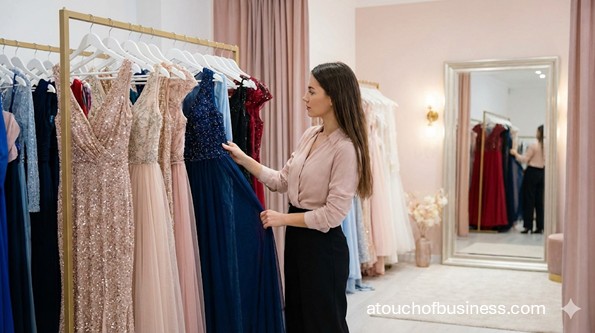
Inventory, Garment Care, Licensing, and Pricing Plan
A dress rental business rents dresses and related items for a short time window, usually tied to events. Some businesses focus on local pickup and return. Others ship to customers and manage returns by mail.
Before launch, your main job is to prove demand, choose a clear niche, set your standards, and build a reliable pre-launch setup for inventory, garment care, storage, and customer agreements.
What You Rent, Add-On Services, And Typical Customers
Most dress rental businesses focus on special-occasion wear where customers want a high-end look without owning the item. Your product mix should match real demand in your target area and your ability to clean and inspect garments to a consistent standard.
Common products and services include the following.
- Core rentals: formal gowns, cocktail dresses, prom dresses, bridesmaid dresses, maternity formalwear, plus-size formalwear, seasonal event dresses.
- Optional accessories: shawls, wraps, belts, clutches, costume jewelry, garment bags.
- Fit support: size guidance, measurement-based recommendations, appointment fittings (if local), limited pinning guidance when applicable.
- Logistics add-ons: scheduled pickup/return windows, delivery in your local area (where permitted), shipping options, rush handling (only if your setup can support it).
- Damage-related handling: documented inspection on return, cleaning and repair routing, and clear terms for excessive damage or missing items.
Typical customer types are fairly consistent across markets, but the mix varies by location and season.
- Prom and homecoming customers and their families.
- Wedding guests, bridesmaids, and event attendees.
- College and professional customers attending galas, holiday events, and formal work functions.
- People who need a dress for a single photo session or milestone event.
- Travelers who prefer renting to packing or purchasing.
How Does a Dress Rental Business Generate Revenue
Revenue typically comes from rental fees based on dress category, brand tier, and rental length. Some businesses use flat rates by category. Others use tiered pricing based on replacement value and demand.
Common revenue components include the following.
- Rental fee per item (by day, weekend, or event window).
- Accessory rentals bundled with the dress or rented separately.
- Delivery or shipping charges (when offered).
- Late fees (only if allowed in your agreement and disclosed in advance).
- Cleaning or repair charges only when disclosed and tied to documented conditions that exceed normal wear (based on your written terms).
Pros And Cons To Weigh Early
This business can work when you have consistent event demand and a tight system for garment care and inventory control. It can struggle when the niche is unclear, cleaning is not reliable, or your agreements are vague.
Here are practical pros and cons to consider before you spend heavily.
- Pros: repeat demand tied to predictable events; customers may rent multiple times a year; inventory can produce multiple rentals if maintained to a standard; possible to start small with a narrow niche.
- Cons: inventory is capital-heavy at scale; quality control is time-sensitive; damage and loss risk is real; cleaning and repairs can create delays; sizing and fit issues can create high customer service load; sales tax on rentals is common but varies by state rules.
Small-Scale Vs. Large-Scale Setup
Many dress rental businesses can start small if you keep the niche narrow and the inventory controlled. A large-scale version typically requires more inventory, more space, and staff help to keep turnaround times consistent.
Here’s a practical way to separate the two.
- Small-scale: limited inventory in 1–2 categories, appointment-only fitting or shipping-only, outsourced cleaning, owner-managed processes, small storage footprint.
- Large-scale: broad inventory across many sizes and categories, dedicated showroom, frequent fittings, in-house garment care equipment, higher volume shipping/returns, staff for fittings, inspections, and customer support.
Entity choices often follow scale. Many small businesses start as a sole proprietorship and later form a limited liability company as the business grows and risk increases. If you plan to raise outside funds, sign a commercial lease, or hire staff early, you may need a structure that fits that plan.
Readiness Check Before You Spend
Starting a business is a personal decision before it’s a legal one. You’ll do better when you’re clear on why you’re doing this and what you’re signing up for.
Ask yourself: “Are you moving toward something or running away from something?” If you’re starting only to escape a job or a financial bind, that may not sustain motivation when the hard days show up.
You also need to decide if business ownership is right for you and if this business is the right fit. Passion matters because it helps you push through problems. Without it, people tend to look for a way out instead of solutions.
Now the reality check. Are you ready for uncertain income, long hours, difficult tasks, fewer vacations, and full responsibility? Is your family or support system on board? Do you have (or can you learn) the skill set—and can you secure funds to start and operate?
If you want a broader checklist before you commit, review Points to Consider Before Starting Your Business. For the mindset piece, read How Passion Affects Your Business. If you want a deeper reality check from real owners, explore Business Inside Look.
Skills you’ll use early (and can learn or hire for) include the following.
- Garment quality inspection and consistent documentation.
- Basic fabric knowledge and stain awareness (enough to route to the right cleaning method).
- Customer service and fit guidance without overpromising.
- Scheduling, organization, and inventory tracking.
- Basic photo and listing preparation for online catalogs.
- Comfort reading local rules and completing registrations.
Learn From Owners You Will Not Compete Against
You can learn faster by speaking with people already doing the work. The key is to protect your future market and respect their business.
Only talk to owners you will not be competing against. That usually means a different city, region, or service area.
Smart questions to ask include the following.
- Which dress categories rent most consistently in your area, and what surprised you about demand?
- What are the top three causes of returns you can’t re-rent quickly (fit, damage, timing, cleaning delays), and how did you adjust?
- What do you wish you had clarified in your rental agreement before your first 50 rentals?
Step 1: Choose A Clear Niche And A Simple Launch Plan
Pick a niche you can actually support with your starting inventory and space. “Everything for everyone” is expensive in this business because sizing and variety drive inventory depth.
Decide what you will rent first, what you will not rent yet, and what “ready to rent” means for your brand. Your standard should be specific enough that two people could inspect the same dress and reach the same conclusion.
Step 2: Confirm Demand And Confirm The Math Works
Demand is not the same as interest. You’re looking for proof that people will rent in your area, at a price that can cover cleaning, repairs, replacements, supplies, taxes, and your time.
Start with simple market checks: event calendars, local venues, schools, wedding seasons, and what similar services offer. Then pressure-test pricing using realistic turnaround times and a conservative assumption for wear and damage.
If you need a practical way to think about demand before you invest, review supply and demand basics and apply it to your niche.
Step 3: Decide Your Business Model And Your First 90 Days
Your business model should match your location, your cash, and your available time. A shipping-first model needs packaging, labels, and return handling. A local showroom model needs appointments, zoning checks, and a customer-ready space.
Pick one primary model for launch and keep the rest as future options.
- Appointment-only local showroom: customers try on, reserve, and return locally.
- Shipping-first rental: customers book online; you ship and process returns.
- Hybrid local plus shipping: local try-on plus shipping to repeat customers.
- Subscription-style wardrobe rentals: recurring fee for a defined number of items (complex to launch; usually not a first version).
- Event partnerships: partnerships with venues, photographers, or planners (requires clear referral terms and non-competing boundaries).
Also decide how you will start: solo, with a partner, or with investors. If you expect heavy volume, frequent fittings, or long hours of inspection work, plan staffing later and focus on building a repeatable system first. If you will hire early, read how and when to hire so you understand the early compliance and workload impact.
Step 4: Plan Inventory Sourcing And Set Quality Rules
Inventory is your product, so sourcing is a startup decision, not an afterthought. Your goal is to launch with dresses that match your niche, your size range, and your ability to clean and store them correctly.
Common sourcing paths include buying new from wholesalers, purchasing retail, sourcing secondhand, or consigning. Each option changes your margins, replacement plan, and quality control needs.
Define your acceptance rules up front.
- Allowed brands and materials (based on how they hold up to repeated cleaning).
- Condition standards (seams, zippers, lining, hems, beading).
- Size range and how you will label and track each item.
- Replacement planning for your top-demand sizes and categories.
Step 5: Decide How Cleaning, Repairs, And Hygiene Will Work
You need a consistent plan for cleaning and inspection before launch. Customers expect a clean garment and a predictable experience. Your reputation depends on it.
Most startups choose one of two paths: outsource cleaning to a professional cleaner or do limited in-house care (like steaming and spot checks) while outsourcing deep cleaning.
If you plan to operate dry cleaning equipment using perchloroethylene (PCE), federal air emission standards may apply to dry cleaning facilities that use PCE. Hazardous waste rules may also apply depending on the waste you generate. If you outsource cleaning, those rules generally apply to the cleaner’s facility, not your rental business, but you still need clear vendor terms and turnaround times.
If you will import, manufacture, or private-label new dresses under your brand name, federal textile labeling and care labeling rules can apply to the responsible business. If you’re renting retail dresses without altering labels or presenting them as your own branded garments, those labeling rules may not apply in the same way, but you should confirm based on your exact plan.
Step 6: Choose A Location And Storage That Protect Your Inventory
Even a home-based startup needs a real plan for storage. Dresses need space, organization, and protection from dust, odor, sunlight, humidity, and pests.
If you want a storefront or a customer-facing fitting area, convenience matters. Customers will not love a long drive for a single try-on. Use business location considerations to think through foot traffic, parking, access, and lease terms.
Your space decision also affects compliance. Home-based, appointment-only, and retail storefronts can fall under different zoning rules. Plan for the possibility that you may need inspections or a Certificate of Occupancy (CO) before opening a customer-facing location.
Step 7: Write Your Rental Terms, Pricing Rules, And Customer Paperwork
Your rental agreement is part of your launch infrastructure. It sets expectations, reduces disputes, and supports consistent decisions. Don’t rely on memory or “we’ll figure it out.”
Define rental windows, pickup and return rules, late handling, and what “normal wear” means for your niche. Keep it plain and specific.
Pricing is also a startup decision because it shapes demand and covers risk. Use pricing guidance to think through cost coverage and profit targets. Then test your prices against competitor ranges and your cleaning and replacement assumptions.
Step 8: Assemble Essential Equipment And Build Your Setup
Start with the gear that supports your launch model. Shipping-first needs packaging and label tools. Local fittings need mirrors and fitting space. Every model needs inventory tracking and inspection tools.
Below is a practical, itemized essentials list. Scale drives how much you need, but these are common launch basics.
- Inventory Storage And Protection: garment racks, heavy-duty hangers, garment bags, clear labeled bins for accessories, shelving, humidity control tools (as needed), lint rollers, fabric-safe odor control products, inventory tags, lockable storage (as needed).
- Garment Care And Inspection: steamer, iron and ironing board (if appropriate for your fabrics), stain treatment supplies (fabric-appropriate), sewing kit for minor repairs, spare buttons and hooks, measuring tape, fabric brush, gloves for inspection and handling (as needed), inspection lighting.
- Fitting And Customer Area (If Local): full-length mirrors, fitting room divider or private fitting space, seating, size chart signage, clips and pins for fit assessment, disinfecting wipes for shared surfaces, appointment calendar tool.
- Shipping And Returns (If Shipping): shipping boxes or poly mailers sized for garments, tissue or protective wrap, packing tape, shipping label printer, label supplies, return labels, scale, tracking workflow tool, return bins, reusable garment bags designed for shipping.
- Photography And Listings: camera or phone with consistent image quality, tripod, lighting, backdrop, mannequin or dress form, garment clips for display, basic editing software, measuring tools for listing details.
- Office And Systems: computer, secure internet connection, printer, document scanner (optional), inventory management system or database tool, barcode or tag system (optional), accounting software, secure password manager.
- Security And Loss Prevention: locks, security camera system (as needed), secure storage for high-value items, documented check-in and check-out process, photo documentation process for condition.
As you build your cost plan, use estimating startup costs to avoid missing categories. Scale is the main driver of total startup cost in dress rentals.
Step 9: Complete Legal Setup, Tax Accounts, And Local Permissions
Handle legal setup before you accept your first booking. You’re building a real business, and the paperwork supports banking, taxes, permits, and contracts.
If you want a structured overview of the process, review how to register a business and adapt it to your location and model.
Here’s a location-aware checklist, organized by level of government. Requirements vary by jurisdiction, so use the “how to verify” steps to confirm what applies to your exact setup.
- Federal: Employer Identification Number (if needed). When it applies: hiring employees, operating as an entity that requires it, opening certain business bank accounts, or working with vendors that require it. How to verify locally: Internal Revenue Service -> search “Get an employer identification number.”
- Federal: Shipping promise and delay-notice/refund rules for shipped orders. When it applies: taking orders online or by phone for merchandise you will ship to customers (confirm how the rule applies to shipped rentals under your model). How to verify locally: Federal Trade Commission -> search “Mail, Internet, or Telephone Order Merchandise Rule.”
- Federal: Textile and care labeling rules (limited situations). When it applies: importing, manufacturing, or private-labeling garments under your brand name. How to verify locally: Federal Trade Commission -> search “Care Labeling Rule” and “Textile Fiber Products Identification Act.”
- State: Entity formation and name availability. When it applies: forming a limited liability company or corporation, or registering a business name at the state level. How to verify locally: Secretary of State -> search “business entity search” and “form an LLC” (varies by state).
- State: Sales and use tax registration for rentals. When it applies: renting tangible personal property in a state where rentals are taxable or where you have a registration duty. How to verify locally: State Department of Revenue -> search “sales tax permit” and “rental taxability” (varies by state).
- State: Employer accounts (if hiring). When it applies: hiring employees in the first 90 days. How to verify locally: State workforce agency -> search “unemployment insurance employer registration” (varies by state).
- City-County: General business license. When it applies: many cities and counties require a general business license or registration. How to verify locally: City or county licensing portal -> search “business license” and your industry keywords (varies by jurisdiction).
- City-County: Assumed name or doing-business-as filing. When it applies: operating under a name different from your legal name or your entity name. How to verify locally: Secretary of State or county clerk/recorder -> search “assumed name” or “doing business as” (varies by jurisdiction).
- City-County: Zoning and home-occupation rules. When it applies: home-based storage, appointment fittings, customer pickups, signage, or increased traffic. How to verify locally: City or county planning and zoning -> search “home occupation permit” and “zoning verification” (varies by jurisdiction).
- City-County: Building permits and Certificate of Occupancy (CO). When it applies: opening a showroom, changing the use of a space, or building out a fitting area. How to verify locally: City or county building department -> search “Certificate of Occupancy” and “change of use” (varies by jurisdiction).
Insurance is often required by contracts rather than law. For example, a commercial landlord, venue partner, or event contract may require proof of general liability coverage. Use business insurance guidance to understand common coverage types, then confirm requirements in writing with the party requesting proof.
Varies by jurisdiction
Rules differ by state, county, and city. The fastest path is to verify your requirements using official portals and the exact search terms below.
Use this checklist as a pre-launch verification routine.
- Secretary of State: search “business entity search,” “form an LLC,” “assumed name” (terms vary).
- State Department of Revenue: search “sales tax permit,” “rental taxability,” “marketplace facilitator” (if using third-party platforms).
- City or county licensing: search “business license,” “home-based business,” “retail showroom” (varies by jurisdiction).
- Planning and zoning: search “home occupation permit,” “zoning verification,” “sign permit” (varies by jurisdiction).
- Building department: search “Certificate of Occupancy,” “change of use,” “tenant improvement permit” (varies by jurisdiction).
- Fire department or fire marshal: search “fire inspection,” “assembly occupancy,” “retail inspection” (varies by jurisdiction).
- State workforce agency: search “unemployment insurance employer registration” (if hiring).
Owner questions to decide what applies include the following.
- Will you run a customer-facing showroom, or will you be shipping-only?
- Will you have employees in the first 90 days?
- Will you handle cleaning in-house, and will that involve regulated solvents?
Step 10: Set Up Banking, Bookkeeping, And Payment Methods
Open business accounts at a financial institution so you can separate business and personal activity. Keep your records clean from day one. It saves time at tax season and helps you see what is working.
If you may need funding, learn what lenders typically expect by reviewing how to get a business loan. Even if you don’t borrow, writing down the numbers keeps you grounded.
Also set up how you will accept payment, manage deposits if you use them, and issue refunds according to your written terms. If you ship, confirm your shipping promises match what you can reliably do.
Step 11: Lock In Your Name, Brand Assets, And Online Presence
Your name needs to work legally and practically. Check availability, confirm you’re not creating confusion, and secure the matching domain and social handles.
Use selecting a business name as a guide, then build a basic identity set: logo, colors, and simple brand rules. If you want a structured list of brand items, see corporate identity package considerations.
Next, build a simple website that clearly shows your niche, sizes, rental windows, and how booking works. If you need a starting point, use an overview of developing a business website. If you plan a local showroom, consider basic signage and printed materials like business cards.
Step 12: Run A Pre-Launch Test Week And Fix Gaps
Before you open to the public, run a controlled test. Use a small set of rentals with friends, testers, or a limited soft launch. Your goal is to prove your process works end-to-end.
This is where you validate timing: booking, check-out, packaging, cleaning turnaround, inspection, and returns. Fix issues while stakes are low.
Day-to-day activities you should be ready to handle include the following.
- Respond to inquiries, confirm availability, and document reservations.
- Prepare dresses: inspect, photograph condition, and stage for pickup or shipment.
- Fit support: appointment scheduling or measurement checks (based on your model).
- Returns: check-in, condition documentation, routing to cleaning or repair, and restocking.
- Inventory updates: track what is out, what is due back, and what is unavailable.
- Customer communication for reminders, delays, or replacement needs.
A simple “day in the life” during a test week might look like this.
- Morning: check bookings due today, confirm pickups or shipments, and prep garments with photos and tags.
- Midday: fittings or customer messages, handle returns, and document condition consistently.
- Afternoon: drop off or schedule cleaning, complete minor repairs, restock inventory, and update your calendar and availability.
- End of day: reconcile transactions, confirm next-day reservations, and review what slowed you down.
If your model includes a physical location, this is also where you plan your first public push. A grand opening can be useful for local visibility when it matches your niche and your capacity. See ideas for your grand opening. If you expect walk-in traffic, review how to get customers through the door.
Red Flags To Catch Before You Commit
Most problems in this business show up before launch if you look closely. Red flags are usually about unclear demand, weak agreements, or a setup that can’t support quality.
Watch for these early warning signs.
- You can’t define your niche in one sentence, so your inventory plan keeps expanding.
- Cleaning and repair turnaround times are uncertain, and you don’t have backup options.
- Your agreements are vague about returns, condition, and late handling.
- You’re relying on best-case timelines for shipping, cleaning, or fittings.
- You’re buying inventory without a clear size plan and tracking method.
- You’re planning a showroom without confirming zoning, inspections, or Certificate of Occupancy requirements.
- You’re underestimating how much time inspection and documentation take.
If you want guidance building a support team without guessing, review building a team of professional advisors. It can help you decide what to do yourself and what to delegate.
Recap And Next Moves
A dress rental business can start small when you keep the niche narrow and the standards clear. Your pre-launch priorities are demand proof, a realistic pricing model, reliable cleaning and inspection, and a legal setup that matches your scale.
If you want to keep your planning organized, write a basic plan even if you don’t seek funding. Use how to write a business plan as a guide, then build your checklist for compliance, gear, inventory, and your first test week.
Is This the Right Fit for You?
This business tends to suit you if you like detail work, you can stay consistent with standards, and you don’t mind repetitive inspection and documentation. It also helps if you can handle customer expectations calmly when fit or timing gets stressful.
The key realities are simple: inventory costs money, quality takes time, and cleaning and repairs drive your schedule. If you can prove demand, price for real conditions, and launch with a controlled setup, you give yourself a fair shot.
Go back to your motivation. “Are you moving toward something or running away from something?” If you’re moving toward building something you care about—and you’re ready for the responsibility—this can be a practical business to build step by step.
101 Tips for Managing Your Dress Rental Business
The tips below cover many parts of a dress rental business.
Use them like a menu—pick what fits your current stage and ignore what doesn’t.
Save this page so you can return when a new problem pops up.
To keep it simple, apply one tip at a time.
What to Do Before Starting
1. Pick a clear niche first, such as prom, wedding guest, black-tie, maternity formalwear, or plus-size formalwear, so your inventory plan stays focused.
2. Decide your rental model early: local appointment-only, shipping-only, or a hybrid, because it changes your space, supplies, and staffing needs.
3. Build a size and fit plan before you buy inventory by listing the exact size range you will carry and the minimum number of options per size.
4. Write your “ready-to-rent” standard in plain language, including what counts as acceptable wear, what requires repair, and what gets retired.
5. Choose your cleaning approach up front, and confirm turnaround times so you don’t overbook dresses you can’t turn around fast enough.
6. Assign every dress a unique item identifier and track it from day one, even if you start with a simple system, so you can follow each rental cycle.
7. Create a standard inspection routine for check-out and return, including photos, so condition decisions stay consistent across customers and staff.
8. Set a realistic buffer window for shipping and returns so you’re not relying on best-case carrier timing for back-to-back rentals.
9. Draft your customer-facing policies early, then read them as if you were a first-time customer, and remove anything vague or confusing.
What Successful Dress Rental Business Owners Do
10. Photograph each dress the same way every time, using consistent lighting and angles, so listings look reliable and customers know what to expect.
11. Keep a fit note on every dress, such as “runs small in the bust” or “longer torso works best,” so you can guide customers faster.
12. Track the top reasons returns can’t go back into circulation quickly, then fix the root cause instead of blaming “bad luck.”
13. Maintain a small “back-up option” set in your most-rented sizes so you can rescue rentals when fit issues happen.
14. Build relationships with a dependable cleaner and a dependable alterations provider so you have capacity when your volume spikes.
15. Use written step-by-step procedures for cleaning handoff, garment handling, packaging, and return processing so quality does not depend on memory.
16. Review rental history monthly to identify dresses that are high-demand, high-damage, or slow movers, then adjust purchasing and pricing.
17. Keep a replacement plan for your top sellers so you are not scrambling when a high-demand dress is damaged beyond repair.
18. Treat packaging as part of the product by making it protective, consistent, and easy for customers to use for returns.
19. Protect high-value inventory with extra documentation, secure storage, and stricter reservation controls rather than guessing who will be careful.
Running the Business (Operations, Staffing, SOPs)
20. Start each day by checking what is due out, what is due back, and what is in cleaning or repair, so your availability is always accurate.
21. Reserve inventory based on the customer’s event date and your buffer time, not just the ship date or pickup date.
22. Confirm key fit information before the rental is finalized, such as measurements, height, and preferred fit, to reduce last-minute issues.
23. Take standardized condition photos at check-out and at return, then store them with the rental record so disputes are not personal.
24. Use a “two-person check” for check-out or return on high-value items, even if that means a quick second look, to reduce missed damage.
25. Separate returned garments from ready-to-rent garments until inspection is complete, so you don’t accidentally reissue an unverified dress.
26. Track cleaning status in real time and don’t mark a dress as available until it is back, inspected, and approved.
27. Create a fast lane for minor fixes, such as loose hooks or small seam repairs, so small issues do not block multiple future rentals.
28. Store dresses in a way that reduces wear, using garment bags and spacing that prevents snagging, crushing, and odor transfer.
29. Standardize how you label sizes and measurements, and do not rely only on the brand’s tag, because sizing varies by brand.
30. Use packaging steps that prevent common damage, such as protected beading, secured straps, and folded areas buffered to reduce creasing.
31. If you ship, confirm every package gets a carrier acceptance scan, because it supports customer communication and dispute handling.
32. Reconcile reservations, payments, and refunds on a set cadence so small errors do not pile up into large problems.
33. Train staff on how to handle garments safely, including jewelry and embellishments, so handling damage does not become “normal.”
34. If you use cleaning chemicals, keep a Safety Data Sheet for each product and train employees on hazard communication requirements.
35. Build a clear escalation path for problems, such as missing returns, shipping delays, or disputed damage, so staff are not improvising under pressure.
36. Track how long each step takes, such as inspection, packing, and check-in, so you can staff for peak season without guessing.
37. Run a monthly inventory audit that confirms each dress is physically present, in the right condition category, and accurately listed as available or unavailable.
What to Know About the Industry (Rules, Seasons, Supply, Risks)
38. If you advertise shipping timeframes for shipped orders, make sure you have a reasonable basis for those timeframes and a plan for delays.
39. Build a written delay-and-refund routine for shipping issues so you handle delays consistently and protect customer trust.
40. If you operate dry cleaning equipment that uses perchloroethylene, verify applicable federal requirements and any state restrictions before purchase or use.
41. If you manufacture, import, or private-label apparel, learn what labeling rules apply before you place the first order with a supplier.
42. If you sell or import new clothing textiles, understand that flammability standards can apply, and confirm obligations based on your exact products.
43. Confirm how your state taxes rentals of tangible personal property, and keep a simple system for collecting, tracking, and remitting the correct amounts.
44. Plan for demand spikes tied to events in your area, such as prom, wedding season, holiday parties, and local galas, so you don’t run out of core sizes.
45. Treat prom season as a capacity test by limiting inventory to what you can clean, inspect, and turn around without cutting corners.
46. Avoid overbuying “statement dresses” that only work for one narrow event type, because they often sit unused outside that window.
47. Expect damage and loss risk, and control it with documented condition standards and reservation controls rather than hoping customers are careful.
48. Build fraud controls for shipped rentals, such as verifying customer identity signals and using consistent approval rules for high-value orders.
49. Protect customer data by limiting access, using strong passwords, and avoiding storing unnecessary payment information in your own systems.
Marketing (Local, Digital, Offers, Community)
50. Choose two to three marketing channels you can manage consistently, because inconsistent marketing usually loses to steady marketing.
51. Create a simple offer that matches your niche, such as “prom weekend package” or “wedding guest bundle,” rather than a generic discount.
52. If you have a storefront or appointment space, keep your local business profile accurate with hours, photos, and booking instructions.
53. Build a content library of real photos across body types and sizes so customers can picture fit and avoid surprises.
54. Use customer permission-based photos and testimonials to reduce trust barriers, because rentals require confidence.
55. Partner with nearby businesses that share your audience, such as photographers, venues, salons, and event planners, and define referral terms clearly.
56. Track which dresses drive first-time bookings, then feature those dresses prominently in your marketing instead of guessing what “should” sell.
57. Send timely reminders for seasonal demand, such as prom and holiday events, so customers book before your best inventory is gone.
58. If you run promotions, set a start and end date and track results, so you don’t train customers to wait for constant discounts.
59. Build a simple repeat-customer path, such as a credit toward the next rental or early access to new arrivals, to reduce acquisition pressure.
60. Use clear language in ads and listings about rental windows and return timing so customers self-select correctly.
Dealing with Customers (Trust, Education, Retention)
61. Set expectations early about fit and sizing, and explain what you can and cannot guarantee, so customers know how decisions are made.
62. Provide a measurement guide that tells customers exactly what to measure and how, because vague sizing questions create late problems.
63. Always collect the event date and time, because it drives your scheduling and shipping buffer decisions.
64. Send a confirmation message that restates rental window, return method, and what to do if issues appear on arrival.
65. Offer a back-up size or back-up option when feasible for high-stakes events, because it reduces panic and last-minute cancellations.
66. If you offer fittings, keep appointments structured with time limits, required measurements, and clear next steps so your schedule stays workable.
67. Make return instructions simple and consistent, including what to include in the box or bag and how to seal it securely.
68. Teach customers what not to do with stains, such as avoiding random chemicals on delicate fabrics, and tell them to follow your return instructions instead.
69. Keep customer communication calm and specific during problems, focusing on solutions, timing, and next steps rather than blame.
70. Use a consistent late-return process so customers understand timing consequences and you don’t negotiate under pressure.
71. Build customer trust with transparency, such as showing how you inspect and clean, without overexplaining or promising perfection.
72. Ask customers for structured feedback, such as fit, comfort, and event type, because those details improve future recommendations.
Customer Service (Policies, Guarantees, Feedback)
73. Set a response-time standard for messages, then staff and schedule around it during peak season.
74. Use a short script for common issues, such as fit concerns or shipping delays, so your tone stays consistent and helpful.
75. Keep exceptions rare and documented, because unpredictable exceptions become a hidden policy that customers expect.
76. Make refunds and credits rule-based, tied to timing and documented issues, so customers feel treated fairly and staff have clarity.
77. Create a clear arrival-issue routine, such as requiring photos within a defined timeframe, so you can verify problems quickly.
78. Handle damage claims with facts, such as photos and condition standards, and avoid emotional language that escalates conflict.
79. For missing items, use a step-by-step process that includes tracking confirmation, customer contact attempts, and documented timelines.
80. Track customer complaints by category, then fix the top two causes first, because recurring complaints usually come from the same sources.
81. Encourage reviews only after a successful rental, and respond to negative reviews with specific resolution steps instead of defensiveness.
82. Use simple customer satisfaction checks, such as a short post-rental message, to catch problems before they become public complaints.
Sustainability (Waste, Sourcing, Long-Term)
83. Choose durable fabrics and constructions for inventory purchases, because repeated cleaning and handling will reveal weak materials fast.
84. Repair strategically by fixing issues that restore rental quality, and retire pieces that consistently fail inspections.
85. Use reusable garment bags when it fits your model, and keep them in rotation with cleaning and inspection like any other asset.
86. Reduce packaging waste by standardizing box sizes and using recyclable materials where practical for shipping and returns.
87. Create a responsible retirement plan for inventory, such as resale, donation where appropriate, or textile recycling when available.
88. Track the most common causes of premature retirement, then adjust buying rules to extend garment life.
Adapting to Change (Seasonality, Shocks, Competition, Tech)
89. Adjust your buying plan using your actual rental history, not assumptions about what “should” be popular.
90. Build a peak-season plan that includes cleaning capacity, inspection time, and customer support coverage, then test it before the rush hits.
91. Watch carrier performance and build alternate options for shipping, because delays can spike without warning.
92. Add services only when your core process is stable, because complexity can break quality control quickly in rentals.
93. Consider low-risk tech upgrades that reduce errors, such as item identifiers, automated reminders, and standardized photo documentation.
94. Revisit your pricing and policies at least twice a year, because costs and customer expectations shift over time.
What Not to Do
95. Don’t overbook inventory by assuming every return will be on time and every cleaning cycle will be smooth.
96. Don’t mark dresses as available while they are in cleaning, repair, or uninspected return status, because it creates avoidable cancellations.
97. Don’t skip condition documentation, because “I remember how it looked” won’t help during disputes.
98. Don’t rely on trendy purchases without demand proof in your niche, because slow-moving inventory ties up cash and storage space.
99. Don’t apply random stain products to delicate fabrics without testing, because you can set stains or damage fibers permanently.
100. Don’t leave policies vague, because vague policies create inconsistent decisions and customer frustration.
101. Don’t ignore licensing, tax, and safety requirements, because compliance problems are harder and more expensive to fix after the fact.
Use these tips to tighten one part of your business at a time.
When you keep your standards clear and your process consistent, most problems become smaller and easier to solve.
FAQs
Question: Do I need a business license to start a dress rental business?
Answer: Many cities and counties require a general business license, but the rules vary by location.
Check your city or county licensing portal and search for “business license” and “clothing rental” or “formalwear rental.”
Question: Can I run a dress rental business from home?
Answer: It depends on local zoning and home-occupation rules, especially if you will have customer visits, pickups, signage, or frequent deliveries.
Verify with your city or county planning and zoning office before you set up fittings or customer-facing traffic.
Question: Do I need a Certificate of Occupancy to open a showroom?
Answer: A customer-facing space may need inspections and a Certificate of Occupancy depending on how the space is used and whether it was remodeled.
Confirm requirements with your local building department before you sign a lease or start tenant improvements.
Question: Should I form a limited liability company or start as a sole proprietorship?
Answer: Many small businesses start as sole proprietorships and later form a limited liability company as risk and volume grow.
Check your state’s Secretary of State site for official entity options and filing steps.
Question: Do I need an Employer Identification Number?
Answer: You may need an Employer Identification Number if you form certain business entities, hire employees, or a financial institution requires it to open accounts.
The Internal Revenue Service provides a free application process and official guidance on who needs one.
Question: Do I have to collect sales tax on dress rentals?
Answer: Sales tax rules for rentals of tangible personal property vary by state and sometimes by local jurisdiction.
Verify with your state Department of Revenue by searching “sales tax permit” and “rental taxability.”
Question: What insurance do I need before I open?
Answer: Insurance requirements are often driven by leases, venues, and contracts rather than a single universal law.
Use the Small Business Administration’s insurance guidance to identify common coverage types, then confirm any required coverage in writing with the party requesting proof.
Question: What are the essential systems I should set up before taking my first booking?
Answer: You need a way to track inventory availability, reservations, condition documentation, cleaning status, and payments.
A simple system can work at first, but it must prevent double-booking and keep a record tied to each dress.
Question: What equipment is truly essential to launch?
Answer: At minimum you need secure storage, garment protection, inspection lighting, measurement tools, and basic garment care tools like a steamer.
If you ship, add shipping supplies, a label printer, and a scale so packages go out consistently.
Question: How do I set up cleaning and repairs as a startup?
Answer: Most startups either outsource cleaning to a professional cleaner or use limited in-house care while outsourcing deep cleaning.
Confirm turnaround times and define a written “ready-to-rent” condition standard before you accept reservations.
Question: If I ship dresses, what rules apply to shipping promises and delays?
Answer: If you take orders online or by phone and ship merchandise, federal rules require a reasonable basis for stated shipping timeframes.
If you cannot ship when promised, you may need to send delay notices and handle refunds based on the rule’s requirements.
Question: Do I need to worry about chemical safety rules if employees handle cleaning products?
Answer: If you have employees exposed to hazardous chemicals, OSHA hazard communication rules can apply, including training and access to Safety Data Sheets.
Set up chemical labels, storage, and training before staff begin handling cleaning products.
Question: What if I want to run my own dry cleaning in-house?
Answer: If you operate perchloroethylene dry cleaning equipment, federal air emission standards can apply to dry cleaning facilities using that solvent.
Confirm federal, state, and local restrictions before buying equipment or signing a lease for in-house dry cleaning.
Question: Do apparel labeling rules matter for a dress rental business?
Answer: Labeling rules are most relevant if you import, manufacture, or private-label apparel under your brand.
If you do, review federal care labeling requirements and confirm your responsibilities before placing orders.
Question: How do I prevent double-booking and last-minute inventory failures?
Answer: Tie every reservation to an event date and build buffer time for cleaning, inspection, and shipping variability.
Do not mark items available until they are physically back, inspected, and approved for rental.
Question: What metrics should I track weekly as an owner?
Answer: Track utilization rate by dress, average turnaround time, damage rate, late return rate, and refund or dispute rate.
Also track cash tied up in inventory and how long dresses sit without renting.
Question: When should I hire help, and what roles come first?
Answer: Hire when the volume forces you to skip inspection, documentation, or customer response time standards.
First roles are usually return processing, inspection and prep, and customer scheduling support.
Question: What are common owner mistakes that hurt profitability?
Answer: Overbuying inventory without demand proof, underestimating cleaning and repair time, and running with unclear policies are common issues.
Weak tracking systems also create hidden losses from unrecorded damage, missing items, and schedule conflicts.
Related Articles
- Starting a Costume Rental Business from the Ground Up
- How to Start a Profitable Dancewear Business
- How to Start a Successful Men’s Clothing Store
- Start a Baby Clothing Store with a Clear Plan
- How to Open a Children’s Clothing Boutique That Stands Out
- How to Start a Kilt Store Successfully
- How to Open a Kimono Store: Step-by-Step Guide
- Start an Athletic Clothing Line: Complete Launch Guide
Sources:
- American Apparel & Footwear Association: Labeling Guidance
- Centers for Disease Control and Prevention: Laundry and Bedding
- Drycleaning & Laundry Institute: Stain Removal Guide
- Electronic Code of Federal Regulations: 16 CFR Part 435, 16 CFR Part 1610, 40 CFR 63 Subpart M
- Federal Trade Commission: Order Merchandise Rule, Care Labeling Rule, Mail Order Merchandise, Textile and Wool labeling
- Internal Revenue Service: Employer Identification Number
- OSHA: