
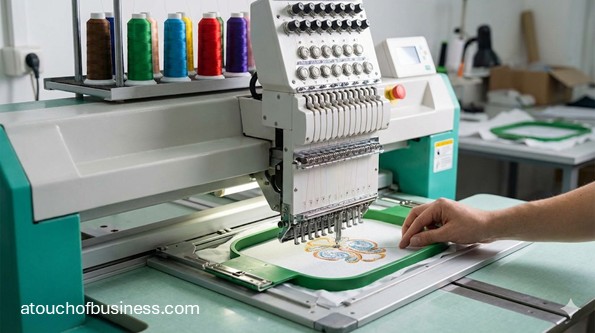
Overview of an Embroidery Business
An embroidery business creates stitched designs on fabric. You use an embroidery machine to sew logos, names, and artwork onto items like hats, shirts, jackets, and bags.
This is a business you can start small. Many owners begin at home with one machine and a tight product focus. If you want to go bigger later, you can add more machines, staff, and bigger orders.
At the core, you are selling clean stitching, consistent quality, and dependable turnaround. The work looks simple from the outside, but the setup matters. If you build your process before you sell, you save yourself a lot of stress.
Common Embroidery Business Models
Before you buy equipment, pick a business model. Your model decides what you sell, how you price, and what kind of machine setup makes sense.
Start with one model that fits your life and your budget. You can expand later once orders and cash flow feel steady.
- Home-Based Custom Embroidery: You work from home and sell to local customers, online customers, or both.
- Business Uniform Embroidery: You focus on repeat orders for local companies that need branded workwear.
- Team and School Apparel: You stitch for sports teams, clubs, and school staff apparel.
- Online Personalization Shop: You sell personalized items like monograms, names, and gifts, then ship orders.
- Contract Embroidery (White Label): You stitch for other brands or print shops that sell to the end customer.
- Patch-Focused Shop: You create and finish patches for clubs, teams, and organizations.
Solo is common at the start. You can run this business yourself if you keep your product line tight. Partners and investors are possible too, but they add complexity. If you are brand-new, simple is usually safer.
Also decide if you will work full time or part time. Part time can work if you set realistic deadlines and do not overpromise.
Step 1: Do the Mindset and Readiness Checks First
Before you price anything or shop for machines, slow down and check your fit. You need to decide if owning a business is right for you. Then decide if this specific business is right for you.
Passion matters here. It’s tough when stitches break, fabric shifts, or a design looks great on screen but fails on the first test run. If you care about the craft, you stay in it and solve problems. Without that passion, people often look for an exit instead of working the problem.
Now ask yourself this question: “Are you moving toward something or running away from something?”
If you are only trying to escape a job or fix a short-term financial problem, your motivation may fade fast. Embroidery can pay well, but it takes time to build skill, trust, and repeat work.
Be honest about risk and responsibility. Income can be uneven. Hours can be long. Vacations get harder. You are the one who fixes problems when they show up.
Ask yourself if your family or support system is on the same page. Then ask if you have the skills, or can learn them, and if you can secure funds to start and operate until orders become steady.
If you want a deeper readiness check, start here: Points to Consider Before Starting Your Business and How Passion Affects Your Business.
Step 2: Talk to Experienced Owners (Only Non-Competing)
This step can save you weeks of guessing. Find owners in a different city or region and ask for 10 minutes. Keep it respectful and short.
Only talk to owners you will not be competing against.
Here are smart questions to ask:
- “What type of embroidery orders gave you the cleanest start, and why?”
- “What do you wish you knew before buying your first machine?”
- “What causes the most rework for new owners?”
If you want help thinking like an owner, use this resource as a guide: Business Inside Look.
Step 3: Pick a Clear Niche and a Tight Product Menu
Embroidery has a lot of options. That’s good, but it can also pull you in too many directions.
Choose one lane first. Then build your samples, your gear, and your marketing around that lane.
Good starter lanes include hats, left-chest logos on workwear, name personalization, or patches. Each one has different setup needs, so choosing early helps you avoid buying the wrong extras.
Step 4: Validate Demand and Profit Before You Spend Big
You are not just checking if people like embroidery. You are checking if people will pay enough for you to cover your bills and pay yourself.
Start local. Search for embroidery shops, print shops that offer embroidery, and uniform suppliers in your area. Look at what they sell and how they position themselves.
Then confirm demand with real conversations. Ask local businesses, team managers, school groups, and event organizers what they order now and what they struggle to get.
This step ties into basic market reality. If you want a clean way to think about it, review: Supply and Demand.
Step 5: Decide How You Will Generate Revenue
This is where you define what you will sell and how you will charge for it. You can sell finished embroidered products, provide embroidery as a service, or do both.
Here are common revenue options:
- Embroidery on customer-supplied garments
- Embroidery on blanks you provide (hats, polos, hoodies, bags)
- Logo setup and digitizing support
- Patches (including backing and finishing)
- Contract stitching for brands and print shops
Keep it simple early. If you offer everything on day one, quoting gets messy and production gets harder than it needs to be.
Step 6: Choose Solo, Partner, or Staffed Startup
Most embroidery businesses can start as a solo owner setup. That’s common because one person can run one machine, manage orders, and deliver finished products if the order volume is reasonable.
A partner can help if you split skills. For example, one person handles customer work and sales while the other handles production and design prep.
Staffing early is possible, but it usually makes sense only if you already have steady demand lined up. If you hire too soon, your fixed expenses grow fast.
If you are unsure, start solo and hire later. You can also outsource pieces you do not want to learn right away, like digitizing.
Step 7: Plan Your Workspace and Your Location Choice
Your workspace should support clean work and repeat results. You need room for the machine, supplies, and finished orders without turning your home into a mess.
If you plan to run a storefront or commercial space, location matters more. Customers will care about parking, pickup hours, and convenience. For help thinking through location, use: business location considerations.
If you plan to work from home, your location is still important, but in a different way. Local zoning and home-occupation rules can limit customer traffic, signage, and equipment use. You will verify that later in the compliance step.
Step 8: Understand the Core Skills You Will Need
You do not need to be an expert on day one. But you do need a basic skill plan. It’s tough when you start taking orders and realize you do not know how to fix common stitch issues.
These skills matter most at the start:
- Running an embroidery machine and doing clean setups
- Hooping fabric correctly so the design stays aligned
- Choosing stabilizers that match the fabric
- Handling embroidery files and sizing designs
- Basic quality checks before you deliver an order
- Quoting and customer approvals
If you do not have a skill, you have two options. Learn it or hire it out. The key is to not pretend. A slow, correct start protects your reputation.
Step 9: Build Your Essential Startup Items List
This step keeps you from impulse buying. List what you truly need to launch, then research pricing for each item. Your startup costs will depend heavily on your size and goals.
Start with the basics. You can always expand later when revenue supports it.
Embroidery Production Equipment
- Embroidery machine (single-needle or multi-needle)
- Stable stand or heavy-duty table
- Hoops in multiple sizes
- Hat frame and hat hoop setup (if doing caps)
- Thread stand and spool racks
- Bobbin winder (if not built into your machine)
Computer and Software
- Computer that can run embroidery-related software
- Digitizing software (or a plan to outsource digitizing)
- Basic design editing software for artwork cleanup
- File transfer method your machine supports
- Backup storage (external drive or secure cloud storage)
Supplies and Consumables
- Embroidery thread in core colors
- Bobbin thread or prewound bobbins
- Embroidery needles in multiple sizes
- Cut-away stabilizer
- Tear-away stabilizer
- Wash-away stabilizer
- Topping film for high-pile fabrics (as needed)
Finishing and Quality Tools
- Fine embroidery scissors
- Thread snips
- Tweezers
- Seam ripper
- Measuring tape or ruler
- Strong task lighting
- Pressing setup (iron or garment press)
Blanks and Materials (If You Sell Finished Items)
- Blank hats and beanies
- Blank polos, shirts, hoodies, jackets
- Blank bags, towels, and other fabric goods
- Patch fabric (if offering patches)
- Patch backings (if offering patches)
Packaging and Shipping (If You Ship Orders)
- Shipping boxes or poly mailers
- Packing tape
- Shipping labels
- Label printer (optional)
Workspace Basics
- Storage bins and shelving
- Work table for prep and finishing
- Chair and anti-fatigue mat (if needed)
- Clean area for finished items
Once the list is complete, price each item. Build a range for your startup budget. If you want guidance for cost planning, this resource helps: estimating startup costs.
Step 10: Plan Your File Workflow and Digitizing Approach
Embroidery depends on stitch-ready files. A regular image file is not the same as a file your machine can stitch.
You have three clean options at the start. You can digitize designs yourself, outsource digitizing, or accept customer-supplied stitch files and test them before production.
If you are new, outsourcing can be a good bridge. It helps you launch faster while you learn the craft at a comfortable pace.
Step 11: Set Your Pricing and Quoting System
Pricing needs to cover your time, supplies, and equipment wear. It also needs to leave room for profit so you can pay yourself.
Keep your quoting system simple. Decide what you need to know before you give a price. That usually includes the item type, design size, stitch complexity, and quantity.
For help thinking through pricing the right way, use: pricing your products and services.
Step 12: Choose Your Suppliers and Lock In Your Blanks
If you sell finished items, your blanks matter. Your customers will notice quality, fit, and how well the embroidery holds up.
Pick suppliers you can rely on. Build relationships early. When something is out of stock, good suppliers help you find a close match fast.
Even if customers bring their own garments, you still need steady suppliers for thread, stabilizers, and needles.
Step 13: Write a Business Plan That Keeps You On Track
You do not need a complex plan to start. You do need a plan that keeps you focused and helps you make clear decisions.
Your plan should cover what you sell, who you sell to, your pricing approach, your startup budget, and how you will get customers.
If you want a solid structure, use: how to write a business plan.
Step 14: Set Up Funding and Your Banking Basics
Some owners start with personal savings. Others use financing. The right answer depends on your goals, your budget, and your comfort level.
What matters is having enough funds to start and operate until revenue becomes steady. That includes equipment, supplies, and basic living costs while you build momentum.
If you plan to borrow, this resource can help you prepare: how to get a business loan.
Also set up a clean banking setup at a financial institution. Separate business and personal activity from the start. It keeps your records cleaner and your decisions clearer.
Step 15: Make Your Business Legal
This is where many first-time owners get overwhelmed. You do not have to figure it out alone. You just need to take it step by step and verify requirements where you live.
Many small businesses start as sole proprietorships. That is a common default because it does not require state formation filings. Later, many owners form a limited liability company for liability and structure, and it can also help with banking and partnerships.
At a minimum, you will likely deal with business registration, tax setup, and local licensing rules. Start here for a plain guide: how to register a business.
Step 16: Handle the Core Federal Tax Step
You may need an Employer Identification Number from the Internal Revenue Service. Many businesses use one for taxes, hiring, and banking.
If you need one, use the official Internal Revenue Service portal and follow the instructions carefully. Keep your confirmation in a safe place.
Step 17: Confirm State and Local Tax Requirements
If you sell physical embroidered products, your state may require sales tax registration. Rules vary, so you must verify with your state revenue department.
If you hire help, you may also need employer accounts for payroll taxes and unemployment insurance. This is another area where the rules depend on where you live.
If you are unsure, a qualified tax professional can help you set things up correctly and avoid expensive cleanup later.
Step 18: Check Local Zoning and Building Requirements
If you work from home, check home-occupation rules. Some areas limit customer pickups, signage, and equipment use.
If you lease a commercial space, you may need local approvals based on how the space will be used. Some locations require a Certificate of Occupancy depending on the building and the type of use.
Call your local city or county office and ask simple questions. You are not asking for permission to dream. You are confirming what is allowed before you commit to a lease or build-out.
Step 19: Choose a Business Name and Secure Your Online Handles
Your business name should be easy to say and easy to remember. It also needs to be available where you register businesses in your state.
Once you pick a name, secure a matching domain and social handles if you can. You do not need perfection here. You need consistency.
For help with the name step, use: selecting a business name.
Step 20: Set Up Insurance for Real-World Risk
Embroidery has real risk. You handle customer items, you use equipment, and you may have customers visiting your location.
General liability insurance is a common baseline. You may also want coverage for equipment, inventory, and property based on your setup.
Some clients and venues require proof of coverage before they do business with you. That’s normal. Plan for it.
To learn the basics, use: business insurance.
Step 21: Build Your Corporate Identity Basics
You do not need fancy branding to launch. You do need a clean, consistent look that makes you seem real and trustworthy.
Start with a logo, basic business card, and a simple online presence. If you plan to use signage, confirm local sign rules first.
These resources can help you build what you need without going overboard:
Step 22: Set Up Your Website and Ordering Path
Customers need a clear way to place an order or request a quote. If they have to chase you for details, they may move on.
Your website can be simple. Show what you sell, how to request a quote, and how customers can contact you.
If you want a practical overview, start here: developing a business website.
Step 23: Build Samples and a Small Portfolio
This is where confidence grows. Samples help you prove quality before you ask customers to trust you.
Create a small set that matches your niche. If you plan to sell hats, make hat samples. If you want uniform work, stitch left-chest logo samples on polos or jackets.
Keep your sample set tight and strong. A few excellent examples beat a large set of random items.
Step 24: Create Your Pre-Launch Paperwork and Payment Setup
Custom work needs clear approvals. You need a way to confirm design placement, size, colors, and spelling before you stitch.
Set up your invoice and accept payment process before you launch. You want customers to feel confident and you want your records clean.
If you plan to embroider customer-supplied garments, your terms should be clear. If an item is damaged or flawed before it arrives, you want that documented.
Step 25: Prepare Your Physical Setup for Clean Production
Set up your workspace so you can work without chaos. You need a clean place for blanks, supplies, and finished orders.
Create a simple flow: receive the order, prep the garment, stitch, finish, inspect, and package. When your layout supports your process, you make fewer errors.
Even at home, storage matters. When everything has a place, you move faster and feel less overwhelmed.
Step 26: Plan How You Will Get Customers
You do not need a huge marketing plan to start. You do need a clear plan to get your first orders.
If you are local, talk to businesses that wear uniforms, coaches, school groups, and event organizers. If you are online, build simple product pages and show clear sample photos.
If you open a storefront, customer traffic becomes more important. This resource can help with that scenario: how to get customers through the door.
If you want to create a launch moment, consider a small grand opening push. This guide can help: ideas for your grand opening.
Step 27: Run a Soft Launch Before You Go Wide
A soft launch protects you. It gives you real orders without overwhelming you.
Start with a small number of customers and a limited product menu. Track what takes the most time and what causes the most rework.
Then adjust your quoting, timing, and approvals. Small improvements early add up fast.
Varies by Jurisdiction
Rules for business registration, licensing, zoning, taxes, and signage vary by state, county, and city. Do not guess. Verify.
Use this simple checklist to confirm requirements where you live:
- State business registration: check your Secretary of State business portal
- Sales tax setup: check your state department of revenue or taxation portal
- Local business licensing: check your city or county licensing portal
- Zoning and home-occupation: check your city or county planning department
- Building use approvals: check your local building department before leasing space
Smart questions to ask your local office:
- “Can I run an embroidery business from home at my address?”
- “Do you allow customer pickup at a home-based business?”
- “Do I need a general business license to operate?”
Pre-Opening Checklist
Before you open the doors or accept your first big wave of orders, slow down and confirm the basics. This is where you protect your time and your reputation.
- Confirm your business registration and tax setup are complete
- Verify local licensing and zoning requirements are satisfied
- Confirm your insurance coverage is active
- Double-check your equipment and core supplies are ready
- Test your ordering and invoicing process end to end
- Finish your samples and publish them on your site and profiles
- Start your first marketing push and track responses
Self-check: If a customer contacted you today, could you quote the job, confirm the design, stitch it cleanly, and deliver it on time without scrambling?
101 Practical Tips for an Embroidery Business
Here you’ll find practical tips for different goals, from getting organized to growing your orders.
Not every tip will fit your business today, and that’s normal.
Save this page so you can come back when a new problem shows up.
Pick one tip, test it for a week, and keep what works.
What to Do Before Starting
1. Pick a narrow niche first, like hats, left-chest logos, patches, or name personalization. A tight focus makes it easier to price, market, and produce clean results.
2. Choose two or three “starter products” and build everything around them. You’ll learn faster when you repeat the same work instead of switching fabrics every hour.
3. Decide early if you will embroider customer-supplied items. It can help you start faster, but it also increases risk if the fabric is thin, worn, or tricky.
4. Choose your main customer type before you buy equipment. Businesses, teams, and gift shoppers want different items and have different timelines.
5. Build a sample set before you accept real orders. People trust what they can see, and samples give you proof you can deliver quality.
6. Learn the difference between an artwork file and a stitch-ready embroidery file. This will prevent a lot of confusion during quoting and design approval.
7. Decide how you will handle digitizing from day one. You can learn it, outsource it, or accept only stitch-ready files and test them before sewing.
8. Set up a clean workspace with strong lighting and enough table space to prep garments. A crowded setup leads to mistakes you don’t see until it’s too late.
9. List your essential supplies, not just the machine. Thread, needles, and stabilizers are the real “everyday needs” that keep orders moving.
10. Create a quote checklist you can reuse for every request. At minimum, you need the item type, design size, stitch area, and quantity.
11. Build a simple approval process before you sell anything. You want written confirmation on spelling, placement, and thread colors before sewing begins.
12. Research local rules for your setup, especially if you work from home. Licensing, zoning, and home-occupation rules can change by city and county.
13. Choose a legal structure that matches your risk level and goals. Many small businesses start as a sole proprietorship, and many later form a limited liability company for added structure.
14. Build a startup budget based on your real equipment and supply list. Your costs will change based on size, machine type, and whether you sell blanks or stitch customer-supplied items.
15. Set up a business bank account early and keep clean records from the start. It’s tough when you mix transactions and later try to untangle them.
What Successful Embroidery Business Owners Do
16. Test every new fabric with a sew-out before running a full order. One small test can save a full box of ruined items.
17. Keep a “stitch file” for what works on each item type. Write down stabilizer choice, needle type, and any tension changes you make.
18. Standardize your hooping method and teach yourself to do it the same way every time. Consistency is what turns decent work into reliable work.
19. Keep a core set of thread colors stocked and ready. Waiting for a common color can delay an entire order.
20. Schedule machine cleaning and oiling based on your manual, not your mood. Preventive care is cheaper than repairs and lost orders.
21. Keep spare needles, bobbins, and common wear items on hand. If a tiny part fails mid-order, you don’t want your work to stop.
22. Create a “clean finished zone” where completed items sit untouched. This keeps finished orders safe from dust, pets, and accidental snags.
23. Use a pre-stitch checklist before every run. Confirm file, placement, hoop size, stabilizer, and thread colors before you press start.
24. Photograph finished work before it leaves your shop. Photos protect you in disputes and help your marketing without extra effort later.
25. Give realistic turnaround times and protect your schedule. If you rush constantly, quality drops and stress climbs.
26. Do a final review of spelling and placement before sewing names or monograms. The smallest typo becomes the biggest problem.
27. Reorder supplies before you hit the last roll or last spool. “Almost out” turns into “order delayed” faster than you think.
Running the Business (Operations, Staffing, SOPs)
28. Write a basic standard process for each order type you sell. When you follow the same steps, you get the same results.
29. Use a job ticket for every order, even small ones. It should include customer name, item type, thread colors, and design placement.
30. Separate every customer’s items the moment they arrive. Use labeled bins so nothing gets mixed up when your week gets busy.
31. Block time for production and time for admin work. If you switch tasks all day, you lose focus and make avoidable errors.
32. Batch similar jobs together when possible. Threading and hoop changes take time, so grouping work helps you stay efficient.
33. Create a “design ready” step before anything goes on the machine. If the file is wrong, you want to catch it before the needle hits fabric.
34. Use written approvals before you accept payment and begin sewing. It protects you and keeps the customer involved in the final decision.
35. Store stabilizers by type and label them clearly. When you grab the wrong stabilizer, the embroidery can pucker or shift.
36. Track how long common jobs take from start to finish. Your future pricing gets smarter when it’s based on real time, not guesses.
37. Add a final quality check before packaging. Look for loose threads, alignment issues, and small marks that can be fixed quickly.
38. If someone helps you, train them on simple finishing tasks first. Trimming and packaging are good entry tasks before machine work.
39. If you hire early, start with part-time help during busy weeks. This keeps payroll lighter while you learn what work volume is normal.
40. Write basic safety rules for scissors, needles, and machine use. Small shops still have real injury risks, especially when you work tired.
41. Back up your customer files and stitch files on a schedule. Losing designs means you can’t repeat orders fast.
42. Keep customer contact details and approvals in one place. It’s tough when messages are scattered and you can’t prove what was approved.
43. Set a redo policy before your first problem order happens. Decide what you fix for free and what requires a new charge.
44. Create a shipping workflow if you ship orders often. Packaging size and labeling should be simple enough that you can do it quickly and consistently.
45. Reserve a weekly “catch-up block” for quotes, invoices, and supply ordering. If you ignore admin work, it piles up and drains you.
What to Know About the Industry (Rules, Seasons, Supply, Risks)
46. If you sell finished apparel, labeling rules may apply. This can include fiber content, country of origin, and business identity depending on what you sell.
47. If you sell wearing apparel, federal rules generally require a permanent care label with care instructions, unless a specific exception applies. Verify what applies to the items you sell.
48. A Registered Identification Number can be used on textile labels, but it is optional. If you use one, keep the information updated.
49. Do not assume a customer owns the rights to a logo just because they have the file. When in doubt, ask for written permission to use the design.
50. Expect season spikes in schools, sports, holidays, and company events. Plan your promotions and supply orders around these patterns.
51. Blanks can go out of stock without warning. Keep two backup options for your most popular items so you can still deliver.
52. Hat embroidery often requires special frames and careful placement. If hats are your niche, practice on extra blanks before you sell them.
53. Very small text does not stitch cleanly on many fabrics. Set a minimum letter size rule so customers don’t pay for results you can’t deliver.
54. Stabilizer choice is not optional—it’s part of quality control. The wrong stabilizer can cause shifting, puckering, or weak stitching.
55. Customer-supplied items can fail due to fabric quality, stains, or prior damage. Have a clear policy so expectations are fair from the start.
56. Some fabrics do not handle heat well during finishing. Test pressing methods on similar material before you press a customer order.
57. Avoid copyrighted characters and designs unless you have proper permission. Popular does not mean allowed.
Marketing (Local, Digital, Offers, Community)
58. Start local with one target group you can reach easily. For example, contractors, gyms, or youth sports teams.
59. Make a small sample pack for business clients. A stitched hat and a left-chest logo sample can close deals faster than a long pitch.
60. Partner with screen printers that do not offer embroidery. You can become their go-to stitch shop without competing head-to-head.
61. Connect with school clubs and booster groups before the season starts. Early timing matters because they plan orders in advance.
62. Offer simple pricing ranges on common items to reduce quote fatigue. You can still confirm the final price after design review.
63. Use close-up photos that show stitch quality, not just the full shirt. People buy details when they can actually see them.
64. Post short videos of the machine running and finished results. It builds trust and makes your work feel real.
65. Claim and complete your Google Business Profile if you serve local customers. Accurate hours and photos help you show up in local searches.
66. Ask for reviews right after delivery, when the customer is happiest. A quick message works better than waiting weeks.
67. Create a referral thank-you for repeat business clients. A small discount on the next order can keep them coming back.
68. Offer price breaks for larger quantities when it makes sense for your workload. It encourages bulk orders and helps you plan production.
69. For teams, use an order window with a clear deadline. It helps you batch the work instead of dealing with constant add-ons.
Dealing with Customers (Trust, Education, Retention)
70. Ask what the item is used for before you quote. Workwear, gifts, and team gear need different durability and placement choices.
71. Confirm placement with a mockup or photo proof before stitching. Customers often imagine a different size than what you planned.
72. Require written confirmation for names, initials, and spelling. A simple “Yes, approved” message prevents painful disputes.
73. Explain what embroidery can and cannot do. It’s great for bold logos, but photo-style gradients may not translate well.
74. Set expectations on thread color matching. Screen colors are not thread colors, and small differences are normal.
75. Give a clear turnaround estimate and stick to it. Customers trust consistency more than speed that changes every week.
76. Keep all order communication in one place. When messages are scattered, details get lost and problems grow.
77. Offer reorders as an easy next step after a successful job. Repeat work is simpler, faster, and often more profitable.
78. Save the final approved design settings for each repeat client. It makes the next order smoother and reduces questions.
79. Encourage uniform clients to order extra pieces. It helps them handle new hires or replacements without rushing you later.
Customer Service (Policies, Guarantees, Feedback)
80. Set a policy for customer-supplied items and share it before you accept the order. It should cover stains, tears, and fabric failure risks.
81. Define what counts as a defect and what counts as “normal variation.” Small differences can happen in thread, fabric, and placement.
82. Decide how you handle rush work and communicate it clearly. Rush orders should come with realistic timelines, not miracles.
83. Build a proof approval step into your process for every custom job. If you skip this, you own every misunderstanding.
84. Keep a record of what was ordered, approved, and delivered. When questions come later, your records should answer them fast.
85. If you make a mistake, fix it quickly and be direct about the plan. Customers forgive honest owners more than silent delays.
86. Ask for feedback after delivery and listen without arguing. Even tough feedback can reveal a simple improvement.
87. Make reordering easy with a saved file and a simple reorder message. Convenience keeps customers loyal.
Sustainability (Waste, Sourcing, Long-Term)
88. Save stabilizer scraps for small designs and test runs. Small cuts can still be useful on smaller hoops.
89. Choose blanks that hold embroidery well and last through washing. Better base products reduce complaints and rework.
90. Reuse boxes and packing material when it’s clean and professional. It reduces waste and cuts supply expenses.
91. Offer local pickup when it makes sense. It can reduce shipping materials and keep delivery simple.
92. Maintain your machine on schedule to extend its life. Good care is part of sustainability and financial stability.
93. Keep your workspace organized so you don’t lose supplies and reorder duplicates. Waste often starts with clutter.
Staying Informed (Trends, Sources, Cadence)
94. Review your machine manual and follow official guidance for care. Your machine is the heart of your shop, so treat it like it matters.
95. If you sell finished apparel, stay aware of labeling rules and updates. Rules can change, and you want to stay compliant.
96. Keep your design software updated and tested before a busy week. Update problems hurt the most when deadlines are tight.
97. Set a monthly learning habit, even if it’s short. One small skill upgrade each month adds up fast.
Adapting to Change (Seasonality, Shocks, Competition, Tech)
98. Keep a backup supplier list for blanks and core supplies. When one source is out, you still need a way to deliver.
99. Add equipment only when demand supports it. If you expand too soon, you carry extra expenses without steady orders.
100. Test new products in small batches before you promote them. It protects quality and prevents problems on customer orders.
101. Review your pricing every few months using real job times and real supply usage. If your prices stay the same while your costs rise, your profit disappears.
FAQs
Question: Can I start an embroidery business by myself, or do I need staff?
Answer: Many embroidery businesses can start as a solo owner setup with one machine and a narrow product focus.
Hiring usually makes sense after you have steady order volume and clear systems.
Question: What are the first legal steps to start an embroidery business?
Answer: Choose your business structure, register your business if required, and set up your tax accounts.
Start with your state business filing office, state tax agency, and your city or county licensing office.
Question: Do I need an Employer Identification Number to start an embroidery business?
Answer: You may need one for banking, hiring, and some tax filings.
The Internal Revenue Service issues Employer Identification Numbers online at no cost.
Question: Do I need a business license to run an embroidery business?
Answer: It depends on your city and county, so you must verify locally.
Search your city or county site for “business license” and “business registration.”
Question: Can I run an embroidery business from home legally?
Answer: Many owners can, but local zoning and home-occupation rules decide what is allowed.
Confirm rules on customer visits, signage, and equipment use before you invest.
Question: If I rent a shop space, what building approvals should I check?
Answer: Ask your local building department what approvals apply to your use and any changes to the space.
Some spaces require a Certificate of Occupancy depending on the building and use type.
Question: Do I need to collect sales tax for embroidered products?
Answer: Many states require registration if you sell taxable physical goods.
Check your state department of revenue or taxation website before you start collecting tax.
Question: What insurance should I have before I accept my first real orders?
Answer: General liability insurance is a common starting point for customer-related claims.
You may also want coverage for equipment and inventory based on your setup.
Question: What equipment is truly essential to launch?
Answer: At minimum, you need an embroidery machine, hoops, thread, needles, stabilizers, and basic finishing tools.
You also need a computer and a plan for digitizing or stitch-ready design files.
Question: Should I start with a single-needle or multi-needle embroidery machine?
Answer: Single-needle machines can work for smaller starts, but multi-needle machines reduce thread-change time.
Match the machine to your product focus, order volume goals, and budget.
Question: Do I have to buy digitizing software to start?
Answer: No, you can outsource digitizing or start with customer-supplied stitch files and test them first.
Digitizing software becomes more valuable when you want faster edits and more control.
Question: What is the difference between an embroidery design file and a machine stitch file?
Answer: Design files are made for editing, while machine files are made to stitch on specific machines.
Confirm file compatibility with your machine and test before production runs.
Question: How do I choose stabilizer for different fabrics?
Answer: Stabilizer supports fabric so it does not shift, pucker, or stretch during embroidery.
Start with cut-away, tear-away, and wash-away options and test on each fabric type.
Question: If I sell embroidered shirts or hats, do I need product labels?
Answer: Many textile products sold in the United States need labels that include key information like fiber content and country of origin.
Most apparel requires a permanent care label with care instructions, unless a specific exception applies.
Question: How do I estimate startup costs for an embroidery business?
Answer: Costs are driven by machine choice, hoops, hat tools, digitizing approach, and how much blank inventory you carry.
Build a detailed item list first, then price each item to create a real budget range.
Question: How should I set up pricing as a new embroidery business owner?
Answer: Build pricing around stitch complexity, setup work, materials, and the time it takes you to finish the job.
Track your real time on jobs for a month and adjust so you can cover expenses and pay yourself.
Question: Where do I find suppliers for blanks and embroidery supplies?
Answer: Use suppliers with reliable stock, consistent color options, and predictable shipping times.
Always test a new blank before committing to a large order.
Question: What systems should I set up before I get busy?
Answer: Create a job ticket, a proof approval step, and a simple file storage system for each customer.
These three systems prevent errors and make repeat orders faster.
Question: What is the simplest workflow to run orders without confusion?
Answer: Use the same order flow every time: quote, approval, test stitch, production, finishing, final check, then packaging.
Consistency reduces rework and makes your timing more predictable.
Question: How do I protect myself when customers bring their own garments?
Answer: Document item condition when it arrives and get written approval before sewing.
A clear policy helps prevent conflict when fabric quality causes problems.
Question: When should I hire help, and what should they do first?
Answer: Hire when your order volume is steady and delays are costing you sales or quality.
Start help on trimming, packaging, and order prep before machine operation.
Question: What marketing tends to work best early for embroidery businesses?
Answer: Local outreach to businesses, teams, and schools works well because they often reorder the same designs.
Strong samples and clear ordering steps usually beat fancy marketing in the beginning.
Question: What numbers should I track to run the business smarter?
Answer: Track quote-to-order rate, average order size, redo rate, and time per item.
These show whether pricing, quality, and scheduling are working.
Question: How do I avoid cash flow problems in the first year?
Answer: Require payment timing that fits custom work and keep supply reorders predictable.
Separate business transactions from personal spending and review expenses monthly.
Question: How often should I clean and maintain my embroidery machine?
Answer: Follow the schedule in your machine’s manual and keep it consistent.
Routine care helps prevent downtime during busy weeks.
Question: Should I trademark my business name or logo?
Answer: A trademark is not required to start, but it can help protect your brand identity.
Use official trademark resources to understand timing, strength, and filing basics.
Related Articles
- Screen Printing Startup Guide: Plan, Print, and Grow
- Start a T-Shirt Business: Step-By-Step Startup Guide
- Start a Vinyl Decal Business: The Step-by-Step Guide
- Mug Printing Business Guide: Permits, Gear, Pricing
- How to Start a Promotional Products Business That Stands Out
- How to Start a Tie Dye Business: Your Comprehensive Guide
- How to Start a Fabric Dyeing Business: A Beginner’s Guide
- How to Start a Sewing Pattern Business: Step-by-Step Guide
- How to Start a Profitable Rhinestone Business
- How to Start a Quilt Business
Sources:
- Brother Support: What is DST
- FTC: Apparel labeling rules, Care labeling rule, RN database, Clothing and textiles
- IRS: Get EIN
- OESD: Stabilizer basics
- OSHA: Small business handbook
- SBA: Licenses and permits, Business insurance
- Sulky: Cut-away vs tear-away
- USPTO: Trademark basics
- Wilcom: Supported file formats