
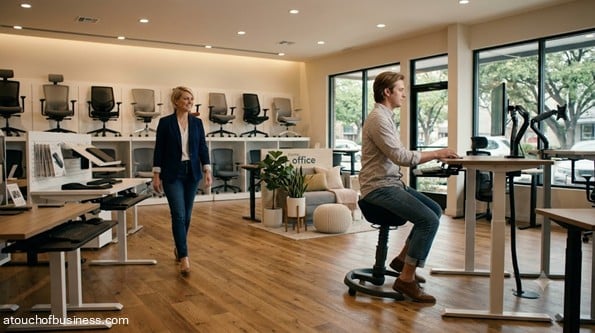
What to Expect From This Guide to Starting an Ergonomic Furniture Store
This guide walks readers through the key decisions and practical steps involved in opening an ergonomic furniture store, from choosing a showroom model and validating local demand to arranging suppliers, inventory systems, customer policies, staffing, and opening preparations.
Inside the guide, you will find:
- Startup roadmap: Work through business fit, retail model, market demand, planning, registration, funding, location, suppliers, showroom systems, staffing, and soft opening.
- Retail interviews: Gain perspective from founders and specialists discussing product selection, customer guidance, sourcing, logistics, service options, and competition with online sellers.
- Startup FAQs: Review answers about retail licenses, showroom models, wholesale accounts, product standards, freight damage, warranties, staffing, and financial mistakes.
- Market and model: Compare special-order and stocked-inventory approaches while assessing home-office buyers, business customers, local competitors, and demand for in-person testing.
- Financial planning: Consider startup costs, supplier minimums, gross margins, fixed expenses, break-even sales, funding sources, slow periods, returns, and damage exposure.
- Store operations: Plan zoning, occupancy approval, accessible showroom layout, receiving space, supplier terms, floor models, POS tracking, special orders, and written policies.
- Opening preparation: Check permits, inventory condition, payment processing, supplier accounts, insurance, product labels, warranty terms, staffing, and customer navigation before opening.
Continue with the full guide to test whether your market, showroom plan, supplier access, and operating budget form a workable retail concept.
Running an ergonomic furniture store means spending your days helping people find a chair that actually fits them or a desk that stops their neck from aching by 2 p.m.
As the owner, you meet customers one-on-one, guide them through adjustments, place special orders, receive large freight shipments, and manage a showroom that has to earn its rent every month.
This is specialty retail — not a side hustle and not a passive income stream. Before you follow any startup steps, take an honest look at whether this business is the right fit for you.
Do you enjoy helping people compare products and explaining technical tradeoffs? Can you stay calm when a chair arrives damaged and a customer is waiting?
Can your household manage the income gap that almost always comes before a new retail store finds its footing?
Startup costs for a physical showroom are real and front-loaded. You’ll spend on a lease deposit, build-out, floor model inventory, supplier account minimums, insurance, and operating capital — before your first sale.
Think carefully about your access to capital. Running out of operating funds is one of the primary reasons new retail stores close, especially in the slow months before word spreads.
You’ll also want support from the people you live with. Retail hours, irregular income, and the stress of a startup affect everyone in the household, not just you.
One of the most useful things you can do before committing is talk to people who already run specialty retail stores — ergonomic dealers in other cities, office furniture showroom owners in non-competing markets.
Prepare specific questions before those conversations. Ask about vendor headaches, slow-season cash flow, and what they wish they’d known before signing their first lease.
Each owner’s path is different, but firsthand experience cuts through a lot of guesswork.
It’s also worth thinking about whether to start from scratch or buy an existing business. Franchise options in ergonomic specialty retail are limited, so verify what’s realistically available in your market before assuming that path exists.
Red Flags Before You Start
Some of these warning signs mean pause and research further. Others mean reconsider the model. A few may mean this isn’t the right business for your market.
Watch for these before you commit:
- No visible local demand. If your local population buys everything online and no one is looking for an in-person test experience, foot traffic will be hard to generate. Validate before you sign a lease.
- Strong online and big-box competition. Amazon, Wayfair, and direct-to-consumer ergonomic brands compete aggressively on price and selection. Your advantage is the in-person test — but only if customers in your market are willing to pay for that experience.
- Insufficient capital. Furniture retail requires significant upfront spending before any revenue arrives. If your funding is uncertain, address that before committing to a lease or supplier minimum orders.
- Supplier access problems. Some premium ergonomic brands sell only through authorized dealer networks. Verify which accounts you can actually open — and at what minimum order — before building your product plan around a specific brand.
- Thin net margins after fixed costs. Gross margins on ergonomic furniture can be strong, but net profit after rent, insurance, staffing, and operating costs is structurally tight in furniture retail. Calculate your break-even volume before you sign anything.
- Return and damage exposure. A chair returned after use loses significant value and often can’t be restocked at the original margin. Freight damage on large furniture boxes is common. Both erode profitability if you haven’t negotiated clear supplier terms and written firm policies.
- Long-term lease before your market is proven. Signing a multi-year lease before you’ve validated local demand is one of the highest-risk moves in retail. Push for a short initial term or a flexible renewal structure.
- Market concentration at the top. A small number of dominant manufacturers control a large share of the premium ergonomic furniture market. Independent retailers have less supplier leverage than large chains. This is a structural industry reality — not a reason to walk away, but it affects your pricing, supplier terms, and margin.
Step 1: Do a Fit and Motivation Check
Before spending on anything, assess whether this business genuinely fits your personality and skills.
Are you comfortable having long one-on-one conversations with customers about posture, pain, and product adjustments? Can you handle the operational side — vendor lead times, damaged shipments, and complicated returns?
Ask yourself why you want to own this business. Are you drawn to solving a real problem for people, or are you looking for an escape from something else?
The answer matters, because retail problems show up on real days, not ideal ones.
Talk to owners of specialty retail stores in non-competing markets. People who run ergonomic dealerships in other cities, or who manage office furniture showrooms far from your location, can offer honest perspective.
Prepare your questions before those conversations. Ask about the worst months, the supplier relationships that burned them, and how long it took to build a reliable customer base.
Step 2: Decide on Your Business Model
The model you choose affects almost everything downstream — your inventory investment, your space needs, your supplier minimums, and what customers experience when they walk in.
The two most common models for ergonomic furniture stores are:
- Showroom with special orders. You display floor models that customers test in person, then order the specific product, color, or configuration directly from the supplier. This limits your inventory investment and reduces the risk of slow-moving stock.
- Showroom plus carry-in-stock inventory. You stock some items for immediate sale alongside floor models. This model gives customers same-day or next-day access to popular items but ties up capital in inventory that may sit before it sells.
Also decide early whether you’ll pursue B2B customers — small and large office managers, corporate procurement contacts — in addition to home office consumers.
Corporate buyers often purchase in volume, but they expect competitive pricing, delivery capacity, and a supplier-style relationship.
Set your model before you negotiate a lease, open supplier accounts, or plan your inventory. Every downstream decision follows from this one.
Step 3: Validate Local Demand
Your showroom only works if enough people in your market are willing to come in and pay for an in-person experience they can’t get online.
Map out the competition: independent ergonomic dealers, national office furniture chains, big-box retailers, and online sellers shipping into your area. Your job is to find the gap — not just the presence of competitors.
Maybe no one in your market has floor models customers can actually sit in. Maybe nobody explains chair adjustments or offers local delivery and assembly. Those gaps tell you where you can compete.
Your most likely first customers will be:
- Home office workers and remote employees who want to try before they buy
- Small business office managers equipping a team of two to 10 people
- Corporate procurement contacts who need volume pricing and documented product specs
Home office buyers often care as much about personal fit as price — they’re spending on something they’ll use every workday.
Corporate buyers care about spec documentation, warranty terms, and whether you can coordinate a multi-unit delivery.
Knowing which customer type your location can realistically attract first shapes everything from your product mix to your lease size. Read up on local supply and demand before committing to a location.
Business Plan
A written plan forces you to confront the numbers before you spend them.
Document your business model, your product mix, your target customer types, and your competitive position. Then list every startup cost category and every recurring operating cost.
The profit logic in ergonomic furniture retail requires close attention. Gross margins on individual products can be substantial — but net profit after rent, payroll, insurance, utilities, and operating costs is structurally tight in furniture retail.
Work through your break-even calculation with your own numbers. How many chairs and desks do you need to sell each month at your expected gross margin to cover all fixed costs?
Is that number realistic for your market and your location? If it isn’t, revisit your model — smaller space, leaner inventory, or a different customer mix — before signing a lease.
Plan for slow months. Furniture purchases are high-consideration decisions. Customers don’t always buy on the first visit, and there will be stretches where sales are thin.
Your plan should address:
- Startup cost categories: lease deposit, build-out, floor model inventory, supplier minimums, POS system, signage, insurance, and working capital reserve
- Operating cost categories: monthly rent, utilities, insurance, staffing, supplier replenishment, and loan payments if applicable
- Funding sources: personal savings, SBA loans, equipment financing, and supplier trade credit
- Break-even sales volume and what happens during slow periods
- Whether you can cover personal living expenses while the store ramps up
Use a guide on how to write a business plan to make sure your plan covers all the bases before you commit.
Step 4: Choose a Legal Structure and Register the Business
Most ergonomic furniture store owners form a limited liability company (LLC) for the liability protection it provides.
Register your entity with your state’s secretary of state or equivalent office. If you’re operating under a trade name that differs from your legal entity name, file a DBA (doing business as) registration as well.
Apply for an Employer Identification Number (EIN) from the IRS early in the process. You’ll need it for your business bank account, tax accounts, and payroll if you hire anyone. The application is free at irs.gov.
See how to choose a business structure if you’re weighing your options.
Step 5: Register for Sales Tax Before Your First Sale
Most states require retail sellers of tangible goods to register with the state department of revenue and collect sales tax from customers.
Do this before you open, not after. Setting up sales tax collection after you’ve already made sales creates a compliance mess that’s hard to unwind.
Some states exempt certain business-to-business purchases. Verify your state’s specific rules with the department of revenue before finalizing your pricing structure.
Step 6: Confirm Funding Before Signing a Lease
A physical showroom requires significant capital before a single sale happens. Lease deposits, build-out, floor model inventory, insurance, and operating reserve all land before revenue begins.
Identify your funding sources before you commit to a space or place supplier orders.
Common funding options include:
- Personal savings
- Small Business Administration (SBA) loan programs
- Small business bank loans or lines of credit
- Equipment financing for your POS system or delivery vehicle
- Supplier trade credit, if available (net-30 or net-60 terms from some wholesale accounts)
Most lenders want a business plan, personal financial history, credit review, and collateral documentation. Have those ready before you apply.
Step 7: Find and Lease a Retail Location
Location determines who walks through the door — and whether enough people will walk through to cover your rent.
Before you sign anything, verify these points:
- Zoning. Confirm the address is approved for customer-facing retail. Contact the local planning or zoning department before you invest time in lease negotiations.
- Certificate of occupancy. Many jurisdictions require a certificate of occupancy before you open to the public. If the prior tenant had a different use, or if you’re doing renovations, a new inspection is typically required.
- ADA accessibility. Retail spaces open to the public must meet Americans with Disabilities Act (ADA) requirements — accessible parking, doorways at least 32 inches wide, aisles at least 36 inches wide, and service counters no higher than 36 inches.
- Delivery access. Ergonomic furniture arrives in large cartons on pallets. You need a receiving area with wide access for hand trucks and dollies — ideally a loading dock or at minimum a ground-level freight entrance.
Your showroom also needs enough square footage to set up functional demo zones. Customers who can’t sit in a chair and raise a desk before buying have no reason to choose you over an online seller.
Have a lawyer review the lease before you sign. Retail lease terms — rent escalations, build-out responsibilities, and exit clauses — significantly affect your financial risk.
Step 8: Apply for Local Licenses and Permits
Most cities and counties require a general business license to operate within their jurisdiction. Contact your city or county business licensing office to confirm what’s required at your address.
If you’re installing exterior signage — which customers will notice before they ever walk in — you’ll likely need a sign permit. Some jurisdictions have strict rules about size, lighting, or design, especially in regulated commercial zones or historic districts.
Allow extra time for sign permit processing. Installation delays can push back your opening date if you haven’t planned for them. Learn more about business signage options and requirements.
Step 9: Establish Supplier Relationships
Your product selection is what customers evaluate the moment they walk in. Strong supplier relationships keep that selection credible, available, and competitively priced.
Most wholesale suppliers require a business license or tax ID to open a trade account. Apply directly with manufacturers and distributors, and provide your registration documents.
When evaluating suppliers, compare these terms in writing before committing:
- Minimum order quantities
- Lead times for special-order fulfillment
- Freight responsibility — who pays when a shipment arrives damaged
- Return and warranty claim procedures
- Whether the supplier drop-ships to your customers or requires you to receive and re-ship
Look for products that meet ANSI/BIFMA standards. ANSI/BIFMA is a set of voluntary performance benchmarks developed by the Business and Institutional Furniture Manufacturers Association, covering structural integrity, durability, and stability for chairs, desks, and related products.
Stocking ANSI/BIFMA-tested products matters to corporate buyers, who often require documented quality standards before approving a purchase.
It also reduces your exposure if a product fails under normal use.
Build relationships with at least two suppliers per major product category. Single-supplier dependence creates real risk when lead times slip or a product line is discontinued.
Step 10: Plan and Set Up the Showroom
Your showroom is your primary sales tool. Customers who walk in need to test products, compare options, and understand the differences — without being overwhelmed.
What customers will notice first:
- Whether they can actually sit in the chairs and adjust them
- Whether the desk height range is demonstrated live
- How clearly products are labeled and priced
- Whether the aisles are easy to navigate with room to move around each piece
- Whether the space looks like an expert curated it — or like a warehouse
Choose floor models that function as decision drivers — a well-adjusted ergonomic chair at a range of settings, a sit-stand desk at multiple heights, and a monitor arm showing both a seated and standing position.
Keep the selection intentional. A showroom with too many options and no clear differentiation slows customer decisions and dilutes your expertise.
Plan a back-of-house receiving area separate from the customer floor. Incoming shipments — large cartons, often on pallets — need space for unboxing, damage inspection, and staging.
Step 11: Set Up Inventory and Point-of-Sale Systems
A point-of-sale (POS) system is essential before your first transaction. It should track inventory by SKU, process payments, manage special orders, and keep customer records.
Set up receiving protocols from day one. Every inbound shipment should be inspected before you sign the delivery receipt.
Document damage immediately with photos. Most suppliers require freight damage claims within a very short window — sometimes 24 to 72 hours. A missed deadline means you absorb the loss.
Also set up a special-order tracking system. When a customer orders a specific chair configuration that isn’t on the floor, you need a reliable way to track that order’s status and communicate delivery timing.
Step 12: Set Pricing and Write Your Return and Warranty Policy
Pricing for ergonomic furniture retail starts with your product cost and the margin you need to cover fixed expenses. Research manufacturer suggested retail pricing across your product lines and compare what comparable specialty retailers charge.
Accessories — monitor arms, anti-fatigue mats, keyboard trays, and footrests — often carry stronger gross margins relative to large furniture pieces. Build your accessory selection with that in mind.
Write a return and warranty policy before opening day. Your policy must match what your suppliers will actually honor. If you promise customers easy returns on chairs and your supplier won’t accept them back after 30 days, you absorb that loss.
Post the policy visibly in the store and include it on all customer receipts and special-order agreements.
If you offer written warranties on the products you sell, the federal Magnuson-Moss Warranty Act governs how those warranties must be presented. Written warranties must clearly disclose their terms in plain language and be designated as either “full” or “limited.”
Review the Federal Trade Commission’s guidance at ftc.gov before finalizing any warranty language.
Pricing also involves thinking about how to price your products and services in a way that covers costs and reflects the value of your in-person expertise.
Step 13: Get Business Insurance Before Opening
Your commercial landlord will almost certainly require proof of general liability insurance before you move in.
Common coverage for an ergonomic furniture store includes:
- General liability. Covers third-party bodily injury and property damage claims — for example, a customer who trips on a floor model display.
- Commercial property. Covers your showroom contents, inventory, fixtures, and equipment against fire, theft, and covered damage.
- Product liability. Covers claims arising from products you sell — including claims about products the manufacturer made but you sold. Even if you didn’t manufacture the item, you can be named in a product defect claim.
- Business Owner’s Policy (BOP). Bundles general liability and property coverage at a lower combined cost than buying each separately.
- Workers’ compensation. Required in most states once you hire employees. Verify your state’s threshold before your first hire.
- Commercial auto. Required if you operate a store-owned delivery vehicle.
Learn more about what to look for in business insurance for retail operations.
Step 14: Set Up Business Banking and Payment Processing
Open a dedicated business checking account before your first sale. Keep business finances completely separate from personal ones from the start.
Set up payment processing through your POS system. Confirm it accepts major credit and debit cards.
Consider whether to offer third-party consumer financing for larger purchases. Ergonomic chairs and sit-stand desks are high-ticket items. Some customers hesitate at the full price but will purchase readily when a monthly payment option is available.
Step 15: Hire and Train Staff if Needed
A small showroom with a special-order model can be run solo, especially at first. But there are real physical demands — receiving large cartons, moving floor models, setting up displays — that add up quickly.
If you plan to carry immediate-delivery inventory or offer delivery and assembly services, you’ll almost certainly need help before or shortly after opening.
Anyone working in the store needs to understand how to demonstrate product adjustments, explain the differences between chair models, and handle inbound shipments carefully. A staff member who can’t demonstrate a product is a lost sale.
If you’re hiring, set up payroll, register for your state’s employer accounts, and confirm your workers’ compensation coverage is active before anyone starts work.
Review guidance on when and how to hire if this is your first time bringing on employees.
Step 16: Complete Your Pre-Opening Checklist and Soft Open
Before you open the doors to the public, confirm every operational element is in place.
Work through these before opening day:
- All permits, business licenses, and certificate of occupancy confirmed and in hand
- Every floor model received, inspected, and tested for full function
- Showroom laid out with clear demo zones and ADA-compliant aisles
- Price tags and product specifications posted on all floor models
- POS system and payment processing tested and working
- Inventory and special-order tracking systems active
- All supplier accounts open and first orders confirmed
- Supplier return and damage-claim procedures documented
- Return and warranty policy posted in the store and included in receipt templates
- Special-order customer agreement ready for use
- Business bank account open; business and personal finances separated
- All required labor law posters displayed if you have employees
- Business phone, email, and basic online listing live with store hours and address
Run a soft opening with a small invited group before your public launch. Use it to test your demo flow, catch operational gaps, and answer the customer questions you didn’t anticipate.
Opening-Day Red Flags
These are the issues that show up in the final days before opening — and that can quietly hurt the first impression customers form.
- Floor models that don’t function properly. If a customer tries a sit-stand desk and the mechanism sticks, or a chair’s lumbar adjustment is broken, that’s the experience they walk out with. Test every model fully before opening.
- No certificate of occupancy in hand. Operating without one — even briefly — creates legal exposure. Confirm this is resolved before unlocking the door.
- Payment processing not tested. Run test transactions before customers arrive.
- Freight damage from the first shipment not documented. If you received opening inventory and signed off on delivery without inspecting it, you may have already waived your right to file a damage claim. Set a receiving protocol before the first box arrives.
- Supplier accounts not active yet. If a customer walks in and wants to place a special order but your trade account isn’t open, you can’t take the order. Confirm account status before opening day.
- Return and warranty policy not posted. Customers who buy ergonomic furniture — especially chairs — often come back with questions or fit concerns. If your policy isn’t visible, disputes become harder to resolve cleanly.
- No general liability insurance in place. Most commercial leases require it before occupancy. Don’t open without it.
- Aisles too narrow for easy customer navigation. Walk the space before opening. Crowded displays that block movement undermine the in-store experience customers came for.
Frequently Asked Questions
Do I need a special license to sell ergonomic furniture in a retail store?
No specialized furniture sales license is required at the federal level. You’ll need standard retail setup: a general business license from your city or county, state business registration, sales tax registration with your state’s department of revenue, and a certificate of occupancy for your retail space.
Some states have additional requirements for furniture retailers. Verify with your state’s consumer protection or business licensing agency before opening.
What’s the most realistic business model for a new ergonomic furniture store?
The most practical entry model is a showroom with limited in-store inventory combined with a strong special-order system. You display carefully chosen floor models for in-person testing, then order the specific product from the supplier when a customer buys.
This approach reduces your upfront inventory capital while still giving customers the testing experience they came for. Add immediate-delivery stock only after you know which items actually move in your market.
How do I open wholesale accounts with ergonomic furniture manufacturers?
Most suppliers require a valid business license or tax ID before opening a trade account. Contact manufacturers and distributors directly, submit a dealer application, and provide your business registration documents.
Some premium brands maintain authorized dealer networks with specific requirements. Verify access before building your product plan around a brand you may not be able to carry.
What does ANSI/BIFMA compliance mean, and does it matter for a retail store?
ANSI/BIFMA compliance means a product has been tested against voluntary safety and performance standards developed by the Business and Institutional Furniture Manufacturers Association. These tests cover structural integrity, durability, and stability under commercial-grade use.
BIFMA standards aren’t a government mandate, but they matter significantly to corporate buyers who require documented quality standards for procurement approvals. Stocking ANSI/BIFMA-tested products also reduces your exposure if a product fails under normal use.
How do I handle freight damage on incoming furniture shipments?
Inspect every shipment at the point of receipt before signing the delivery paperwork. Document any visible damage with photographs and note it on the delivery receipt immediately.
Supplier damage-claim windows vary — some require claims within 24 to 72 hours of delivery. Get your supplier’s freight damage and return procedures in writing before you place your first order.
Am I required to provide written warranties to customers?
You’re not legally required to offer a warranty. But if you do offer a written warranty — including when you pass through a manufacturer’s warranty — the federal Magnuson-Moss Warranty Act applies.
The Act requires warranties to be written in clear language, fully disclose their terms and conditions, and be designated as either “full” or “limited.” Review the FTC’s guidance at ftc.gov before finalizing any warranty language you give customers.
Can I run this business alone without employees?
Yes, a small showroom with a special-order model can be run solo, at least at first. Managing inbound freight — heavy cartons, often on pallets — is the most physically demanding solo task and may require outside help on receiving days.
If you add immediate-delivery inventory, regular delivery service, or volume B2B accounts, you’ll likely need at least one additional person fairly quickly.
What are the biggest financial mistakes new ergonomic furniture store owners make?
Three come up most often. The first is buying too much inventory before knowing which products your specific market actually wants. The second is underestimating operating capital needs during the slow months before the store builds a reputation.
The third is setting a return and warranty policy that’s more generous than what your suppliers will back — leaving you absorbing losses on returned or damaged goods. Build clear supplier terms into every policy decision before opening day.
Advice From Ergonomic Furniture Founders and Retailers
These interviews share practical lessons from ergonomic furniture founders, retailers, and office furniture specialists. They discuss product selection, customer service, sourcing, logistics, retail expansion, and competing with large online sellers.
Use their experiences to evaluate your product range, sales model, supplier relationships, and service options before starting an ergonomic furniture store.
Podcast Interview With Terry Cassaday of ergoCentric
Terry Cassaday discusses building an ergonomic chair company and expanding the business through additional retail storefronts.
The interview offers useful perspective on moving into physical retail and presenting specialized ergonomic products to customers.
Why Back in Action Is Sitting Pretty
Lucinda Newbound explains how her family’s ergonomic furniture retailer uses knowledgeable staff, customer consultations, and carefully selected products.
Her advice shows how a smaller store can compete through expertise, personalized recommendations, and a clear specialty.
How to Start a Furniture Company From Scratch With Greg Hayes
Branch co-founder Greg Hayes discusses developing an initial office furniture range and serving individual customers and large organizations.
His experience can help a new retailer choose a focused starting inventory and identify promising residential and commercial customer groups.
Jason McCann, Co-Founder and CEO of Vari
Jason McCann shares the challenges behind his first company and the development of the VariDesk into a broader workplace furniture brand.
The discussion demonstrates the value of solving a specific customer problem before expanding into a larger product collection.
Interview With Autonomous Founder Duy Huynh
Duy Huynh explains how Autonomous changed its original product strategy and developed its SmartDesk and ErgoChair furniture lines.
His experience is useful for understanding customer-focused design, product-market fit, business pivots, and supply-chain control.
Meet the Owners of Business Office Outfitters
Kelly and Jerry Sinclair discuss selling new, used, and refurbished office furniture through retail, e-commerce, and commercial contracts.
The interview provides ideas for combining furniture sales with space planning, design, delivery, installation, and personalized service.
Related Articles
- How To Start a Retail Furniture Store
- How To Start a Furniture Restoration Business
- How To Start a Children’s Furniture Store
- How To Start an Outdoor Furniture Store
- How To Start an Interior Design Business
- How To Start a Home Decor Business
Sources:
- IRS: Apply for an EIN Online
- FTC: Businessperson’s Guide, Warranty Law, Magnuson-Moss Warranty Act
- U.S. House (USC): 15 USC Ch. 50 Consumer Warranties
- eCFR: 16 CFR Part 700, Warranty Interpretations
- ADA.gov: ADA Guide for Small Businesses
- AccessibilityChecker: ADA Requirements for Retail Stores
- UpCounsel: Retail Store Legal Requirements
- NRS Plus: Retail Store Licensing Step-by-Step
- Wexford Insurance: Furniture Business License Guide
- BIFMA: ANSI/BIFMA Standards Overview, BIFMA Compliant Program
- WeberKnapp: What Is ANSI/BIFMA Compliance, Finding an Ergonomic Furniture Supplier
- Eureka Ergonomic: BIFMA Certification Explained
- Bevco: ANSI/BIFMA Certification for Chairs
- Insureon: Furniture Store Insurance Coverage
- The Hartford: Furniture Store Insurance Overview
- TechInsurance: Furniture Store Insurance Policies
- Global Furniture USA: Choosing a Wholesale Furniture Supplier
- Artisan Furniture USA: Wholesale Furniture for Retailers
- Artisan Furniture USA: Wholesale Furniture Suppliers USA
- iEnhance: Furniture Profit Margin Strategies
- BusinessDojo: Furniture Shop Profitability Analysis
- Grand View Research: U.S. Office Furniture Market Report
- STORIS: Furniture Retailer Inventory Guide
- Cross-Check: Independent Furniture Retailer Strategies
- RetailTouchPoints: Amazon and Online Furniture Sales
- LivePlan / Bplans: Ergonomic Office Furniture Business Plan
- Alexandria POS: How to Start a Furniture Store