
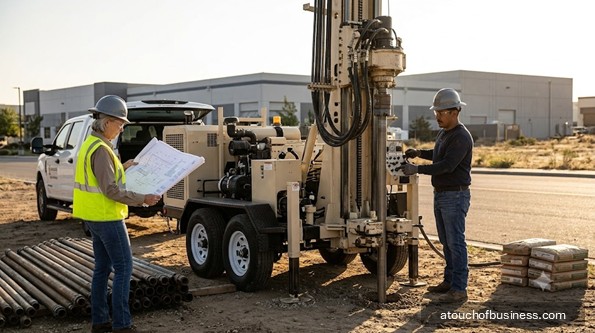
What to Expect From This Guide to Starting a Geothermal Drilling Business
This guide walks through the key decisions and practical steps involved in starting a geothermal drilling business. The highlights below show selected areas covered within its detailed planning, setup, and opening guidance.
Inside the guide, you will find:
- Startup steps: Follow an ordered path from evaluating the business through licensing, equipment, staffing, systems, and opening preparation.
- Industry interviews: Learn from drilling professionals discussing equipment, training, staffing, financing, project logistics, and market decisions.
- Startup FAQs: Review practical answers about experience, licenses, service models, compliance, geology, pricing, and buying an existing company.
- Business fit: Consider the physical demands, technical experience, household impact, income uncertainty, and capital commitment involved.
- Demand and finances: Examine local contractor demand, geology, funding, project volume, pricing, fixed costs, reserves, and profit logic.
- Equipment and requirements: Explore drilling rigs, support equipment, insurance, credentials, environmental rules, safety programs, suppliers, and documentation.
- Risks and preparation: Identify warning signs, costly mistakes, liability concerns, and checks to complete before the first project.
Begin with an honest look at whether the demands, experience requirements, and financial commitment fit your situation.
As a geothermal drilling contractor, you bore vertical or horizontal boreholes into the earth for ground-source heat pump systems, install high-density polyethylene loop pipe, and grout each borehole to seal it and enhance heat transfer between the pipe and the surrounding ground.
You mobilize a drill rig to each project site, complete the bore field, and demobilize — then move on to the next job.
There is no storefront, no walk-in traffic, and no recurring service revenue from systems you’ve already installed.
That last point deserves real attention before you go any further. Geothermal drilling is largely a set-it-and-forget-it service for the customer. You drill the holes, install the loops, and walk away. New project contracts are the only thing that keeps revenue flowing.
The startup path for this business is unusually demanding — technically, financially, and physically. Before you get into the steps, take an honest look at whether this business genuinely fits where you are right now.
Is This Business Right for You?
Geothermal drilling is outdoor, heavy-equipment work in all weather and at all kinds of job sites.
You and your crew spend long days operating and maintaining large drill rigs, handling grout and drilling fluid, and managing the logistics of moving a rig from site to site.
Do you have hands-on drilling experience — in water wells, oil and gas, geotechnical work, or a related underground trade?
If the answer is no, that matters more here than in almost any other construction business.
Most states require the owner or a full-time qualifying party to hold a well driller license. That license typically demands documented experience of one to two years working under a licensed driller before you can even sit for the exam.
Operating a drill rig or mastering butt-fusion welding — the process that makes loop pipe leak-proof — takes years of seat time. Owners who plan to manage the business without understanding the craft take on serious liability and serious financial risk.
Think carefully about the financial side too. This business requires substantial capital for a drilling rig, compressor, support truck, trailer, grouting system, insurance, and operating reserve — all before you complete your first project.
Can your household manage an income gap during the startup period?
Does your family understand that the first months may involve high fixed costs and an unpredictable project pipeline?
Business ownership carries real pressure, and geothermal drilling carries more of it than most trades.
Talk honestly with the people who depend on your income before you commit to equipment financing or licensing costs.
It also helps to talk with people who run geothermal drilling operations and water well companies in other markets — not in your future service area, where they’d see you as competition, but in different regions where they can speak freely.
Ask about rig maintenance burdens, slow seasons, difficult geology, crew recruiting, and how long it took to build a steady project pipeline.
You can read more about what experienced business owners say about ownership to get a realistic picture before you decide.
Red Flags Before You Start
Some of these warning signs mean you should pause. Others mean you should stop and reconsider entirely.
You don’t have drilling experience and no licensed driller to partner with.
If you can’t personally operate a drill rig and haven’t identified an experienced licensed driller willing to serve as a full-time qualifying party, the business can’t legally or practically operate. This is a stop condition. Licensing can take two years or more to resolve.
Your local market is thin or already covered.
If few HVAC contractors in your area are actively selling ground-source heat pump systems, the subcontract pipeline will be too thin to support rig overhead.
If established drillers have already locked in those relationships, breaking in as a newcomer will take much longer than your capital reserve may allow.
Your capital is short.
Launching without enough capital to cover equipment, insurance, and an operating reserve is one of the most common ways drilling businesses fail.
Rig breakdowns happen, projects get delayed, and payments come in cycles. Verify that you have adequate funding — including reserves — before committing to equipment.
Your local geology requires equipment you can’t afford.
Hard rock markets — granite, basalt, volcanic formations — require heavy-duty rigs with large-capacity compressors that cost considerably more than rigs suited to soft-sediment areas.
Research your area’s subsurface conditions before buying any equipment. Purchasing the wrong rig for local geology is an expensive mistake that’s hard to recover from.
You’re planning to focus mostly on residential homeowners.
The federal residential geothermal tax credit has expired. Residential demand is expected to soften as a result.
The commercial and institutional market — schools, municipal buildings, commercial properties — retains federal tax incentives and represents a more stable near-term project pipeline for new drillers. Factor this into your customer strategy from day one.
The workforce gap is real.
Finding experienced drilling crew members is genuinely difficult in most markets. The skilled geothermal driller shortage is an industry-wide structural issue, not a local quirk.
You can’t run a rig alone. If you can’t identify at least one qualified crew member to hire or train, delay your launch timeline accordingly.
Groundwater liability exposure is significant.
Underground loop failures are among the most expensive claims geothermal contractors face. A grouting failure or pipe leak can result in groundwater contamination with remediation costs reaching hundreds of thousands of dollars.
You must have the right insurance and the technical knowledge to grout correctly before you drill a single borehole for a paying customer.
Step 1: Assess Your Fit and Commit Honestly
Before you research equipment or look at licensing requirements, get clear on whether this business is right for you at this point in your life.
Geothermal drilling is not a business you can grow into gradually with low startup costs. The capital commitment, licensing barriers, and physical demands all arrive before the first project check does.
Ask yourself these questions honestly:
- Do you have documented, hands-on drilling experience in a related trade?
- Can you tolerate income uncertainty while building a project pipeline?
- Is your household financially able to handle a slow first year?
- Do you have access to the capital this business requires — not just to open, but to stay open?
- Are you physically suited to outdoor, heavy-equipment work year-round?
If you answered no to several of those, it may mean the timing isn’t right yet — not that the business is wrong for you permanently.
Talk to geothermal drilling contractors and water well operators in non-competing markets. Prepare specific questions before those conversations: How did you finance your first rig? How long until your project pipeline was steady? What do you wish you had known before you started?
Firsthand insight from working drillers is worth more than anything you’ll read online. Every driller’s path is different, but patterns emerge when you talk to enough of them.
You can also read more about what business owners consider the hardest part of ownership before you commit.
Step 2: Choose Your Business Model Before Everything Else
Geothermal drilling contractors generally operate in one of two ways, and the choice affects your licensing requirements, equipment list, startup costs, and how you find customers.
The two main paths are:
- Drilling-only subcontractor: You bore the boreholes, install the loop pipe, and grout. An HVAC contractor handles the heat pump connection. This is the simpler entry path, requires less licensing in most states, and taps directly into HVAC contractor demand for drilling partners.
- Full-service installer: You handle the complete ground loop from drilling through manifolding and connecting to the heat pump. This typically requires both a well driller license and a state mechanical or HVAC contractor license — and adds pipe fusion equipment to your startup costs.
The drilling-only subcontract model is worth serious consideration for a startup. HVAC contractors who sell geothermal systems frequently struggle to find a reliable drilling partner, and that gap is a real business opportunity.
You’ll also need to decide whether to focus primarily on residential properties, commercial buildings, or institutional clients like schools and municipal facilities. Each segment has a different project size, a different sales cycle, and different permit complexity.
Make your model decisions before you price equipment or explore licensing — those choices drive everything downstream.
Step 3: Validate Local Demand Before Committing to Equipment
Don’t buy a rig before you know there’s a market for it in your area.
The most direct demand signal is the local HVAC contractor market. Are geothermal HVAC contractors in your region actively installing ground-source systems? Are they looking for a reliable drilling subcontractor?
Check the International Ground Source Heat Pump Association (IGSHPA) contractor directory for active geothermal installers in your service area. Search the National Ground Water Association (NGWA) member list for existing drilling contractors. Understanding who’s already in the market helps you find gaps rather than run into direct competition.
Review public well permit records at your state environmental agency. That data shows where drilling activity is concentrated and can reveal whether the market is active or sparse.
Geology matters as much as market demand. Research your area’s subsurface conditions using your state geological survey.
Soft sediment areas support a wider range of rig types and generally lower per-foot drilling costs. Hard rock areas require more capable — and more expensive — equipment.
If the local market is primarily scattered residential projects with no clear commercial or institutional pipeline, think carefully about whether project volume can support your fixed costs before you sign an equipment loan.
Read more about evaluating local supply and demand before you move forward.
Step 4: Get Licensed and Credentialed — Before You Drill Anything
Licensing for geothermal drilling is one of the most complex credential landscapes in the construction trades. Get this right before you mobilize a rig or sign a project contract.
More than 38 states require contractors to hold a state-issued well driller license — separate from a general contractor license. In many states, the qualifying party named on that license must be a full-time operator, not just a name on file.
Some states have a dedicated geothermal or heat exchange drilling license category. Others fold geothermal borehole work under the standard water well driller license.
Verify the exact requirement with your state’s water resources board or environmental agency before you assume anything.
If you’re offering full-service installation that connects the ground loop to the heat pump, a separate mechanical or HVAC contractor license is typically required in addition to the well driller license.
Two industry credentials are widely expected and in some states required:
- IGSHPA Vertical Loop Installer (Driller) accreditation: Specific to borehole drilling; recognized by state licensing boards in some jurisdictions and expected by HVAC contractor clients in most markets.
- NGWA Certified Vertical Closed Loop Driller (CVCLD): Requires two years of documented experience constructing loop wells or water supply wells plus a written exam. Study materials are published by NGWA.
For full-service scope, the IGSHPA Accredited Installer credential covers heat pump system design and ground-loop installation per ANSI/IGSHPA standards.
If you don’t yet have the required documented experience to qualify for state licensure, your realistic options are: work as an employed driller to accumulate hours first, bring on a licensed qualifying party as a key hire, or acquire an existing licensed drilling company.
Operating without the required license results in stop-work orders and fines. Don’t skip ahead on this step.
You can learn more about business licenses and permits as a general starting point.
Step 5: Consider Whether to Start from Scratch or Buy an Existing Company
This decision is worth taking seriously before you spend anything on equipment or licensing.
Buying an existing water well or geothermal drilling company can provide a drilling rig, an active state driller license, trained crew, and an established customer base — all at once.
For a business with this many entry barriers, that combination is genuinely valuable.
An acquisition target with existing water well permit activity may already have subcontract relationships with HVAC contractors in place, which shortens the time to steady revenue significantly.
Starting from scratch gives you full control of equipment selection and business model design. But it also means building credibility and a project pipeline from zero while carrying heavy fixed costs from day one.
Evaluate both options before committing to equipment financing. The best path depends on your capital, your timeline, your tolerance for risk, and what’s available to buy in your target market.
Read more about starting from scratch versus buying a business to think through the tradeoffs clearly.
Step 6: Form Your Legal Entity and Complete Business Registration
Given the environmental liability exposure and the value of your equipment, a sole proprietorship is rarely the right structure here.
Geothermal drilling carries real groundwater contamination risk. A grouting failure or pipe leak can trigger claims that dwarf the cost of any single project.
Protecting your personal assets through an LLC or corporation is a practical necessity, not just a technicality.
Register your entity with the state secretary of state or equivalent office. Apply for a federal Employer Identification Number (EIN) through the IRS — you’ll need it before hiring employees and before opening a business bank account.
If you plan to operate under a trade name different from your legal entity name, register a DBA with the appropriate state or county office.
Set up required state tax accounts: sales and use tax registration (verify whether drilling services are taxable in your state), employer withholding, and any applicable state income tax accounts.
Explore your business structure options before you file, and consider consulting an attorney who works with construction contractors.
Step 7: Secure Funding and Banking Before Any Equipment Commitment
Open a dedicated business checking account before you accept any deposits or project payments.
Keeping business and personal finances separate from the start protects you legally and makes bookkeeping far simpler.
The capital requirements for this business are substantial. Equipment financing through drilling equipment manufacturers, SBA loans, equipment leasing, commercial bank loans, and private investors are all realistic options.
Equipment lenders may require proof of licensed status before approving drilling rig financing. That’s one more reason to complete the licensing step before you shop for equipment.
Operating capital planning is critical. Drilling projects often have a gap between contract award and first mobilization. Larger commercial projects may pay on milestone billing rather than upfront.
You need enough reserve to cover payroll, fuel, insurance, and rig maintenance between payments.
If you plan to bid on public or municipal contracts, surety bonding is typically required. Verify bonding requirements with your state’s driller licensing board before you open.
Learn more about business loan options and how to open a business bank account.
Step 8: Research and Acquire the Right Equipment for Your Geology
The drilling rig is the single largest capital commitment of your startup — and it must match your local geology.
Soft sediment areas may allow lighter rotary rigs. Hard rock markets require air-rotary or dual-rotary rigs with high-capacity air compressors capable of handling granite or basalt. Rotary rigs are the workhorse of the industry and handle most residential and commercial applications in moderate geology.
Purchasing a rig that can’t handle your area’s geology is one of the costliest startup mistakes in this business.
Research your local subsurface conditions through your state geological survey before you evaluate any equipment. Then match the rig type and capacity to what you’ll actually encounter on the job.
Core equipment for a drilling-only subcontract operation includes:
- Drilling rig (air-rotary, mud-rotary, or dual-rotary based on geology)
- Air compressor for air-rotary applications
- Drill pipe, stabilizers, and a selection of drill bits matched to local formations
- Support truck and equipment trailer for rig transport
- Water tank or portable water supply system
- Grout pump, mixing system, and tremie pipe for borehole grouting
- HDPE U-bend loop pipe assemblies for each project
- Pressure-testing manifold and gauges
If you’re offering full-service installation, add a pipe fusion machine for butt-fusion welding of HDPE pipe and the manifold installation tools needed to connect the loop field.
New rigs carry premium pricing and often have long lead times. Used equipment is widely available but requires thorough mechanical inspection.
Budget for maintenance costs either way — rig downtime on a project-based business is expensive.
You’ll also need secured yard or shop space to store and maintain the rig between jobs. A commercial lease is a fixed monthly cost that runs regardless of project volume.
Verify whether your property can legally accommodate the equipment if you plan to operate from home.
Step 9: Get the Right Insurance in Place Before Any Site Work
The insurance requirements for geothermal drilling go well beyond what most contractor policies cover by default.
The groundwater contamination exposure alone makes this a specialized underwriting category. Standard general liability policies often contain pollution exclusions that leave drilling operations unprotected for exactly the risks that matter most.
The core insurance package for a geothermal drilling contractor includes:
- General liability — foundational coverage for bodily injury and property damage on job sites
- Contractors pollution liability — specifically covers groundwater or aquifer contamination from a compromised borehole or heat transfer fluid leak; this is essential and non-optional
- Inland marine / equipment floater — covers the drilling rig, grout pump, and related tools during transport and on-site operations
- Commercial auto — required for all trucks and trailers used to transport equipment between job sites
- Workers’ compensation — legally required in most states for any employees; drilling crew classifications carry elevated rates due to heavy equipment and outdoor hazards
- Professional liability (errors and omissions) — covers claims of design error or negligence; general liability does not cover faulty workmanship in a planning or design context
An umbrella or excess liability policy is also worth considering, given the potential scale of groundwater contamination claims.
Work with an insurance broker who specializes in water well drilling or geothermal contractor risks. Verify that your pollution liability policy explicitly covers heat transfer fluid leaks — not just standard environmental pollutants.
Learn more about business insurance options as a starting point.
Step 10: Complete Federal and State Environmental Compliance Setup
Geothermal drilling sits at the intersection of groundwater protection law and construction contractor licensing. You need to understand both layers before the first job.
At the federal level, the EPA administers the Safe Drinking Water Act’s Underground Injection Control (UIC) program. Open-loop return wells are classified as Class V injection wells requiring notification or permit.
Most states have been delegated authority to run their own UIC programs — check with your state environmental agency to understand which rules apply in your jurisdiction.
Closed-loop systems face minimal direct federal UIC requirements, but state grouting standards, drilling permits, and borehole construction rules still apply to every job.
Federal OSHA standards apply to all your drilling site activities. Key standards include 29 CFR 1926 Subpart P covering excavations and 29 CFR 1910.1200 covering hazard communication for drilling fluids, grout chemicals, and heat transfer fluids.
Build a written OSHA safety program before your first site mobilization.
Your program should address heavy equipment operation, struck-by hazards, hand tool safety, chemical handling, and site-specific excavation risks. Document all crew safety training before the first job.
Many states also require a completion report and drilling log to be filed with the state agency after each borehole, documenting formation type, depth, grouting method, and casing details.
Verify this requirement with your state environmental agency before you open.
Step 11: Set Up Suppliers, Pricing, and Project Intake Systems
Establish supplier accounts before projects begin — not while you’re already on a job site.
Priority supplier relationships to set up before opening:
- HDPE pipe distributor (establish credit terms)
- Thermally enhanced grout and bentonite supplier
- Drill bit and drilling consumables vendor
Identify at least two supply sources for critical materials. A single-supplier dependency for grout, pipe, or drill bits creates real project risk if a supplier has a shortage or delivery delay.
Pricing for drilling-only subcontract work is typically structured on a per-linear-foot basis for the borehole, with separate line items for mobilization, grouting materials and labor, HDPE loop materials, and permit fees passed through to the client.
Mobilization charges are standard in this industry. Transporting a drill rig to and from a site is a real cost — don’t leave it out of proposals.
For sites with uncertain geology, consider including a contingency clause in your contract that allows for additional charges if drilling encounters conditions significantly harder than the site assessment indicated.
Get that language reviewed by an attorney before you use it.
Full-service pricing adds pipe fusion, manifolding, header installation, and pressure testing to the per-project total.
Before you take on the first job, have standard project intake documents ready: client contract or subcontract agreement, site assessment checklist, drilling log templates, completion report forms, and lien waiver documentation.
Read more about pricing your services before you finalize your rate structure.
Step 12: Hire and Train Your Crew Before the First Project
A drill rig requires at least two people to operate — a licensed driller and at least one experienced helper or apprentice. You cannot safely run a site alone.
The geothermal drilling industry faces a genuine shortage of qualified crew members. Don’t assume you can hire an experienced driller quickly.
If you’re recruiting from water well, oil and gas, or geotechnical drilling backgrounds, build hiring and onboarding lead time into your launch timeline.
If you’re offering loop installation in addition to drilling, at least one crew member needs demonstrated competency in HDPE butt-fusion welding. Pipe fusion is a skilled process — poor technique produces joins that fail under pressure.
Before any crew member’s first day on site:
- Complete all employment paperwork: IRS W-4, I-9 employment eligibility, state withholding forms
- Enroll all employees in workers’ compensation coverage
- Conduct and document a site safety orientation covering OSHA hazard communication requirements
- Document any additional skills training, including pipe fusion certification if applicable
A single grouting error can result in a groundwater contamination claim. Invest in a well-trained crew from the start — before you drill your first paid borehole.
You can read more about hiring for your business as you build out your team.
Step 13: Complete Pre-Opening Readiness Before the First Mobilization
Before your rig leaves the yard for the first paying project, every system needs to be confirmed and in place.
Licensing and credentials:
- State well driller license active and posted as required
- IGSHPA Vertical Loop Installer accreditation obtained
- NGWA CVCLD credential obtained or in process
- HVAC or mechanical contractor license in place (if offering full-service scope)
- Surety bond in place if required by your state or planned project types
Insurance:
- General liability, contractors pollution liability, inland marine, commercial auto, workers’ compensation, and professional liability all active
- Insurance certificates available to provide to clients on request
Equipment:
- Drilling rig serviced, inspected, and cleared for operation
- Support truck and trailer inspected and road-registered
- Grout pump and mixing system tested
- HDPE pipe fusion equipment inspected and calibrated (if applicable)
- Initial consumable inventory on hand: drill bits, HDPE pipe, bentonite, thermally enhanced grout
- All PPE on site for every crew member
Compliance and documentation:
- Written OSHA safety program complete and on file
- Hazard communication program and safety data sheets current for all site chemicals
- Drilling permit process confirmed for the first job’s jurisdiction
- Drilling log and completion report templates ready
- 811 utility locate requirement confirmed and built into site mobilization procedure
Client and project readiness:
- Standard contract or subcontract agreement reviewed by an attorney and ready to use
- First project scope, site conditions, and permit requirements confirmed in writing
- Mobilization logistics mapped and crew scheduling confirmed
Business Plan
A geothermal drilling business requires more advance planning than most construction startups — and a more rigorous look at the financials before you commit.
Your business plan should address the startup path above, but the financial section deserves particular care.
The break-even question in this business centers on two variables: how many linear feet of borehole your crew can complete per day, and whether project volume in your service area is enough to keep the rig turning consistently.
An air-rotary rig can typically advance 500 feet of depth per day in favorable geology. Hard rock cuts that rate significantly.
Calculate the minimum number of projects per month needed to cover your fixed costs — rig financing, crew payroll, insurance, fuel, and maintenance — before you sign any equipment loan.
Slow project periods are one of the leading causes of failure in capital-intensive field service businesses. Your plan should spell out how long your operating reserve can sustain the business if projects are delayed or sparse in the first months.
Mobilization costs matter too. Every site visit involves rig transport. Factor that into your per-project cost structure and price it into every proposal from day one.
Your plan should also address the revenue model clearly: this is a project-based business with no recurring income from systems you’ve already installed. Every month of revenue depends on new contracts.
Build your plan around realistic project volume for your market, your crew size, and your rig capacity.
Address equipment decisions in the plan: new or used rig, drilling-only or full-service scope, residential or commercial focus. Each choice affects your startup costs, your revenue per project, and your licensing requirements.
Include your licensing and credential timeline. If you or a key hire needs to complete state licensing before the business can legally operate, that timeline is a critical path item — not a detail to sort out later.
Read more about writing a business plan and review guidance on estimating profitability for a new business before you finalize your projections.
Opening-Day Red Flags
These are the warning signs that you’re not ready to mobilize — even if you have a project booked.
Your driller license or a required credential is still pending.
Operating without the required state well driller license exposes you to stop-work orders and fines. No project is worth that risk. Confirm every credential is active before the rig leaves the yard.
Your insurance certificates aren’t ready to produce.
Most HVAC contractors and commercial clients require proof of insurance — including pollution liability — before work begins. If you can’t provide a certificate on the first day, the job stops. Have all certificates organized and accessible before mobilization.
You haven’t confirmed the drilling permit for the first job’s jurisdiction.
Many states require a drilling permit to be filed before any borehole work begins. Confirm the permit process and timeline for every jurisdiction you’ll work in — and don’t assume the process is the same across county or state lines.
Your rig hasn’t been through a full pre-job inspection.
Equipment failures on a job site are expensive in time, crew cost, and customer confidence. Before the first mobilization, service the rig, test all systems, and confirm you have spare bits and critical consumables on hand.
You don’t have a signed contract or subcontract agreement before you show up.
Starting work without a signed contract — one that addresses scope, geology contingencies, mobilization charges, and payment terms — leaves you exposed if the project runs long or conditions change. Get it signed before the rig moves.
The site hasn’t been utility-located.
All drilling sites require an 811 one-call utility locate before drilling begins. Skipping this step is a safety hazard and can expose you to significant liability if you hit a buried line. Build this into your standard site mobilization checklist without exception.
Your crew safety documentation isn’t complete.
OSHA requires a written hazard communication program and documented safety training for all employees. Confirm all training is documented before the crew sets foot on site.
Frequently Asked Questions
Do I need a special license to drill geothermal boreholes, or does a general contractor license cover it?
A general contractor license is typically not sufficient. More than 38 states require a state-issued well driller license specifically for borehole drilling — separate from a general contractor license.
Some states have a dedicated geothermal drilling endorsement; others classify this work under the standard water well driller license. Check with your state’s water resources board or environmental agency for the exact requirement before you drill a single borehole.
Do I need drilling experience before I can start this business?
Yes, in most cases. Most states require the owner or a full-time qualifying party to have documented drilling experience — often one to two years — before qualifying for a well driller license.
Beyond the license, the technical demands of operating a rig, grouting correctly, and managing environmental risks require hands-on expertise that a course alone can’t provide. If you lack that background, the realistic options are working as an employed driller first, bringing on a licensed qualifying party, or acquiring an existing drilling company.
What is the difference between a drilling-only subcontractor and a full-service geothermal contractor?
A drilling-only subcontractor bores the boreholes, inserts the loop pipe, and groutes — then turns the project over to an HVAC contractor who handles the heat pump connection.
A full-service contractor manages everything from the borehole through the heat pump hookup, typically requiring both a well driller license and a state mechanical or HVAC contractor license. Drilling-only subcontracting is the simpler entry path and has strong demand because many HVAC contractors actively need drilling partners.
Does the type of loop system — open or closed — change my compliance requirements significantly?
Yes, significantly. Closed-loop systems are sealed and face minimal direct federal regulation, though state grouting standards, drilling permits, and well construction rules still apply to every job.
Open-loop return wells generally fall under the EPA’s Underground Injection Control Class V program and require notification or permit. Many states also impose additional permitting, water-rights, and discharge-monitoring requirements for open-loop work. Most startup drilling operations focus on closed-loop vertical bore work first and add open-loop capability later.
What happens if I hit unexpected hard rock during a project?
Hard rock is one of the most common financial risks in geothermal drilling. It slows penetration significantly, increases drill bit wear, and can extend a job well beyond the planned schedule.
Whether you absorb that cost or pass it to the client depends entirely on your contract language. Before you price any job, research local geology and include contract language that addresses the risk of encountering harder formations than anticipated. Get that language reviewed by an attorney before you use it.
What is IGSHPA certification, and do I need it?
The International Ground Source Heat Pump Association (IGSHPA) offers two credentials relevant to drilling contractors: the Accredited Installer, which covers heat pump system design and installation, and the Vertical Loop Installer (Driller) accreditation, which is specific to borehole drilling.
Some states recognize IGSHPA certification within their licensing framework; others treat it as a voluntary professional standard. Even where it’s not legally required, HVAC contractor clients increasingly expect it, and insurance carriers underwriting geothermal risk look for it on file.
How does pricing typically work in geothermal borehole drilling?
Drilling is typically priced on a per-linear-foot basis, with the rate varying by geology, market, and depth. Additional line items include mobilization, grouting materials and labor, loop pipe materials, and permit fee pass-throughs.
Mobilization charges are standard — transporting a rig to and from a site is a real cost that belongs in every proposal. Rocky terrain costs more per foot than soft sediment, and that difference must be reflected in your pricing for any market where geology varies.
Should I consider buying an existing water well drilling company rather than starting from scratch?
Buying an existing operation deserves serious consideration. An established water well or geothermal drilling company can provide a rig, an active state license, trained crew, and an existing customer base simultaneously — eliminating most of the hardest entry barriers at once.
The downside is purchase price and the need to carefully evaluate equipment condition, existing contracts, and any outstanding liabilities. If a company with a qualifying licensed driller is available in your target market, the acquisition path is often faster and lower-risk than building from zero.
Interviews with Geothermal Drilling Professionals
These interviews share practical lessons about drilling equipment, professional training, staffing, project costs, site selection, customer partnerships, and business growth. The professionals also discuss challenges involving financing, permitting, drilling logistics, and workforce development.
Readers can use this advice to identify required skills, evaluate equipment needs, explore suitable markets, and understand the risks behind geothermal projects. The interviews can also help readers prepare better questions for trainers, suppliers, drilling contractors, and potential business partners.
Growth Through Grit in Geothermal Drilling
Colorado Geothermal Drilling owner Dan Rau discusses starting the company, adapting during a recession, modifying equipment, completing difficult residential projects, and developing partnerships with HVAC contractors.
This interview helps prospective owners understand the importance of persistence, flexible project planning, suitable equipment, and strong relationships with other contractors.
The journey from driller’s helper to company leader
Thermex Geothermal president Robert Meyer explains his progression from a drilling helper to a company leader. He also discusses entry-level roles, employee expectations, training, and opportunities in ground-source geothermal drilling.
The discussion is useful for planning a staffing structure, defining crew responsibilities, and creating a practical path for inexperienced employees to develop drilling skills.
Drilling into Geothermal Heating & Cooling #024
Bedrock Energy co-founder Joselyn Lai and Dandelion Energy founder Kathy Hannun discuss drilling technology, system design, workforce shortages, vertical integration, equipment choices, project throughput, and ground-loop installation logistics.
Their experiences help prospective owners understand major cost drivers and the connection between drilling speed, crew size, equipment mobility, training, quality control, and profitability.
Interview – GEL’s approach to funding and social acceptance for UK geothermal
Geothermal Engineering Ltd. founder Ryan Law discusses funding, permits, community engagement, site selection, drilling costs, rig access, project economics, and the challenges of developing deep geothermal projects.
This interview is valuable for understanding the financial and logistical investigation required before committing equipment and capital to a geothermal drilling project.
Interview – Celsius Energy and decarbonizing buildings using shallow geothermal systems
Celsius Energy co-founder Sylvain Thierry explains the company’s end-to-end service model, target markets, compact drilling methods, retrofit projects, system management, customer disruption, and plans for geographic expansion.
The interview helps readers think through service scope, market selection, drilling-site limitations, client communication, safety standards, and the advantages of focusing on particular project types.
Related Articles
- How To Start a Geology Consulting Business
- How To Start an Energy Consulting Business
- How To Start a Home Energy Audit Business
- How To Start an Environmental Consulting Firm
- How To Start an Engineering Firm
- How To Start a Land Survey Business
Sources:
- IGSHPA: Driller Licensing by State, IRA Tax Credit Overview
- GeothermalFinder: Permit Requirements by State, Closed vs. Open Loop Systems, Installation Cost Guide, State Incentives 2026
- EPA: UIC Injection Well Classes
- OSHA: Geothermal Hazards
- NGWA: CVCLD Certification, Association Overview
- The Driller: Geothermal Workforce Gap, The Geothermal Bottleneck
- ACHR News: Driller Scarcity in HVAC Market, Residential vs. Commercial Market
- Allen Thomas Group: Geothermal Installer Insurance
- Excavating Insurance Partners: Well Drilling Insurance Guide
- Contractors Choice Agency: Geothermal HVAC Insurance
- JMP Equipment Company: Vertical Well Drilling Process
- Canary Media: Geothermal Training Center
- Energies Media: MA Drilling Center Launch
- OpenEI: Federal Permitting Overview
- ClimateMaster: Commercial Tax Credits 2026
- WaterFurnace: Commercial Geothermal ITC
- Crabtree Drilling: Geothermal Drilling Company
- Eaton Drilling: Drilling Geothermal Wells Guide
- North Central District Health Dept.: Groundwater Risk from Boreholes
- Apprenticeship Standards: Geothermal Driller Apprenticeship