
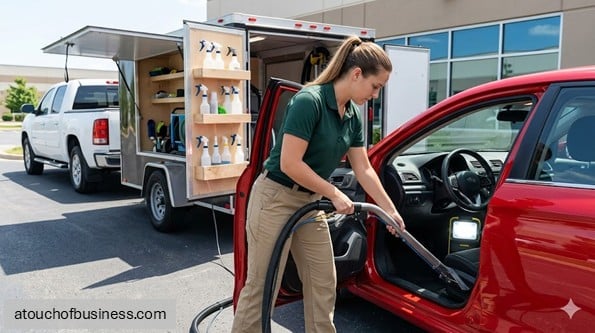
What to Plan Before You Start a Mobile Detailing Business
A mobile detailing business cleans, restores, and protects vehicles at the customer’s location. You bring the tools, supplies, power setup, and work process to the driveway, parking lot, fleet yard, or other approved site.
That sounds simple. It is not. This business depends on your vehicle setup, your route planning, your pricing discipline, and your ability to do quality work in changing conditions.
Do Your Interests Align With Running a Business?
Before you buy equipment, ask whether business ownership fits you at all. A mobile detailing business can give you control and flexibility, but it also puts the pressure on you from the first day.
You need to enjoy the day-to-day work. That means being on your feet, handling chemicals, dealing with weather, loading and unloading gear, driving between jobs, and solving problems on site.
Your reason for starting matters too. Move toward something you care about, not mainly away from a bad job, a difficult boss, or money problems. Image and status will not carry you through long days, equipment issues, customer claims, and slow weeks.
If you enjoy vehicle care, take pride in visible results, and like giving people a convenient service, that is a stronger starting point. Genuine interest usually holds up better when the day-to-day gets difficult.
You also need a reality check. A mobile detailing business is not just washing cars. It is scheduling, quoting, site setup, quality control, payment collection, supply tracking, and legal compliance around wastewater and business setup.
Talk to owners in another city or market area so you are not calling a direct competitor. Bring real questions. Ask what they wish they knew before launch, what equipment they bought too early, how they handle customer sites, and what services actually made sense at the start. Another owner’s firsthand perspective can save you costly mistakes.
Now look at local demand. Is there enough work in your area for this kind of service? If the answer is weak, the business model or the territory may not fit. That is why checking local demand in your area matters before you build anything.
You should also compare starting from scratch with buying a business already operating. In some areas, buying a business already in operation may give you equipment, customers, and systems faster than a brand-new launch. Franchising is less common here than in some other fields, so it is not usually the first comparison.
How a Mobile Detailing Business Works
This is a field-service automotive business. The workflow usually starts with an inquiry, then an estimate, appointment confirmation, travel, on-site inspection, the detail itself, payment, and cleanup.
This decision fundamentally changes how you spend your time. Travel, loading, unloading, weather delays, and site limits all affect how many jobs you can do in a day.
- Customer asks for a quote
- You confirm the vehicle size, condition, and service level
- You travel to the site with the needed tools and chemicals
- You inspect the vehicle and confirm the work
- You complete the service and document the result
- You collect payment and restock for the next job
That flow needs to feel real before launch. If your setup does not support it, you will feel the problem fast.
Choose the Service Mix First
Your service mix shapes nearly every startup decision. It changes your equipment needs, your job times, your price structure, your training needs, and even whether some job sites are practical.
Start with a narrower offer. That makes it easier to estimate time, load the right gear, and avoid taking on work your setup cannot support.
- Exterior hand wash
- Wash and paint protection
- Interior vacuum and wipe-down
- Full interior detail
- Clay bar treatment
- Paint correction
- Ceramic coating
- Headlight restoration
- Fleet detailing
If you add paint correction or coatings at launch, your risk goes up. Those services need more skill, more lighting, more pad and polish choices, and more time per vehicle.
Who Your Customers Are and What They Care About
Most early customers are vehicle owners who value convenience. They want the work done properly without giving up part of their day to drive to a shop and wait around.
In automotive services, trust matters a lot. People care about quality, speed, clear pricing, and confidence that you will not damage the vehicle.
- Busy professionals who want home or office service
- Families with multiple vehicles
- Luxury or enthusiast vehicle owners
- Used-car sellers preparing a vehicle for sale
- Small fleets and local service businesses
- Property managers or real estate professionals with appearance-focused vehicles
Your ideal customer affects your route planning, appointment length, and sales approach. A fleet customer is different from a homeowner who wants a Saturday detail.
Check Local Demand Before You Commit
A mobile detailing business can look promising from the outside, but weak local demand can still make it a poor launch choice. You need enough people in your area who want convenience and will pay for the service.
Look at the number of likely customers, the local income level, the weather pattern, the condition of competing offers, and how far you would need to drive between jobs. That is part of building a realistic plan and avoiding common early startup mistakes.
This decision ultimately dictates your total capacity. A wide territory may bring more leads, but it can also reduce the number of jobs you finish each day.
Pros, Cons, and Early Risks
A mobile detailing business can start with lower fixed overhead than a full shop. You may not need a customer-facing location, and you can launch with a smaller footprint.
But mobility creates its own problems. Travel time, traffic, site restrictions, changing weather, and equipment readiness all shape your day.
- Advantage: lower fixed-location cost than a full shop
- Advantage: convenience is a strong selling point
- Advantage: you can begin with a focused service list
- Challenge: local water-discharge rules can limit where you work
- Challenge: bad routing wastes hours
- Challenge: weak estimating leads to underpriced labor
- Challenge: customer damage claims can be costly
- Challenge: equipment failure can stop the day
Write a Plan Before You Buy Equipment
Your mobile detailing business needs a practical business plan, not a vague idea. Keep it tied to how the business will actually launch in your area.
Use it to define your services, target customers, service radius, operating schedule, startup costs, pricing structure, and expected workload. If you need a framework, start by putting your business plan together around your first stage only.
- What services you will offer at launch
- What vehicle types you will target
- How far you will travel
- How long each service should take
- What your equipment setup will include
- What legal checks you need before opening
- How much working cash you need
Pick the Right Legal Structure for the Business
Your structure affects taxes, paperwork, and liability handling. Many first-time owners compare a sole proprietorship and a limited liability company before launching.
What this choice changes is paperwork, cost, and how you keep business and personal transactions separate. If you need help weighing it, start by deciding on a business structure.
You may also need to register a trade name if you will operate under a name different from your own legal name or the entity name.
Handle Registration, Tax IDs, and Local Licenses
A mobile detailing business still needs proper registration. Being mobile does not remove that step.
At a minimum, confirm your business registration, tax setup, and local license requirements before taking jobs.
- Register the business with the state if your chosen structure requires it
- Apply for an Employer Identification Number if needed
- Check whether your state requires tax registration
- Confirm whether detailing or related services are taxable in your state
- Find out whether your city or county requires a business license
- Check whether a Doing Business As filing applies
If you are unsure about the sequence, review the business registration steps and then confirm what applies in your state and city.
Know the Rules for Water, Runoff, and Job Sites
This is one of the biggest launch issues for a mobile detailing business. You cannot assume you can wash vehicles anywhere you can park.
In many places, commercial wash water cannot go into the street or storm drain. Some areas may also limit how captured wash water can be discharged. That means your service method has to match local rules.
Your cleaning method determines where you can operate and what equipment you need to carry. A rinseless setup, a containment setup, and a full free-flow wash setup do not create the same risk.
- Ask whether commercial mobile washing is allowed at homes, parking lots, and fleet yards
- Ask whether runoff must be prevented or captured
- Ask where captured wash water may be discharged
- Ask whether local approval is needed for discharge to the sanitary sewer
If you plan to base the business at home, also ask about zoning, outdoor storage, work vehicle parking, and home-occupation rules. If you lease a bay or work unit, ask whether a certificate of occupancy applies before move-in.
Choose the Right Mobile Setup
Your work vehicle is part of the business model, not just transportation. It needs to support your service mix, your route plan, your load weight, and your daily workflow.
A van, pickup, trailer, or dedicated detailing rig can all work. The right choice depends on how much water, power, storage, and equipment you need on board.
- Service van with shelves and locked storage
- Pickup with bed storage and mounted equipment
- Trailer setup with tank, reels, and generator
- Lean setup for rinseless or low-water work
This selection impacts your startup costs, payload capacity, parking ease, and daily setup time. A bigger rig may look impressive, but it also costs more and may be harder to manage in residential areas.
Buy Equipment Based on the Work You Will Actually Do
It is easy to overspend here. A mobile detailing business can burn cash fast when you buy every tool you might someday use instead of what your launch services require.
Start with equipment that supports safe, repeatable jobs.
- Water tank if you will carry your own water
- Pressure washer if your service model needs one
- Hoses, reels, buckets, and spray bottles
- Wet/dry vacuum
- Hot water extractor if you will offer deep interior work
- Dry vapor steamer if it fits your process
- Dual-action polisher and pads if offering correction work
- Inspection lights
- Brushes, towels, wash mitts, and applicators
- Generator or power setup if customer power is unreliable
In this business, tools shape both quality and turnaround time. If a service needs specialized equipment, price and schedule it accordingly.
Set Up Chemicals, Safety Gear, and Work Procedures
Your chemical list should match the surfaces and services you handle. Keep it tight at launch so you do not create clutter, confusion, or unnecessary risk.
You may need car shampoo, all-purpose cleaner, wheel cleaner, glass cleaner, degreaser, interior cleaner, compound, polish, dressing, and protection products. If employees will handle hazardous chemicals, you also need labels and Safety Data Sheets in place.
Use gloves, eye protection, spill materials, and any protective gear the work requires. Safe handling is part of the setup process, not something to figure out later.
Build a Price Structure That Matches Time and Risk
Underpricing is one of the fastest ways to damage a mobile detailing business. A professional price list means little if your labor, travel, and add-on services aren’t built into the rate.
Set prices around the vehicle size, condition, service level, and travel distance. That is the starting point for setting your prices in a way that fits the actual work.
- Package pricing for standard services
- Different rates for sedan, SUV, truck, and van
- Condition surcharges for severe interiors or heavy contamination
- Hourly pricing for correction or unusual work
- Travel fees outside your main area if needed
This approach determines your profit margins and your daily schedule. A cheap package that takes too long can fill the calendar and still leave you short on cash.
Plan Startup Costs and Working Cash Carefully
Some people focus only on tools. That is too narrow. Your mobile detailing business also needs enough cash for fuel, supplies, repairs, insurance, software, payment processing, and slow days.
Main cost drivers include your vehicle choice, whether you carry water and power, whether you offer correction or coatings, and whether you start solo or hire help.
- Vehicle purchase or modification
- Trailer if used
- Water, hose, and power setup
- Vacuum, extractor, steamer, and polishers
- Chemicals, towels, pads, and brushes
- Licensing, registration, and insurance
- Phone, software, and payment equipment
- Fuel, restocking, and reserve cash
Before borrowing money, estimate what the business must earn to cover those costs. That is part of early profit and revenue planning.
Funding, Banking, and Recordkeeping
Some owners self-fund the launch. Others need outside funding for the vehicle, equipment, or working capital.
If you need financing, compare owner cash, equipment financing, and small-business loan options. When borrowing makes sense, learn what matters before applying for a business loan.
Open a separate business bank account early. It keeps business activity cleaner and makes tax and bookkeeping work easier from the start.
You also need a payment process before launch. Card readers, mobile invoices, deposits for larger bookings, and clean receipts all matter in a mobile service business.
Insurance and Risk Planning for a Mobile Detailing Business
Insurance is not just a box to check. In this business, your risks travel with you.
You may need general liability coverage, the correct vehicle coverage for business use, and protection for tools and equipment. If you hire employees, workers’ compensation may also apply based on your state rules.
This decision determines your level of protection against damage claims, equipment loss, or road incidents. The leanest setup is not always the safest one.
Suppliers, Consumables, and Restocking
A mobile detailing business runs on supplies that wear out quickly. Towels, pads, chemicals, brushes, and wash media all need a restocking plan.
Set up supplier accounts before opening if possible. Keep your towels and pads organized by use so you do not cross-use paint, wheel, glass, and interior materials.
- Chemical supplier
- Microfiber and pad supplier
- Equipment supplier
- Fuel and maintenance support for the vehicle
- Laundry process for towels and pads
This decision directly impacts your consistency. Weak restocking and poor material separation can lower quality fast.
Name, Domain, and Business Identity
Your name should be clear, usable, and easy to remember. It should also be available for registration, your domain, and your social profiles.
You do not need an elaborate brand package to start, but you do need the basics. Customers should be able to recognize the business, understand the service, and trust that you are real.
- Business name
- Domain name
- Phone number for the business
- Email tied to your domain if possible
- Simple logo and vehicle branding if it fits
- Basic business cards for direct contacts
In a mobile service, your vehicle often acts like moving signage. That makes your presentation part of the first impression.
Set Up Forms, Systems, and Workflow Before Opening
Good work is not enough if your paperwork is messy. You need a clean process from first contact to final payment.
Prepare the forms and systems you will use every week.
- Estimate form
- Service authorization
- Vehicle condition checklist
- Pre-existing damage acknowledgment
- Cancellation and weather policy
- Invoice and receipt template
- Appointment confirmations
- Photo documentation process
This choice provides much-needed clarity. Good forms reduce confusion, support approvals, and help with disputes.
Hiring and Training: Start Lean if You Can
Many owners launch this type of business alone. That keeps the setup simpler and helps you learn the real timing and quality standard before you add payroll.
If you do hire early, do not treat labor like an easy shortcut. New people need training on chemicals, equipment, vehicle handling, customer communication, and quality checks. That is why many first-time owners delay hiring until the workflow is stable.
What the Day-to-Day Work Feels Like
A mobile detailing business can look flexible from the outside, but the day is often packed. You load supplies, drive, set up, inspect the vehicle, do the work, clean up, collect payment, and then reset for the next appointment.
That means your days include physical labor, travel, customer interaction, and constant time decisions. If that mix does not appeal to you, pay attention now.
Main Red Flags Before You Launch
Some warning signs should slow you down. They do not always mean stop, but they do mean think harder before you commit money.
- You have not checked local runoff or wastewater rules
- Your target area requires long drives between jobs
- You plan to offer advanced services without the needed skill or tools
- Your pricing is based on ideal vehicles, not real ones
- Your vehicle setup is too large, too costly, or too hard to manage
- You need steady work fast, but your area may not support enough demand
- You are starting mainly to escape a job, not because you want this business
- You have no cash reserve for breakdowns, weather delays, or slow weeks
This choice ultimately determines the business’s survivability. A business can look busy and still struggle if the basics are weak.
How to Reach Early Customers
Your first-stage sales approach should match the kind of work you want. A homeowner booking is different from a fleet account, so do not use one message for everything.
Be clear about what you do, what the service includes, where you work, and how customers book. Price clarity matters. So does showing up on time and making the process easy.
- Simple website with services, territory, and booking details
- Google Business profile if allowed for your setup
- Before-and-after photos of your real work
- Local outreach to small fleets and service businesses
- Referral requests after completed jobs
- Printed business cards for direct handoffs
Launch Readiness for a Mobile Detailing Business
Do not open because you are tired of preparing. Open when the business is ready to handle real jobs cleanly and legally.
Run test jobs from departure to payment before you announce the launch.
- Business registration complete
- Tax setup confirmed
- Local license checks done
- Water and runoff rules verified
- Vehicle insured for business use
- Core equipment tested
- Chemicals labeled and stored properly
- Pricing sheet finished
- Forms and payment system ready
- service area and routing plan defined
- Supplier and restocking plan in place
- One or more full mock jobs completed
That final test matters. It shows where your time goes, what you forgot to pack, and whether your mobile detailing business is really ready for paying customers.
FAQs
Question: Do I need a business license before I start taking mobile detailing jobs?
Answer: In many places, yes. The exact rule depends on the city, county, and state where you plan to work.
Check local licensing offices before your first paid job. Mobile businesses are often covered even without a storefront.
Question: Should I start as a sole proprietor or form an LLC for a mobile detailing business?
Answer: That depends on how you want to handle liability, taxes, and paperwork. Many new owners compare both before they register anything.
If you are unsure, ask a local accountant or business attorney. It is easier to choose carefully now than to clean up the setup later.
Question: Do I need an Employer Identification Number to open this business?
Answer: Not every owner needs one on day one. Still, many get one early for banking, tax setup, and future hiring.
Question: Can I run a mobile detailing business from my house?
Answer: Maybe, but you need to check local zoning and home-business rules first. Parking a work van, storing chemicals, and outdoor activity can trigger limits.
Question: Do I need special permission to wash cars at a customer’s home or parking lot?
Answer: Sometimes. The main issue is usually where the wash water goes, not just where the vehicle is parked.
Some areas do not allow runoff into the street or storm drain. Ask the local sewer, stormwater, or public works office what is allowed.
Question: What is the smartest service setup for a first-time mobile detailer?
Answer: A smaller offer is usually easier to launch well. Start with work you can finish cleanly, safely, and on time with the tools you actually have.
Adding paint correction or coatings too soon can raise your risk. Those jobs need more skill, better lighting, and more time control.
Question: What equipment do I really need before opening?
Answer: You need enough gear to complete the services you plan to sell without cutting corners. That often includes a work vehicle, vacuum, towels, brushes, chemicals, and a power or water setup if your method needs it.
Do not buy every machine at once. Let your starting service list decide what belongs in the vehicle.
Question: How should I figure out startup costs for a mobile detailing business?
Answer: Build the numbers around your vehicle, equipment level, supplies, insurance, licensing, and working cash. Those items usually matter more than a rough online estimate.
Your total can change a lot based on whether you carry water, use a trailer, or offer advanced services at launch.
Question: Do I need insurance before my first job?
Answer: Yes, you should have coverage in place before you begin. The exact mix depends on your vehicle use, your tools, and whether you work alone or hire help.
Question: Is mobile detailing taxable?
Answer: It depends on the state. Some states tax certain vehicle-care services, and others do not.
Check with your state tax agency before you set up invoices. It is much easier to build the tax side correctly from the start.
Question: What is the biggest mistake new mobile detailers make?
Answer: Many start with too much equipment and too many services. That makes scheduling, pricing, and quality harder right away.
Another common problem is ignoring travel time. A full calendar can still turn into a weak week if the route is bad.
Question: How do I set prices when I have no track record yet?
Answer: Base your prices on labor time, travel, supplies, and the kind of vehicles you want to handle. Do not guess from what sounds affordable.
A job that looks profitable on paper can fall apart once you add drive time, setup time, and tough vehicle condition.
Question: How many services should I offer when I first open?
Answer: Fewer is usually better at the start. A short list is easier to explain, price, and perform well.
That also helps you learn your real job times. Once you know the flow, you can decide whether to add more.
Question: What should my daily workflow look like in the first month?
Answer: Keep it simple and repeatable. Confirm the job, load the vehicle, travel, inspect the car, do the work, collect payment, and reset for the next stop.
If any step feels messy, fix it early. Small delays add up fast in a mobile service business.
Question: When should I hire my first helper?
Answer: Usually after you understand your own timing, process, and quality standard. Hiring too early can hide weak systems instead of solving them.
If you do bring someone on, train them on safety, tools, and customer-site conduct from day one.
Question: What basic systems should I have before opening week?
Answer: You need a way to book work, send estimates, collect payment, track customer details, and store before-and-after photos. Those systems do not need to be fancy, but they do need to be reliable.
Question: What policies should I have ready before the first customer?
Answer: Have simple rules for cancellations, weather delays, payment timing, and approval for extra work. You should also document pre-existing damage before you begin.
Question: How do I get my first customers without wasting money?
Answer: Start with a clear local presence and direct outreach. People need to understand what you do, where you work, and how to contact you.
Use real job photos when possible. For business accounts, contact local fleets and service companies with a practical offer.
Question: What should I watch in the first month for cash flow?
Answer: Watch fuel, supplies, payment processing, and how much time you lose between jobs. Those small drains can hurt faster than you expect.
You also need reserve cash for weather delays and equipment trouble. Early income can look better than it really is if you ignore those hits.
Question: Should I use customer power and water, or bring my own?
Answer: That depends on your service method and the kinds of jobs you want. Bringing your own setup gives you more control, but it also raises cost, weight, and complexity.
Using customer utilities can simplify the vehicle build. It can also limit where you can work and how consistent the job setup feels.
Question: How do I know if my service area is too big?
Answer: If you spend too much of the day driving, your area is too wide. Early on, a tighter territory usually gives you better use of time and lower fuel waste.
Question: Do I need written forms for a small mobile detailing business?
Answer: Yes. Even a simple operation should use written approvals, invoices, and condition notes.
That helps with customer clarity and damage disputes. It also makes your work feel more professional from the start.
Question: What should I do before I announce that I am open?
Answer: Run a full practice day first. Test your route, your gear, your service timing, your payment process, and your cleanup routine.
That trial run usually shows what is missing. It is better to find problems before a paying customer does.
Expert Tips From Mobile Detailing Owners
One of the fastest ways to avoid beginner mistakes is to listen to people who already run a detailing business.
Interviews and first-person conversations can give you a clearer picture of startup costs, service choices, early pricing, equipment decisions, and what the first phase really feels like.
- Starting Your Own Detailing Business | Interview with Reflectionz by Eric — A recent interview article from Dr. Beasley’s focused on what it is like to start a detailing business, including the realities of launching either mobile or fixed-location work.
- How to Start a Car Detailing Business – with little (or no) money! — This article is built around interviews with three detailing owners, including two mobile operators, and covers how they got started, what equipment mattered early, and mistakes to avoid.
- I Left Tech & Built My Own Car Detailing Business [My Hobby] — A founder interview from Starter Story with the owner of Fresh Look Mobile Auto Detailing, useful for seeing how one operator framed the service, the customer base, and early business results.
- 22 Year-Old Starts a $50K/Month Mobile Car Detailing Business — A video interview centered on what it takes to start and grow a mobile detailing company, with a founder sharing lessons from the field.
- He Built a Car Detailing Business Without a Shop — A video interview where David Bui talks through building a mobile-style detailing business without relying on a fixed shop, including lessons on services, hiring, and marketing.
- Eminent detail interview — A podcast episode from Sharp Mind Dirty Hands covering detailing, standard operating procedures, business mindset, and what to do when work slows down.
- Business For Detailers — A podcast built around interviews with people in the detailing industry, aimed at owners who want practical business advice rather than technique-only content.
Related Articles
- Start a Mobile Car Wash
- How To Start Your Car Wash Business
- Start a Boat Cleaning Business from Scratch
- Start a Pressure Washing Business
- How To Start Your Car Wrapping Business
- How To Start a Window Tinting Business
- How To Start Your Oil Change Business
- Starting a Windshield Repair Business
- How To Start Your Profitable Auto Body Repair Shop
- How To Start a Custom Car Shop
Sources:
- IRS: Get an EIN
- SBA: Choose a structure, Register your business, Tax ID numbers, Licenses and permits, Pick your location, Open a bank account, Get business insurance, 7(a) loans, Microloans
- EPA: Vehicle washing BMP
- OSHA: Hazard communication, Protective equipment
- Portland.gov: Mobile washer program
- San Diego County: Mobile vehicle washing
- IDA: Detailing resources
- Carwash.com: Start a detailing business, Mobile equipment basics