
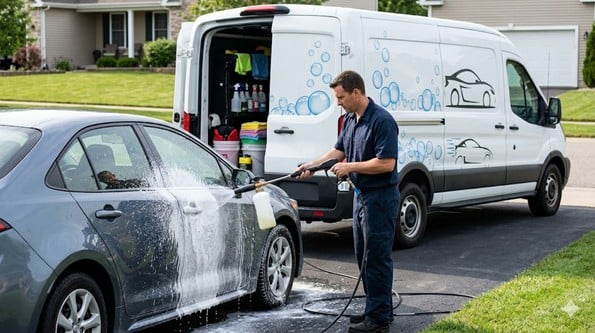
What a Mobile Car Wash Business Really Involves
A mobile car wash cleans vehicles at the customer’s location instead of bringing drivers to a fixed site.
That sounds simple. It is not. You are not just washing cars. You are building a road-ready service setup that must handle travel, job timing, water, equipment, payment, and wash-water control.
This business can work well for someone who wants a lower-overhead entry into automotive service. It also puts pressure on scheduling, route planning, and job scope from day one.
- Common early services include exterior washes, wash and vacuum packages, wheel and tire cleaning, window cleaning, and light interior wipe-down work.
- Typical customers include households, apartment residents, office workers, dealerships, and fleet accounts.
- The mobile model changes everything about pricing, capacity, and equipment because travel time is part of the job.
Is This Business a Good Fit for You?
A mobile car wash business can look attractive because you do not need a full storefront. That is the easy part.
The harder part is the daily work. You will load gear, drive, set up, wash, dry, pack up, answer questions, take payment, and deal with weather, traffic, and late customers.
Ask yourself a few honest questions. Do you actually like hands-on vehicle cleaning? Are you comfortable working outdoors, staying on schedule, and solving small problems all day?
Status won’t carry you very far here. The image of being your own boss fades fast when you are behind on a route and still need to clean up a final job.
Better reasons are much stronger. If you enjoy the day-to-day work, respect the service, and have a clear reason for doing it well, you have a better chance of staying focused.
A mobile car wash is also a lifestyle choice. Fast cash now vs steady structure later is a real tradeoff. If you want predictable indoor work, this may not fit you.
Talk to Owners and Check Local Demand
Before you spend money, find out whether your area gives this business enough room to work.
Talk to owners you will not compete with. Pick operators in another city, region, or market area. Their path will not match yours exactly, but their field experience still matters.
Go in with real questions. Ask about route planning, water setup, wash-water rules, pricing mistakes, travel time, repeat work, and what they wish they had fixed before launch.
Good firsthand owner insight can save you from expensive assumptions.
You also need to measure local supply and demand. If demand is weak, or the area is crowded with mobile detailers and hand-wash operators, the problem may be the market, not your effort.
- Who would hire you first: homeowners, apartment residents, office workers, fleets, or dealerships?
- How far apart are those customers?
- Can your area support repeat work, or only one-off jobs?
- Are people paying for convenience, quality, or the lowest price?
Demand matters more than enthusiasm. Strong interest in the business vs weak demand in the area is a bad match.
Start From Scratch, Buy a Business, or Look at a Franchise?
Most people entering a mobile car wash start from scratch. That gives you full control over the rig, service area, and pricing.
Still, do not assume that is always best. A small local operator with working equipment, known routes, and repeat customers may be worth comparing. That is why it helps to consider a business already in operation if one is available.
Starting from scratch costs less in some cases. Buying an existing setup can help you avoid common startup mistakes. Cheap now vs expensive later is the tradeoff.
- Start from scratch if you want control and can build the system carefully.
- Buy an existing operation if the equipment, records, customer base, and compliance setup are real and verifiable.
- Compare any franchise option only if you find a realistic one for your area and service model.
Your best path depends on budget, support needs, available businesses for sale, and how much uncertainty you can handle at the start.
Choose the Right Offer for a Mobile Car Wash
A mobile car wash gets into trouble when the service list is too broad too early.
Start with a small group of offers you can quote clearly and deliver consistently. More services vs clearer packages is one of the first decisions that affects profit.
- Exterior wash only
- Wash and vacuum
- Wash with basic interior wipe-down
- Fleet wash service
Each offer should have a clear scope. Define what is included, what is extra, what takes more time, and what falls outside your opening setup.
This matters because mobile work has real limits. Vehicle size, soil level, site access, travel time, and water availability can all change the job.
Fast quoting vs correct quoting is another real tradeoff. A fast quote feels good. A correct quote protects your time.
Plan Your Territory, Route, and Capacity
The mobile model lives or dies on territory planning.
A mobile car wash with weak route design loses time between jobs, burns fuel, and falls behind even when demand is strong.
Set a practical opening territory. Keep it tight enough that travel does not eat your day, but large enough to give you enough leads.
- Set a core service radius before launch.
- Decide when travel fees apply.
- Build time blocks that include drive time, setup, washing, drying, payment, and teardown.
- Leave room for weather and traffic delays.
More bookings vs better route density is another early tradeoff. A full calendar is not always a profitable calendar.
Capacity planning matters here too. Water, towels, chemicals, vacuum waste, and daylight all limit how many jobs you can handle in one run.
Build a Plan Before You Buy the Rig
You do not need a complicated document. You do need a working plan that matches the real setup.
Use it to define the offer, target customers, service area, startup costs, pricing rules, equipment list, legal steps, and launch checklist. If you need help, start by building a business plan around the mobile model, not around wishful numbers.
Your plan should answer practical questions.
- Will you bring your own water?
- Will you depend on customer power, or carry a generator?
- Will you offer only residential jobs, or also pursue fleets?
- Will you stay solo at launch, or prepare to hire?
A simple plan that matches reality beats a polished plan that ignores the field.
Choose the Structure, Name, and Tax Setup
Pick your legal structure early because it affects registration, taxes, banking, and paperwork.
For many first-time owners, the first comparison is a sole proprietorship vs a limited liability company. What matters most is using a structure that fits your risk, tax, and recordkeeping needs.
- Register the business with the state if your structure requires it.
- Apply for an Employer Identification Number if needed.
- Check whether you need a Doing Business As filing.
- Secure the domain name that matches your business name.
Keep the name simple, easy to remember, and clear enough for a service vehicle, invoice, and payment link.
Clear now vs confusing later is the tradeoff. A clever name is not useful if customers cannot remember or spell it.
Handle Local Rules Before You Spend on Equipment
This is one of the most important sections for a mobile car wash.
The biggest legal issue is often not the washing itself. It is where the wash water goes and what your city, county, or utility allows.
Do not assume wash water can run into the street or storm drain. In many places, that is treated as an illegal discharge. Some areas also require approval before captured wash water can go into the sanitary sewer.
- Check your city or county business license rules.
- Confirm zoning or home-occupation rules if you will store the rig or chemicals at home.
- Ask whether a certificate of occupancy applies if you rent a garage, bay, warehouse, or office.
- Verify state sales-tax treatment for your service mix.
- Set up employer accounts if you will hire.
Relying on general assumptions instead of local verification is a major risk. Keep the process practical. Call the city licensing office, planning department, stormwater office, sewer utility, and state tax agency when needed.
Build the Rig Around Real Field Work
The rig is not just equipment. It is your worksite, storage area, and delivery system.
A mobile car wash can launch from a van, pickup, or trailer. The right choice depends on payload, maneuverability, budget, and whether you need a fully self-contained setup.
- Pressure washer
- Water tank if you will not depend on customer water
- Hose reels and fittings
- Generator if you need self-contained power
- Buckets, mitts, brushes, microfiber towels, spray bottles, and vacuum equipment
- Proper storage for chemicals and tools
- Containment or recovery gear if local rules require it
Bigger tank vs lighter rig is a real tradeoff. More water gives more independence, but water is heavy and affects payload, fuel use, and vehicle choice.
Do not buy based on appearance. Buy for route conditions, service scope, and the rules where you will work.
Set Prices That Cover Travel, Time, and Scope
Pricing is where many small mobile operators fail early.
If your price only covers the wash, you are leaving out the drive, setup, teardown, and gaps between jobs. That is why pricing your services needs to reflect the mobile setup, not just labor at the vehicle.
You can price by package, by vehicle size, or by the hour. Each method can work if you apply it consistently.
- Use package pricing for standard jobs you can define well.
- Use hourly pricing for jobs with uncertain condition or added labor.
- Set minimum service charges for short jobs.
- Add travel fees or zone pricing outside your main area.
- Set clear extra charges for very dirty vehicles or added interior work.
Low prices may help you book a few jobs. They can also trap you in unprofitable work. Cheap now vs expensive later shows up clearly in pricing.
Plan Startup Costs, Funding, Banking, and Records
Your startup costs will depend on what you already own and how self-contained the rig needs to be.
The main cost groups are easy to spot: vehicle or trailer, pressure-washing equipment, tanks, generator, recovery gear, chemicals, towels, safety items, business setup, and early working cash.
The wider the service list, the more your setup usually costs. A simple wash setup vs a broad detailing setup is not a small difference.
- List every launch expense before you start buying.
- Separate one-time startup costs from weekly operating costs.
- Decide whether you will self-fund, borrow, or use equipment financing.
- Open a business bank account before taking payments.
- Keep business transactions separate from personal ones from the start.
Banking and recordkeeping are part of launch, not cleanup work for later. You will need clean records for taxes, permits, insurance, and pricing reviews.
Set Up Forms, Customer Flow, and Basic Business Systems
A mobile car wash should feel organized from the first call to the final payment.
Your workflow does not need to be fancy. It does need to be repeatable.
- Lead capture form
- Quote template
- Appointment confirmation
- Arrival message
- Before-service checklist
- Invoice and receipt
- Payment process
Estimate, approval, service, quality check, payment, and handoff should all feel clear to the customer.
Adding staff won’t fix a broken system. Weak systems with more staff often create more problems, not fewer.
Set up your domain, business email, and a simple digital presence early. Keep the vehicle name, payment links, and customer-facing documents consistent.
Insurance, Safety, and Risk Control
This business carries more risk than many first-time owners expect.
You are working around customer vehicles, using pressurized equipment, handling chemicals, and operating in driveways, lots, and job sites that you do not control.
Insurance needs vary, but this is not a place to guess. Talk with a qualified insurance professional about vehicle, liability, property, and worker-related exposure before launch.
- Use labeled chemical containers and keep Safety Data Sheets available.
- Use eye and splash protection when the hazard calls for it.
- Train anyone who will handle chemicals or pressure-washing equipment.
- Document vehicle condition before starting work when the job warrants it.
Fast work vs safe work is a false choice. In this business, safe work is part of correct work.
Suppliers, Consumables, and Base Setup
A mobile car wash does not need parts inventory like a repair shop, but it still depends on steady supply flow.
You will need reliable sources for chemicals, towels, hoses, fittings, pressure-washer service, tank hardware, and replacement small tools.
- Choose a pressure-washer service source before your first breakdown.
- Set reorder points for towels, soaps, gloves, and other consumables.
- Plan where towels will be washed and dried.
- Decide where the rig will be stored, loaded, and restocked.
Cheap supplies vs durable supplies matters here too. Saving money on items that fail in the field can cost far more in delays and damage claims.
Hiring and Training for a Mobile Car Wash
Many owners start solo. That can work well if the territory is tight and the service menu is controlled.
If you plan to hire, do it because the workflow supports it, not because you are already overwhelmed.
- Train on wash steps and job scope
- Train on chemical handling and labeling
- Train on pressure-washer safety
- Train on customer communication and payment flow
- Train on route timing and equipment loading
More people vs better systems is worth thinking through carefully. Weak systems with more staff often create more problems, not fewer.
What the Workday Looks Like Before Opening
You should understand the daily rhythm before you launch the business.
A mobile car wash day often starts before the first appointment. You check the rig, fill or confirm water, load chemicals and towels, review the route, and confirm the first stop.
Then you drive, set up, wash, dry, take payment, pack up, and repeat. At the end of the day, you still have cleanup, laundry, restocking, fuel, and basic bookkeeping.
If that sounds manageable and satisfying, the business may fit you. If it sounds draining before you even begin, take that seriously.
Launch the Right Way
Do not open the calendar to the public until the whole setup works in the field.
Run test jobs first. Time the drive, setup, wash, payment, and teardown. Make sure the water, power, pricing, and paperwork all hold up under real conditions.
- Confirm legal registration and tax setup
- Verify local permits, business license, and discharge rules
- Test the rig under full load
- Check every hose, reel, fitting, and storage point
- Confirm card payments and invoices work on-site
- Make sure pricing covers the real time per job
- Prepare customer forms and service terms
- Set your first service area and booking rules
Opening early vs opening ready is one of the biggest startup choices you will make.
Main Red Flags to Think Through
Some warning signs are easier to fix before launch than after you start taking jobs.
Pay attention to these now.
- No clear answer on where wash water can go
- A service area that is too wide for the price point
- A rig that carries more weight than the vehicle or trailer should handle
- Prices that ignore travel, setup, and slow days
- Weak local demand or too many similar operators nearby
- A broad service list that your opening setup cannot support
- No base plan for storage, restocking, laundry, and loading
- Taking on employees before the training and paperwork are ready
A mobile car wash can be a practical business to start. It can also become messy fast if the setup is rushed.
Final Thoughts on Starting a Mobile Car Wash
This business rewards clear thinking more than fast action.
If you like the work, have enough demand in your area, and build the launch around legal checks, route logic, and tight service scope, you give yourself a better start.
If you skip the basics, the problems show up quickly. Small mistakes in route planning, wash-water handling, pricing, or rig setup can turn into expensive ones.
FAQs
Question: Do I need a business license to start a mobile car wash?
Answer: In many places, yes, but the rule is local. Check your city or county business licensing office before you begin taking jobs.
Question: Can I run a mobile car wash from my home?
Answer: Sometimes, but home-based rules may still apply. Ask zoning or planning whether you can park the work vehicle there, store supplies there, and use the property as your business base.
Question: Is an Employer Identification Number required for this business?
Answer: Not in every case, but many owners get one early. It is often needed for banking, taxes, and hiring.
Question: Should I start as a sole proprietor or form an LLC?
Answer: That depends on your tax situation, risk tolerance, and how you want the business set up. Many owners compare both options before registering because the structure affects paperwork and protection.
Question: Do I need a DBA for a mobile car wash?
Answer: You may need one if you use a business name that is different from your legal name or entity name. The filing rules depend on the state or local office that handles assumed names.
Question: What is the biggest legal issue for a mobile car wash?
Answer: For many operators, it is not the washing itself. It is making sure dirty water does not end up in a storm drain and knowing how captured water may be disposed of.
Question: Do I have to collect sales tax on car wash services?
Answer: Maybe. Some states tax these services, while others treat them differently, so you need to check your state tax agency before setting up invoices.
Question: What equipment do I need before I can open?
Answer: Most new operators need a service vehicle or trailer, a pressure washer, hoses, hand tools, chemicals, towels, and a way to take payment in the field. Some areas also push you toward water-control or recovery gear.
Question: Do I need my own water tank and generator?
Answer: Not always. If you cannot count on customer water or power, bringing your own setup gives you more control but also raises weight and startup cost.
Question: How should I figure out startup costs for a mobile car wash?
Answer: Build the number from your actual setup instead of using a generic estimate. Your total will change a lot based on the vehicle, water capacity, power source, recovery needs, and whether you already own some equipment.
Question: What is the best way to set prices when I am just starting?
Answer: Start with a simple method you can explain and repeat. Your price needs to cover driving time, setup time, labor, supplies, and the gap between stops, not just the washing time.
Question: What mistakes do new mobile car wash owners make most often?
Answer: Common problems include charging too little, offering too many services too soon, and skipping local rule checks. Another big mistake is buying equipment before deciding how the workday will really run.
Question: How should my first month of daily workflow look?
Answer: Keep it simple and repeatable. A normal day should include checking the rig, confirming appointments, driving the route, doing the work, collecting payment, and restocking for the next day.
Question: What basic systems should I set up before the first job?
Answer: You need a clean way to quote, schedule, invoice, collect payment, and save customer details. It also helps to keep a short service checklist so every job follows the same steps.
Question: When should I hire my first employee?
Answer: Hire only when your job flow is steady enough to support payroll and training. If the schedule is still uneven, adding labor too soon can create cash pressure fast.
Question: What kind of insurance should I ask about before launch?
Answer: Ask an insurance professional about coverage for business liability, your work vehicle, tools, and any employee-related exposure. The right mix depends on your setup and whether you work alone or with staff.
Question: How do I get my first customers without wasting money?
Answer: Start with a tight service area and a clear offer people can understand quickly. Early demand usually comes from simple local visibility, direct outreach, and making it easy for people to book and pay.
Question: What should I watch most closely in my first month of cash flow?
Answer: Track how much money is coming in versus fuel, supplies, payment fees, laundry, and equipment-related costs. Small leaks add up fast when your route is still being built.
Question: Do I need written policies before opening?
Answer: Yes, even simple ones help. New owners should decide in advance how they will handle cancellations, weather delays, service limits, payment timing, and jobs that arrive in worse condition than expected.
Question: How do I know if my service area is too large?
Answer: If drive time starts taking too much of the day, your area is probably too wide. A smaller territory often gives better route flow and more room for repeat work.
Real-World Advice From Detailers and Wash Operators
Before you spend money on equipment or lock in your service setup, it helps to hear from people who have already done the work.
The resources below give you real-world advice from owners, founders, and experienced detailers who talk about startup choices, early mistakes, customer acquisition, pricing, and mobile workflow.
- Starting Your Own Detailing Business | Interview with Reflectionz by Eric — A practical interview focused on what it is really like to launch a detailing business, including the tradeoff between staying mobile and working from a fixed location.
- How We Started Our $96K/Year Mobile Auto Detailing Business — A founder case study from Josh Belk that is useful for seeing how a mobile detailing business was set up, who it served, and how the service model worked early on.
- He Built a Car Detailing Business Without a Shop — A video interview with David Bui on building a detailing business without a physical shop, which is especially helpful if you want to stay fully mobile.
- How to Start a $75K/Month Car Detailing Business — An interview-driven guide built around advice from GoDetail founder Alan Tursunbaev, with useful startup insight on customer service, business setup, and early growth choices.
- The Waterless Car Wash Entrepreneur Who Grosses Hundreds Of Thousands Annually Online — A founder interview with David Elliott that is worth reading if you are considering a low-water or waterless angle as part of your offer.
- Interview With The Owner Of Lookin’ Good Auto Detailing — A straightforward owner interview that covers how Everette Mitchum got started and how his detailing work grew from a side income idea into a real business.
- Renny Doyle: Growing Multiple Detailing Companies to Success — A strong interview for someone who wants guidance on mentorship, training, systems, and the business habits that matter early.
Related Articles
- How To Start Your Mobile Detailing Business
- How To Start Your Car Wash Business
- How To Start an Auto Detailing Business
- Start a Pressure Washing Business
- How To Start Your Oil Change Business
- How To Start Your Profitable Auto Body Repair Shop
- Starting an Auto Repair Shop
- How To Start a Window Tinting Business
- How To Start Your Car Wrapping Business
- Start an Auto Parts Store
- How To Start Your Tire Shop
Sources:
- IRS: Get an EIN
- SBA: Choose a structure, Choose a business name, Get tax ID numbers, Licenses and permits, Pick a business location, Open a bank account, Fund your business
- EPA: Stormwater BMP guidance
- Portland.gov: Mobile washer program
- San Diego County: Mobile vehicle washing
- New York State Department of Taxation and Finance: Car wash services
- Texas Comptroller: Taxable services
- OSHA: Hazard communication, Eye and face protection
- Mi-T-M: Pressure washer trailers, Trailer package setup
- Detail King: Water tanks
- Jobber: Detailing price setup
- Chemical Guys: Equipment list basics