
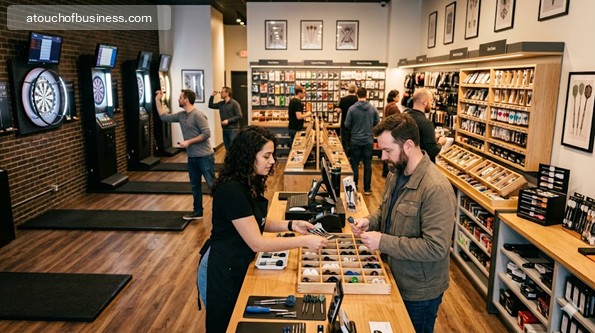
What to Expect From This Guide to Starting a Dart Store
This guide walks readers through the key decisions and practical steps involved in starting a dart store, from validating a niche local market to arranging suppliers, inventory, finances, retail systems, and opening checks. The bullets highlight several useful parts of the fuller discussion.
Inside the guide, you will find:
- Startup roadmap: Follow a practical sequence from personal fit and demand research through registration, location selection, supplier setup, build-out, and opening.
- Industry interviews: Hear from people connected to dart shops and product businesses about customer expectations, stock decisions, tester boards, branding, and trust.
- Startup FAQs: Review answers about licenses, opening inventory, MAP pricing, demo lanes, wholesale approval, online competition, and solo ownership.
- Market demand: Investigate leagues, bars, clubs, tournaments, competitors, and service gaps before committing to rent or inventory.
- Financial planning: Calculate fixed costs, transaction volume, margins, operating capital, funding needs, and the limits of infrequent big-ticket repeat sales.
- Store and stock: Plan product scope, supplier accounts, displays, secure storage, demo throwing space, POS records, pricing, and payment systems.
- Local requirements: Verify zoning, occupancy, sales tax, accessibility, insurance, permits, secondhand rules, inspections, and final opening checks.
Continue with the guide to judge whether your local player base and retail plan can support a dedicated dart shop.
Dart Store Overview
As the owner of a dart store, you sell dart equipment, boards, and accessories to casual players, competitive league participants, bar operators, and collectors.
Your inventory covers everything from entry-level starter kits to competition-grade tungsten barrels, bristle dartboards, soft-tip electronic boards, flights, shafts, cases, mats, and replacement parts.
What separates a storefront dart shop from an online seller is the in-person experience — customers can handle the products, get guidance from someone who knows the sport, and walk out with exactly what they need.
This is a niche retail business. The player base is real and passionate, but local demand varies significantly by market.
Before you invest in a lease, inventory, or build-out, you need to know whether enough players live near you and whether they’re currently underserved.
If you want a broader look at the steps involved in starting a business, that foundation applies here too. This guide focuses on the dart store–specific path from concept to opening day.
Is This Business Right for You?
Running a dart shop is a hands-on retail job. You’ll receive inventory, tag products, stock shelves, serve customers, manage reorders, and close out the register — often alone, especially at the start.
Do you know the product? Customers at every skill level will ask you to help them choose barrel weights, tip types, shaft lengths, and flight styles. Product knowledge is a genuine competitive advantage here.
Think carefully about the personal side too. A specialty niche store takes time to build consistent foot traffic. Can your household cover living expenses while revenue builds? Does your family understand the hours and financial uncertainty that come with a new retail operation?
Before you go further, review what business ownership actually involves. The more clearly you understand those demands upfront, the better your launch decisions will be.
This business may not fit you if:
- You have no knowledge of dart products, board types, or the sport’s terminology
- Your local area has little visible dart activity — no leagues, no bar boards, no clubs
- You can’t cover personal expenses through a slower early period
- You’re not prepared to manage daily retail tasks without a team behind you
- You’re hoping to compete on price alone against established online dart sellers
Talk to people who run dart shops in other markets before you commit. Reach out directly, prepare your questions in advance, and listen honestly.
Their experience won’t match yours exactly, but their firsthand insight is more reliable than anything you’ll find in a business overview.
You can also talk to owners of comparable specialty sporting-goods shops. Ask about what they wish they’d known before opening.
Red Flags Before You Start
A dart store can work well in the right market. In the wrong one, it’s a difficult climb from day one.
Watch for these signals before committing:
- No visible local dart activity. If you can’t find leagues, bars with boards, clubs, or tournament listings in your area, local demand may be too thin to support a storefront. Don’t sign a lease until you’ve confirmed players exist and are underserved.
- Heavy online competition you can’t answer. Amazon and specialty online dart sellers carry the same SKUs, ship fast, and have no storefront overhead. If your only differentiation is product availability, you’ll struggle. Define your angle — selection depth, expert guidance, demo throwing, or league support — before opening.
- Durable products mean infrequent repeat board sales. A quality bristle dartboard lasts years. Your revenue depends on accessories, replacement parts, and a steady flow of new customers. Run the math on that reality before signing anything.
- Rent or overhead that exceeds what a niche customer pool can support. Independent specialty retailers operate on tight net margins after overhead. The rent you commit to must be supportable by a relatively small player base. If the math only works in an optimistic scenario, reconsider the location.
- Overbuying inventory before you know your market. A broad product mix ties up capital in slow-moving items. This is one of the most common early failures in niche retail. Start tight and expand based on actual sales data.
- Signing a lease before confirming zoning and occupancy. This is the single most costly mistake new retail owners make. Confirm that the address is zoned for retail and that occupancy requirements are met before you negotiate any lease terms.
Step 1: Assess Your Fit and Realistic Expectations
Start with an honest personal assessment before you touch a business plan or browse real estate listings.
Do you play darts or follow the sport? Customers will ask detailed questions about barrel materials, tungsten percentages, shaft lengths, and flight shapes. If you can’t answer those questions confidently, you’ll lose sales to online sellers who have detailed product pages and customer reviews.
Ask yourself these questions before moving forward:
- Can I describe the difference between a bristle board and an electronic board to a first-time buyer?
- Do I understand the difference between steel-tip and soft-tip darts and which boards each requires?
- Am I prepared to handle daily retail tasks — receiving, pricing, stocking, selling, and reconciling the register — often on my own?
- Can my household sustain itself financially through the first several months of building revenue?
- Do I have the risk tolerance for a niche retail business in a sport that’s popular in some markets and nearly invisible in others?
There’s no license required to sell darts, but there is real expertise required to sell them well. The hardest part of business ownership often isn’t the legal setup — it’s the daily discipline of keeping a specialty operation running when foot traffic is unpredictable.
Step 2: Consider Buying an Existing Business vs. Starting from Scratch
Before you plan a build-out, check whether an existing dart shop or specialty sporting-goods store is for sale in your target market.
An existing operation may come with fixtures, opening inventory, approved supplier accounts, an established customer base, and a known lease.
Weigh both paths honestly:
- Starting fresh gives you full control over product mix, layout, and brand — but requires building everything from scratch, including customer trust
- Buying an existing shop can shorten your timeline, but you may inherit outdated inventory, poor lease terms, or problems the previous owner couldn’t solve
There’s no established dart store franchise model in the U.S., so franchising isn’t a realistic path here. Plan to build an independent operation.
Learn more about starting from scratch versus buying an existing business before you decide.
Step 3: Validate Local Demand Before Any Commitment
Demand validation is your go/no-go checkpoint. Do not skip it.
Your store’s success depends on how many local players there are and whether they’re currently underserved. Some markets have dense league cultures rooted in bar and pub traditions. Others have little organized dart activity at all.
Research your local market before spending anything:
- Search for active dart leagues, bar leagues, and tournament listings in your area
- Visit bars and pubs — count how many have boards and observe whether they’re being used
- Look for recreation centers, colleges, and clubs with dart programs
- Catalog every existing source of dart gear: sporting-goods chains, big-box stores, bars that sell limited gear, and online sellers who ship locally
Then identify your gap. Can local players get expert selection guidance anywhere nearby? Can they handle a dart before buying it? Can they get replacement flights the same day without ordering online?
That gap is your reason to exist. If you can’t define it clearly, pause before committing to a location.
Think through local supply and demand as a filter before making any financial decision.
Confirm demand before you sign anything.
Step 4: Define Your Business Model and Product Scope
Your business model determines everything downstream — your space requirements, supplier needs, staffing plan, and opening inventory budget.
Decide your primary operating model before you price anything:
- Storefront-only retail — sell in person, serve walk-in customers, build local community ties
- Hybrid model — storefront plus an online complement for broader reach
- League supplier focus — specialize in repeat bulk orders for clubs and bar leagues
Each path has different space, inventory, and fulfillment implications. Pick one primary model for launch and expand later once you understand what your market actually buys.
Also decide now whether you’ll offer service add-ons — board installation, basic part replacement, or beginner fitting. Each one changes your space requirements, equipment needs, and insurance considerations.
Decide on used gear carefully:
- Some jurisdictions require a secondhand dealer license to buy and resell used equipment
- Some require purchase recordkeeping for used merchandise
- Verify with your city or county licensing office before committing to that track
Lock down your model before searching for a location or contacting suppliers.
Step 5: Build a Business Plan Around the Dart Store Reality
A business plan keeps your thinking clear when things get complicated after you open.
Use everything you’ve gathered so far — demand research, model decisions, cost planning, and supplier intelligence — to put the plan together. Learn how to write a business plan that actually guides your decisions.
Your plan should cover:
- Your concept and competitive differentiation — what makes your store worth visiting over online options
- Customer types and how you’ll reach them at launch
- Competitive landscape — who’s already serving local players and how you’re different
- Opening product mix and assortment strategy
- Pricing approach and MAP (Minimum Advertised Price) considerations
- Startup cost list and operating capital requirements
- Funding sources and break-even logic
- Pre-opening steps and target opening timeline
Profit potential belongs in your plan too. See the Business Plan section later in this guide for that detail.
Step 6: Choose a Structure and Register Your Business
Before you open a bank account, contact a supplier, or sign a lease, your business needs a legal structure and a registered name.
Many new retail owners start as a sole proprietorship and later form an LLC as risk and revenue grow. Talk to an attorney or accountant about which structure fits your goals and local rules before you file anything.
Complete these registration steps in order:
- Search your proposed business name through your state’s business filing office and the U.S. Patent and Trademark Office before investing in signs or branding
- Register your business structure with your state’s business filing office
- File a DBA (doing business as) if you operate under a name other than your legal entity name — requirements vary by state and county
- Obtain your Employer Identification Number (EIN) from the Internal Revenue Service — needed for banking, taxes, and hiring even with no employees
Get your EIN before anything else that requires a tax ID. The IRS issues it free, and it unlocks the rest of your setup steps.
Step 7: Handle Sales Tax and Pre-Opening Compliance
Retail sales of tangible goods are taxable in most states. You need a sales tax permit — also called a seller’s permit — from your state tax agency before your first transaction.
Check with your state’s department of revenue for the exact registration process. Some states also require a separate local tax permit at the city or county level.
Other compliance items to verify before opening:
- General business license: Many cities and counties require one before you operate; check your city or county licensing portal
- Sign permit: Exterior signs often require approval; size, lighting, and placement rules vary by jurisdiction; verify with the local building department before ordering signs
- Secondhand dealer license: Required in some jurisdictions if you buy or resell used gear; check with your city or county licensing office
Don’t assume your jurisdiction doesn’t require something. Check each item directly with the relevant office.
Learn more about business licenses and permits so you don’t miss anything before opening.
Step 8: Find, Evaluate, and Secure Your Retail Location
Your location is one of the most consequential decisions you’ll make. A dart shop in the wrong spot — low visibility, no nearby player population, or bad lease terms — is very hard to recover from.
Prioritize locations near bars and pubs with boards, recreation centers, college campuses, or neighborhoods with confirmed dart activity. Good parking, street visibility, and easy access all matter.
Before you sign a lease, verify all of these:
- Zoning: Confirm the address is zoned for retail use with the local planning and zoning office — do this before you tour the space
- Certificate of occupancy: Most storefronts require one, especially if the previous tenant operated a different type of business or if you’re doing build-out; verify with the local building department
- Build-out permits: Any structural, electrical, plumbing, or mechanical changes require building permits and inspections before you open
- ADA accessibility: Storefronts open to the public must meet ADA design standards for entry, aisles, and checkout; verify requirements with your building department
Think carefully about square footage. A compact dart shop can operate in a few hundred square feet for product display plus a receiving area.
If you’re adding a demo throwing lane, you need enough room for the regulation throwing distance of 7 feet 9¼ inches from the oche to the face of the board, plus clearance behind the board and beside the throw line.
Review every lease clause carefully before signing:
- Rent escalation terms and annual increase caps
- Renewal options and exit provisions
- CAM (Common Area Maintenance) charges
- Tenant improvement allowances for build-out costs
- Insurance requirements — some landlords require you to name them as an additional insured
Have an attorney review the lease before you sign. Lease commitments are very difficult to exit.
Check your signage options for the location early — restrictions on sign size or illumination can limit your visibility on the street.
Confirm zoning and occupancy before you negotiate — not after.
Step 9: Assess Profit Potential and Plan Your Break-Even
Understand the financial reality of a dart store before you commit to a lease, place a large inventory order, or take on financing.
Revenue comes from individual retail transactions — walk-in customers, repeat players, league participants, and bar operators buying replacement gear.
The product durability issue is real. A quality bristle board can last years with proper care. High-ticket dart sets don’t get replaced seasonally.
That limits repeat revenue on big-ticket items and shifts your business toward accessories, replacement parts, and new customer acquisition as primary ongoing revenue sources.
Many leading dart brands enforce MAP (Minimum Advertised Price) policies. These set a floor on the price you can publicly advertise and protect your margins against online price erosion — but you must price at or above MAP to stay an authorized dealer. Know this before you build your pricing model.
Before committing to a location or inventory budget, calculate:
- Your total monthly fixed costs — rent, insurance, utilities, POS system fees, any loan payments
- The number of transactions you need each month to cover those costs at your average margin
- Whether your realistic local customer pool can support that volume
- How many months of operating capital you’ll need before revenue is consistent
Plan operating capital as a separate budget from startup spending. Running out of cash to reorder inventory and pay rent during a slow early period is one of the most common reasons retail startups close.
Review how to estimate profitability and revenue for a new business before finalizing your numbers.
If the math only works in your best-case scenario, adjust the model before you commit.
Step 10: Set Up Supplier Accounts and Source Your Inventory
You need confirmed supplier relationships before you can finalize your opening inventory plan — and supplier approval can take time, so start this step early.
Major U.S. dart distributors carry broad product lines from established brands including Winmau, Unicorn, Harrows, Shot Darts, Target, Viper, Arachnid, and Bottelsen. Getting approved for wholesale accounts is the foundation of your entire product offering.
What suppliers typically require to open a wholesale account:
- Proof of business registration
- A valid seller’s permit
- Evidence that your operation is a legitimate dart-related retail business — a physical location, a website, or a demonstrable connection to the sport
Understand each supplier’s minimum order requirements, reorder cycles, lead times, and return policies before placing any order.
Ask about display programs too — some suppliers provide branded merchandiser racks, tester dart sets, and point-of-sale materials at no cost when you stock their products.
Plan your opening inventory thoughtfully:
- Bristle dartboards and electronic/soft-tip boards at multiple price tiers
- Steel-tip dart sets and soft-tip dart sets from beginner to mid-level
- Flights, shafts, and replacement tips in multiple styles
- Dart cases, mats, surrounds, backboards, and mounting hardware
- Accessories — spare parts kits, grip aids, oche markers, and scoreboards
Start with a tighter range than you think you need. Track what sells, then expand based on actual demand — not assumptions.
Overbuying before you know your local market is a predictable early mistake in niche retail.
Step 11: Open a Business Bank Account and Arrange Funding
Open a dedicated business bank account as soon as your entity is registered and your EIN is in hand. Keep business and personal finances completely separate from your first transaction.
Build your funding picture across all startup cost categories:
- First and last month’s rent plus security deposit
- Leasehold improvements and build-out
- Opening inventory
- Display fixtures, shelving, and demo board setup
- POS system hardware and software
- Business insurance first payment
- Signage, permits, and licensing fees
- Security system
- Operating capital reserve — separate from all of the above — to cover fixed costs during the ramp-up period
Funding options to explore before committing to major expenses:
- Personal savings or household investment
- SBA loan programs — the 7(a) program covers general startup funding; microloans cover smaller amounts
- Conventional small business bank loan or line of credit
- Equipment financing for POS systems and fixtures
Don’t sign a lease or place a large inventory order until your funding is confirmed and your operating reserve is in place.
Learn what’s involved in getting a business loan if outside financing is part of your plan.
Step 12: Get Your Business Insurance in Place
Get insurance in place before you open — not after your first customer walks in. A storefront with walk-in traffic, product inventory, and sharply pointed merchandise creates real liability exposure from day one.
General liability insurance is the standard starting point for retail. It covers third-party bodily injury and property damage — a customer who slips in your store, a product that causes a claim, or damage to someone else’s property.
A business owner’s policy (BOP) bundles general liability and commercial property coverage into one plan and is typically the most cost-efficient baseline for an independent retail shop.
Review the basics of business insurance before you shop for coverage.
Additional coverage to consider based on your setup:
- Workers’ compensation: Required in most states as soon as you have even one employee — verify your state’s threshold with your state labor or workforce agency
- Business interruption insurance: Covers lost income if a fire, flood, or other covered event forces a temporary closure
- Cyber liability: Recommended if you store customer data or process card payments through a connected system
- Commercial umbrella: Excess liability coverage above your GL limit; some landlords require this before signing a lease
- Product liability: May be included in your general liability policy — confirm with your insurer
Check your lease for insurance requirements before you bind coverage. Many landlords require minimum liability limits and want to be named as an additional insured on your policy.
Step 13: Build Out Your Store and Set Up for Opening
Once your lease is signed, permits are approved, and funding is confirmed, you can turn the space into a functioning dart shop.
Start with the floor plan. Organize the store into clear product zones — boards, darts by type and tip style, accessories and replacement parts — so customers can find what they need without asking for help at every turn.
Your store setup checklist:
- Freestanding shelving for boards and accessories
- Wall-mounted display racks for dart sets
- Pegboard or rotating displays for flights, shafts, and tips
- A secured case for higher-value dart sets
- End-cap impulse displays near the checkout counter
- Price label holders and shelf signage at every product position
- A receiving table and backstock shelving in a separate storage area
If you’re adding a demo throwing lane, follow regulation setup: the center of the bull should be 5 feet 8 inches from the floor, and the oche should sit 7 feet 9¼ inches from the face of the board.
Install wall protection behind and beside each board, and use directed overhead lighting to eliminate shadows on the target.
Install your POS system and test it thoroughly before opening day. Every product needs to be in the system with a barcode, price, and inventory count.
Run a test transaction end to end — scan, checkout, receipt, and payment — before a single real customer arrives.
Get every inspection and certificate signed off before you open to the public.
Step 14: Set Pricing, Business Identity, and Operations
Most established dart brands enforce MAP policies — you can’t publicly advertise prices below their set floor without risking your authorized dealer status. Build your pricing model around MAP rates from the start.
Learn how to approach pricing your products so your margins are realistic from day one. Your gross margin on any given SKU depends on your supplier cost, the product tier, and the MAP rate — verify actual margins from supplier price sheets before you finalize your product selection.
Identity items to have in place before opening:
- Registered business name confirmed and cleared
- Exterior signage installed — after your sign permit, if required
- Business phone line active
- Business email set up and monitored
- Domain registered and a basic web presence live — this also helps wholesale suppliers verify your business exists
- Bookkeeping or accounting software set up and ready before your first sale
Set up your merchant account so you can accept credit cards, debit cards, and contactless payments. Test all payment types before opening day.
Step 15: Complete Pre-Opening Checks and Prepare to Open
Don’t rush to opening day. A storefront that opens before it’s ready makes a bad first impression that’s hard to recover from in a niche community.
Confirm every item on this list before you open:
- All permits and approvals are in hand — business license, certificate of occupancy, sign permit, and any required inspections
- Entire opening inventory is received, checked, tagged, and priced within MAP policy limits
- POS system is live — inventory loaded, test transaction completed, all payment types working
- Demo boards are mounted at regulation height and distance with wall protection and proper lighting
- Business hours posted at entry
- Business license posted if your jurisdiction requires it
- Return and exchange policy posted at checkout
- ADA accessibility confirmed for the space
- Security cameras and alarm system installed and tested
- Business insurance active before the first customer visits
- Business bank account open and separate from personal finances
- Bookkeeping system operational and ready for day-one transactions
- Any staff trained on the POS, product basics, and store policies
- Secondhand dealer license in hand and purchase log ready — if you’re buying used gear and your jurisdiction requires it
- Shipping supplies rated for steel-tip darts on hand — if you’re also fulfilling online or special orders
Run a soft opening or invite a test group before your public launch. Operating the store with real customers even once will surface gaps that a checklist alone won’t catch.
Do the soft opening before you announce — not after.
Business Plan
A dart store business plan keeps your strategy grounded in reality — before you sign a lease, place a large order, or commit to financing.
Start with your demand research. Who are your customers, where are they, and why will they choose your store over online options or the limited selection at a big-box retailer? Your answer to that question should drive every other decision in the plan.
Work through the financial reality next. Revenue comes from individual product transactions — walk-in customers, league players buying gear and accessories, bar operators restocking boards, and beginners who need a complete first setup.
Repeat revenue on high-ticket items like dartboards and premium dart sets is infrequent — quality products last. Your recurring revenue comes from accessories, replacement parts, and a steady flow of new customers. Plan your product mix with that reality in mind.
Your plan should address each of these financial questions before you commit to major spending:
- What are my total monthly fixed costs — rent, insurance, utilities, POS fees, and any loan payments?
- At my expected average transaction value and gross margin, how many sales per month do I need to break even?
- Is my realistic local customer pool large enough to reach that volume?
- How many months of operating capital do I need before revenue stabilizes?
MAP policies protect your margins by preventing online sellers from undercutting your advertised prices on the same brands. But they also mean you can’t compete on price alone.
Your plan should reflect a clear differentiation strategy — what you offer that online sellers can’t: immediate availability, expert guidance, the ability to try before buying, and community connection with local leagues and players.
Include a realistic funding section that covers startup spending, lease deposits, opening inventory, build-out costs, and a separate operating capital reserve.
Underestimating how long it takes to build consistent revenue is one of the most common reasons retail startups close in their first year.
Use your plan to stress-test the model before you’re committed. If the math only works with optimistic assumptions about traffic and sales volume, adjust your location, scope, or model — not your projections.
Review how to write a strong business plan and avoid the startup mistakes that trip up new retail owners.
Opening-Day Red Flags
Opening before everything is ready creates problems that are hard to undo in a tight-knit niche community. Check every item below before you let the first customer in.
Stop and verify if any of these are unresolved on opening day:
- Zoning or certificate of occupancy not confirmed. Operating without the correct approvals can trigger fines or forced closure. Don’t open until this is resolved.
- Inventory not fully received, tagged, and priced. Empty shelves or unpriced products send the wrong message to early customers who may not return.
- POS system not tested end-to-end. A checkout failure on opening day creates friction with your first real customers. Run a complete test transaction before opening.
- Payment processing not fully active. Test credit, debit, and contactless payments before opening. Don’t assume setup is complete until each method is confirmed working.
- Demo boards not mounted at regulation specs. Incorrect height or throwing distance gives customers a misleading experience. Regulation height is 5 feet 8 inches to the center of the bull; regulation throwing distance is 7 feet 9¼ inches from the face of the board.
- Insurance not active. General liability must be in place before any customer enters your store. A single slip-and-fall on day one without coverage is a serious problem.
- Business license not posted. If your jurisdiction requires it to be displayed, it needs to be visible before you open.
- Return policy not clearly posted. Have it written and posted at checkout before your first transaction.
- Steel-tip darts packaged in weak materials for any outgoing orders. Steel points can pierce inadequate packaging and create liability. Use reinforced packaging for any darts you’re shipping.
- Staff not trained before opening. If you have employees, they need to know the POS, product basics, and store policies before customers arrive.
Frequently Asked Questions
Do I need a special license to sell darts?
No special license is required at the federal level to sell darts. A dart store is standard retail.
You’ll need a business registration, a sales tax permit from your state tax agency, and any local business licenses or zoning approvals your city or county requires.
If you plan to buy or resell used gear, check whether your jurisdiction requires a secondhand dealer license — that’s a separate local requirement.
What products should I stock at launch?
A solid opening inventory covers bristle dartboards, electronic/soft-tip boards, steel-tip and soft-tip dart sets at beginner and mid-range tiers, flights, shafts, replacement tips, dart cases, mats, surrounds, and accessories.
Don’t try to carry everything at once. Start with a tight mix, track what sells, and expand from there.
How do MAP policies affect my pricing?
Most established dart brands use Minimum Advertised Price (MAP) policies, which set a floor on the price you can publicly display.
You can negotiate lower privately, but you can’t advertise below MAP without risking your authorized dealer status. Build your pricing and margin expectations around MAP rates before you finalize your product mix.
Should I include a demo throwing lane in my store?
A demo lane is a meaningful advantage over online sellers. Customers who can handle and throw darts before buying are more likely to purchase and more likely to return.
If space and budget allow, include at least one bristle board at regulation height and distance, with proper lighting and wall protection.
How do I get approved for wholesale supplier accounts?
U.S. dart distributors typically require proof of business registration, a valid seller’s permit, and evidence that your operation is a legitimate dart-related retail business.
Some require a verifiable physical location or website. Start the application process early — supplier approval can take time, and you need confirmed supply before you finalize your opening inventory plan.
What is the difference between a bristle board and an electronic board, and should I carry both?
A bristle (sisal) board is used with steel-tip darts and is standard in competitive play. An electronic board uses soft-tip plastic darts and has automated scoring — popular in bar settings and casual play.
Both customer types are real. Carrying both board styles and their compatible dart sets gives you the broadest appeal in most markets.
How do I compete with online dart sellers?
Online sellers win on price and shipping speed for customers who already know exactly what they want. You win on immediate availability, hands-on product selection, expert guidance, and local community connection for leagues and regular players.
Build your store around those advantages. Don’t try to out-price the internet — out-serve it.
Can I run a dart store as a solo owner without employees?
Yes. Many small dart shops launch with the owner as the sole operator, which keeps payroll costs low during the early period when revenue is still building.
The tradeoff is that every function — buying, receiving, stocking, serving customers, and managing the books — falls to you. Plan your store hours and coverage strategy around your own capacity before you open.
What Dart Store Owners Can Learn From Industry Interviews
These interviews share practical lessons from people involved in dart shops, darts product businesses, and the wider darts retail market. They cover customer demand, stock choices, tester boards, online sales, branding, supplier relationships, and building trust with players.
Readers can use these interviews before starting a dart store to think through what customers expect, which products may need careful stocking, and how a shop can become part of the local darts community instead of only selling equipment.
Inside Jamie’s NEW Darts Shop + 180 Challenge Prize Reveal!
This interview covers the opening of the Stod-Darts shop, including opening day, customer queues, best sellers, tester boards, online orders, and turning a pop-up setup into a proper dart shop.
It is useful because it gives a close look at the first days of operating a dart store and shows how stock planning, customer flow, and try-before-you-buy features matter from the start.
This podcast interview features Dave Smith of Eagle Darts discussing how the business started, how it developed, and what drew him into the darts market.
It is useful because it gives startup-minded readers a grounded example of building a darts business around passion, name recognition, growth, and customer connection.
The Darts Shop Expert: How I Helped the Worlds Best Darts Players! Karl Holden
This interview features Karl Holden, owner of a well-known darts shop, discussing his experience helping top players and working inside the darts retail world.
It is useful because it shows how product knowledge, player relationships, and trusted advice can become a major part of a dart shop’s value to customers.
Do You LOVE DARTS? We Certainly Do!
This interview features Marc Kerr, Senior Media Manager at Dartshopper and founder of Love Darts UK, discussing his role in the darts retail and product space.
It is useful because it gives future dart store owners insight into branding, product identity, online retail, and how specialist darts businesses can connect with committed players.
DART SHOP DIARIES: Discovering UK Dart Shops | EP1 – Dart Scene Heanor
This video is part of a dart shop series that visits UK dart shops and includes conversations with people working in and around the shop environment.
It is useful because it helps readers see how a specialist dart shop presents products, serves local players, and creates an in-person buying experience.
From Garage To Global: The Shot Darts Story
This interview with Peter McCormick of Shot Darts covers the growth of a family darts business, branding, persistence with customers, product storytelling, and building a global presence.
It is useful because dart store owners can learn how suppliers think about brand, community, product positioning, and long-term customer relationships.
Luke Littler: Darts Shop in Enfield ‘Has Queue Down the Street’ After World Championship
This Sky News video includes a darts shop owner in north London discussing the surge in customer interest after Luke Littler’s World Championship win.
It is useful because it shows how trends, major players, and media attention can quickly affect store traffic, beginner demand, and local interest in darts equipment.
Related Articles
- How To Start a Sporting Goods Store
- How To Start a Retail Game Store
- How To Start a Golf Disc Shop
- How To Start a Hobby Store
- How To Start a Board Game Café
- How To Start a Pool Hall
Sources:
- A-Z Darts: Magic Darts Wholesale Account Guide
- Shot Darts: Become a Shot Darts Dealer
- Dutchman Darts: U.S. Darts Distributor Overview
- Dart Brokers: Wholesale Account Information
- UpCounsel: Retail Business Licenses Overview
- Toast POS: Retail Store Licenses and Permits
- Insureon: Retail Store Business Insurance
- Business Insurance USA: Retail Store Insurance Coverage Guide
- HowToStartAnLLC: Dart Store Insurance Overview
- TrueProfit: Retail Profit Margin Benchmarks
- KORONA POS: Good Retail Profit Margin Guide
- ADA.gov: ADA Accessible Design Standards
- SBA.gov: Business Licenses and Permits Guide
- SCORE: Choosing a Retail Store Location
- Wolters Kluwer: Retail Business License Management