
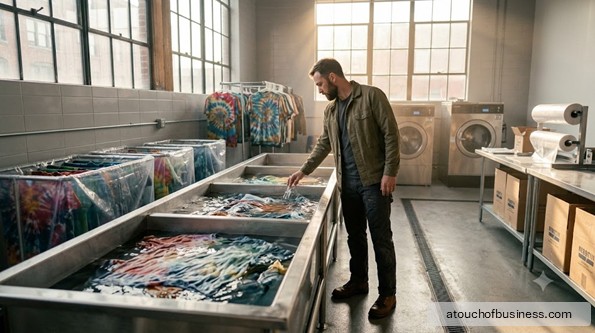
What to Expect From This Guide to Starting a Tie Dye Business
This guide walks you through the key decisions and practical steps involved in starting a shop-based tie dye business, from assessing fit and choosing revenue streams to securing a suitable space, preparing production, testing workshops, and opening the store. The list below spotlights selected parts of that broader review.
Inside the guide, you will find:
- Startup roadmap: Work through ordered steps covering owner fit, industry conversations, revenue choices, demand, registration, location, compliance, production, pricing, and final checks.
- Industry interviews: Hear from tie dye entrepreneurs discussing demand testing, online sales, custom orders, workshops, inventory, suppliers, promotion, and time management.
- Startup FAQs: Get practical answers about licenses, shop space, professional dyes, wastewater, retail pricing, revenue streams, and chemical safety.
- Revenue planning: Compare retail sales, custom dye orders, public workshops, and group events before committing to the shop layout and equipment.
- Financial planning: Price startup items, calculate break-even volume, account for materials and labor, and prepare for seasonal changes in demand.
- Shop requirements: Review zoning, plumbing, ventilation, wastewater, accessibility, production equipment, safety documentation, insurance, and payment systems.
- Opening preparation: Build quality-checked inventory, run test workshops, fix workflow bottlenecks, and complete permit, supply, booking, and facility checks.
Begin by testing whether the hands-on production routine and multi-use shop model suit your skills, finances, and local market.
As a tie dye business owner, you’ll transform plain fabric into vibrant, one-of-a-kind garments and accessories using fiber-reactive dyes and resist techniques — folding, binding, crumpling, or clamping fabric to create patterns no machine can replicate.
The shop-based model layers three things into one physical space: a production studio where you dye, rinse, and wash garments; a retail floor where customers browse and buy finished pieces; and a workshop area where paying participants create their own tie dye under your instruction.
That combination gives you multiple income streams. It also means you carry fixed overhead — rent, utilities, insurance — from the day you sign a lease.
That’s a meaningful difference from selling online or at craft fairs, and it shapes every decision you’ll make before you open.
Before you plan the studio layout or shop for dye suppliers, spend some honest time on the personal side of this decision.
Are you comfortable standing on your feet for hours in a wet, dye-stained environment, managing production while helping walk-in customers and facilitating workshop groups? That’s a realistic picture of a typical day.
Do you have enough savings — or another income source — to cover both your personal living expenses and business overhead while you build a customer base?
Does your household support this plan? A commercial lease is a multi-year commitment. Make sure the people who share your financial life understand what that means before you sign.
If any of those questions give you pause, that’s worth sitting with before moving forward. The realities of business ownership catch many first-time owners off guard.
Red Flags Before You Start
A tie dye shop can work well — but several warning signs are worth checking before you commit to a lease or spend significant capital on setup.
Watch for these red flags:
- The location lacks the right foot traffic. A shop-based tie dye model depends on walk-in customers and workshop bookings. Arts districts, tourist corridors, beach or resort towns, and college neighborhoods support this model. A generic suburban strip mall often doesn’t. Validate foot traffic before you sign anything.
- The space isn’t built for dye work. Tie dye production needs a dedicated utility sink, floor drainage or non-porous flooring, and ventilation for dry dye powder handling. Many commercial spaces lack these features. If adding them would strain your startup budget, keep looking.
- You haven’t priced out the slow season. Demand for tie dye peaks in spring and summer and drops sharply in fall and winter. Fixed overhead doesn’t drop with it. Plan for how you’ll cover costs during slow months before committing to a lease.
- Your technique isn’t production-ready. Producing saleable garments consistently — correct color combinations, even dye uptake, clean pattern definition — takes practiced skill. If you can’t reliably produce market-quality work across multiple techniques right now, more practice time before opening is the right call.
- Workshop revenue looks good on paper but isn’t validated locally. Workshop and group event income can look attractive in a model, but only if sessions actually fill. Check whether your local market will pay for hands-on creative experiences at your planned price point before building the whole model around them.
- You haven’t disclosed the business type to a potential landlord. Dye work produces stained wastewater, uses significant water, and can permanently stain fixtures. Landlords need to know this before you sign. Transparency upfront protects the relationship and the lease.
These aren’t reasons to walk away automatically — but each one is a reason to pause, verify more, or adjust the plan before spending money.
Step 1: Assess Your Fit and Skills Honestly
The first step isn’t research or location scouting. It’s an honest look at whether this business suits you right now.
Running a tie dye studio is physically demanding and creatively repetitive. You’ll pre-soak garments in soda ash solution, apply dye using squeeze bottles, wait for curing windows, rinse, machine wash, hang dry, tag, and display — all while managing the retail floor and facilitating workshops.
Do you genuinely enjoy that kind of hands-on, production-focused routine?
You also need real technical skill, not just enthusiasm. Fiber-reactive dyes bond chemically with fabric, and the results depend on correct pre-treatment, accurate dye mixing, proper curing time, and the right technique for each pattern. Muddy colors or poor dye uptake don’t look artisanal — they look like mistakes.
Be equally honest about the business side. A shop-based model with fixed overhead is not a low-stakes experiment.
You need capital reserves, personal financial stability, and a support system that understands you may not draw a salary for months.
If the technical skills are there and the personal situation supports the risk, keep going. If either is shaky, address those gaps before spending money on a lease.
Step 2: Talk to People Who Run This Kind of Business
Before you validate markets or compare locations, talk to owners who have already done what you’re planning — in a different market, so there’s no competitive conflict.
Look for people running tie dye shops, fiber arts studios, or creative workshop businesses. Ask them specific questions: Which revenue streams actually perform in a shop setting? How do they handle the slow season? What does the real monthly overhead look like? What do they wish they had known before signing their first lease?
Also talk to people who run creative retail operations more broadly — pottery studios, paint-and-sip shops, or other hands-on experience businesses. They deal with the same fixed-overhead, workshop-booking, and seasonal-demand dynamics you will.
These conversations are hard to replace. Every owner’s experience is different, but the patterns across several conversations will tell you more than any article.
For more on what to ask and how to approach these conversations, see advice from real business owners.
Step 3: Define Your Revenue Streams and Business Model
Before you search for a space, decide what your shop will actually do — and in what proportion.
A shop-based tie dye business can generate income from several sources:
- Ready-made retail sales: You produce finished garments and accessories and sell them from the shop floor.
- Custom dye orders: Customers request specific garments, color palettes, or patterns; you dye to their specifications.
- DIY workshop sessions: Participants pay a per-person fee to dye a garment in your studio under your guidance.
- Group event bookings: Birthday parties, bachelorette events, corporate team-building sessions, and school or camp groups using your studio space.
This decision shapes everything that follows. Workshop sessions require large work tables and per-station supply setups. Group events require booking systems and participant waivers. Retail sales require display fixtures and a broad finished-goods inventory.
A space suited for pure retail production isn’t always right for high-volume workshop hosting — and vice versa. Know your model before you tour locations.
Does running a creative experience business appeal to you as much as the dyeing itself? Workshop facilitation is a different skill set from production. Both need to suit you for this model to work.
Step 4: Validate Local Demand and Competition
A great product in the wrong location is a slow failure. Before you commit to any market, validate the demand.
Research what’s already there. Are there other tie dye studios, hands-on craft workshop businesses, or creative experience shops nearby? What do they charge? What do they seem to do well — and where are the gaps?
Then look at the location itself. Your likely first customers are walk-in shoppers who respond to a colorful, visually interesting retail display; families and groups looking for a hands-on experience; and tourists or visitors to arts-focused areas.
Does the area attract those people consistently?
Tie dye demand peaks in spring and summer. If your location only generates foot traffic during those months, you need to plan for what the rest of the year looks like before signing a multi-year lease.
Understanding local supply and demand is one of the most important go/no-go checks before any brick-and-mortar commitment.
Step 5: Consider Whether to Start From Scratch or Buy an Existing Business
Most tie dye shop owners start from scratch — and that’s realistic, given that no established national franchise model exists in this space.
Starting fresh means building a customer base, setting up a studio, and establishing supplier relationships from zero. It gives you full control over the model, the layout, and the brand.
Buying an existing creative studio is worth considering if something suitable exists locally. An existing shop may come with equipment already in place, a running lease, and some established customer relationships.
Evaluate carefully: Does the space suit your specific model? Does the existing equipment meet your standards? Is there genuine transferable goodwill, or just fixtures and a name?
The right path depends on your budget, your timeline, and what’s available in your market. For a detailed look at the tradeoffs, see starting from scratch vs. buying a business.
Business Plan
A tie dye shop carries real fixed costs before it earns its first dollar. Writing a practical business plan before you commit to a lease is the clearest way to know whether the numbers can work.
Start with your revenue model. Which income streams will you use — retail, custom orders, workshops, group events — and in what proportion? Each stream has different equipment requirements, labor demands, and margin structures.
Then map the startup cost categories you’ll need to price out locally:
- Lease security deposit and first and last month’s rent
- Leasehold improvements: utility sink installation, floor protection, ventilation upgrades, plumbing modifications
- Production equipment: washout station, drying racks, washing machine, mixing supplies, utility tubs
- Workshop setup: tables, per-station supplies, booking and scheduling system
- Retail display fixtures, signage, and point-of-sale system
- Initial blank garment inventory across styles and sizes
- Initial dye and chemical supplies: fiber-reactive dye powder, soda ash, urea, synthrapol, and fixative
- Consumables: rubber bands, squeeze bottles, gloves, and plastic sheeting
- Business registration, permit, and license fees
- Insurance: general liability, product liability, and commercial property
- Legal and accounting setup
- Operating capital reserve to cover overhead during the ramp-up period
Price every item on that list based on your specific location and choices — new vs. used equipment, space size, lease rate — before making any commitment.
Then work through your break-even logic. Add up your total monthly fixed costs: rent, utilities, insurance, and minimum supply spend.
Divide that by your average revenue per garment sold or per workshop participant. That’s the minimum volume you need each month just to cover costs, before you pay yourself anything.
Is that volume realistic given your location and the local demand you validated in Step 4?
Factor the slow season into the model explicitly. Tie dye demand drops meaningfully in fall and winter. Your plan should account for how you’ll cover overhead during those months — through private event bookings, holiday workshop programming, savings reserves from peak season, or another source.
Pricing is a core part of the plan. For finished garments, a cost-plus approach is standard: add up your blank garment cost, dye materials per piece, labor time, and a share of overhead, then apply a markup.
Complex techniques — ice dye, geode patterns, multi-step shibori-inspired work — support higher price points than simple spirals. For workshop sessions, build pricing around per-participant material cost, your facilitation time, overhead per session, and your target margin.
For guidance on putting a plan together, see how to write a business plan and estimating profitability for a new business.
Step 6: Choose a Legal Structure and Register the Business
Before you can sign a lease, open a bank account, or buy supplies for resale, you need a legal business entity.
Sole proprietorship and LLC are the most common structures for small creative studios. An LLC is worth considering in particular: when you host members of the public in a studio where chemicals are in use, the personal liability separation an LLC provides has practical value.
File your entity with the appropriate state agency — typically the Secretary of State’s office. If you’re operating under a business name different from your legal entity name, you’ll also need to register a DBA.
Apply for a free Employer Identification Number (EIN) at irs.gov. You’ll need it for your business bank account, tax filings, and any future hiring.
Open a dedicated business bank account before you spend a single dollar on the business. Keeping business and personal finances separate from the start protects you legally and simplifies accounting.
For a full comparison of structure options, see LLC vs. sole proprietorship.
Step 7: Verify Zoning, Location Suitability, and Lease Terms
This step belongs before you sign — not after. Zoning and building requirements can make a seemingly ideal space unusable for a tie dye shop without expensive modifications.
Confirm before you sign anything:
- The space is zoned for retail and light production. A tie dye shop involves both customer-facing retail and active production, and some commercial zones restrict production activity.
- Public workshop sessions are permitted. Hosting members of the public for hands-on activities may require an assembly-use designation or a conditional use permit in some jurisdictions.
- The space has — or can be modified to have — a dedicated utility sink with hot and cold water, floor drainage or non-porous flooring in the production area, and adequate ventilation for handling dry dye powder.
Be transparent with the landlord about your operation. Dye work produces colored wastewater, uses substantial water, and can permanently stain fixtures.
Landlords who discover this mid-lease can create serious problems. Address water usage and dye disposal expectations in writing before you sign.
The space should also meet ADA accessibility requirements for a customer-facing retail and workshop location.
Confirm that the certificate of occupancy covers retail and workshop use — or that a change-of-use filing is feasible and affordable before you commit.
Have an attorney review the lease before signing. Commercial leases offer far fewer tenant protections than residential ones, and the terms you negotiate now follow you for years.
Step 8: Complete Legal and Compliance Setup
Once the location is confirmed, work through the compliance checklist before opening day.
At the city or county level: Apply for a general business license from your city or county clerk’s office. This is required in most jurisdictions before you operate commercially. Check whether your exterior or window signage requires a sign permit — many jurisdictions require prior approval. Search your local planning department for sign permit requirements.
At the state level: Obtain a seller’s permit — also called a sales tax permit — from your state’s Department of Revenue before you make your first sale.
This permit does two things: it authorizes you to collect and remit sales tax, and it lets you purchase blank garments and dye supplies from wholesale suppliers using a resale certificate, meaning you won’t pay sales tax on inventory you’ll resell.
Check how your state treats clothing sales. Some states exempt basic clothing from sales tax; others don’t. Workshop session fees may also be taxable in some states. Your state’s Department of Revenue is the right place to verify both questions.
For wastewater: Contact the local municipal wastewater authority before opening to ask whether commercial-scale dye water disposal to the sanitary sewer requires any pretreatment, a discharge permit, or prior notification.
Requirements vary by municipality and production volume. Never discharge dye water to storm drains.
If you hire employees: Register for state income tax withholding and unemployment insurance accounts with your state’s labor and revenue departments.
OSHA’s Hazard Communication Standard (HazCom) requires you to maintain Safety Data Sheets for all chemical products used, train employees on chemical hazards, and ensure containers are properly labeled.
Fiber-reactive dye powders and soda ash are inhalation irritants when airborne during dry mixing. Your employees need to know this and have the right protective equipment.
For a comprehensive overview of business licenses and permits, that resource covers the broader landscape of what to verify locally.
Step 9: Set Up Suppliers and Build Your Inventory
Your supply chain has two sides: blank garments and dye materials. Set up accounts with reliable wholesale sources before you start production.
For blank garments: Look for wholesale apparel suppliers that carry styles suited for dyeing — t-shirts, sweatshirts, hoodies, socks, tote bags, scarves, and bandanas in a range of sizes. Ask specifically about prepared for dye (PFD) blanks, which are pre-treated for optimal dye uptake and eliminate the soda ash pre-soak step. PFD garments accept color more evenly and produce more vibrant results.
For dye and chemicals: Specialty wholesale suppliers such as Dharma Trading Co., Pro Chemical & Dye, and Grateful Dyes are established sources for professional fiber-reactive dye powder, soda ash, urea, synthrapol, and other auxiliaries. These suppliers offer small minimum orders well suited to a startup studio.
Stock your auxiliaries alongside your dyes:
- Soda ash — the alkaline activator that chemically bonds fiber-reactive dye to cellulose fibers
- Urea — improves dye solubility and keeps fabric moist during curing
- Synthrapol — a specialized detergent for pre-washing fabric and removing excess unfixed dye after curing
- Color fixative for post-wash treatment
- Rubber bands, zip ties, string, squeeze bottles, gloves, and plastic bags for the production process
Build an initial inventory of finished garments before opening day. Your retail floor needs real product on display from the start.
Step 10: Set Up the Production Studio and Retail Space
How you lay out the shop determines how smoothly it runs. Get this right before you open, not after your first busy weekend exposes the gaps.
The production area needs these non-negotiables:
- A dedicated utility sink with hot and cold water — rinsing dyed garments in a residential bathroom fixture will permanently stain it
- Non-porous flooring or sealed concrete that can handle water, dye, and regular cleaning
- Adequate ventilation — fiber-reactive dye powder is an inhalation irritant when you’re measuring and mixing dry; airflow matters
- Drying racks with enough capacity to handle your production volume
- A washing machine for the final heat-set wash after rinsing — this is part of the production process, not optional
Keep the production area and the customer-facing retail area clearly separated. Customers who wander into an active dye session face a real risk of ruining their clothing.
If your model includes workshops, set up dedicated stations with table surface protection (plastic sheeting), per-station supplies laid out before each session, and a clear path from entry to the dyeing area to the rinsing area.
Establish your wastewater disposal protocol before the first garment hits water. Dilute dye water and route it to the sanitary sewer drain — never to a storm drain.
If the local wastewater authority requires any pretreatment steps, have those in place before opening.
On the retail side, set up display racks and shelving for finished garments, clear pricing on every item, and a point-of-sale system tested and ready before you take your first customer.
Step 11: Price Your Products and Services
Pricing is where creative businesses most commonly undervalue their work. Don’t guess — build your prices from actual cost data.
For finished garments: Start with cost-plus pricing. Add up the blank garment cost, the dye and chemical cost per piece, your labor time valued at a rate that covers the business, and a share of your monthly overhead allocated per unit. Then apply a markup — a 2x to 4x multiple on total cost is standard in this industry.
Simple techniques like a basic spiral support the lower end. Complex, labor-intensive work like ice dye, geode patterns, or multi-step shibori-inspired designs support the higher end.
For workshop sessions: Build the per-participant price from material cost per station (blank garment, dye portion, consumables), your facilitation time for the session, overhead allocated to the session, and your target margin.
A session with low enrollment must still cover those costs. Price accordingly, and consider a minimum participant requirement for bookings.
For custom orders: Charge a premium above standard retail. Color-matching, specific pattern execution, and guaranteed turnaround require more of your time than producing standard inventory.
Research what comparable operators in other markets charge. You’re not copying their prices — you’re checking whether your cost structure allows you to be competitive at a price the market will actually pay.
For a broader look at pricing your products and services, that guide covers the core methods in practical terms.
Step 12: Set Up Insurance, Payment Processing, and Banking
Get these in place before you open — not on opening day.
Insurance is especially important for a customer-facing studio:
- General liability insurance covers customer injuries and property damage claims in the shop. Many commercial landlords require proof of coverage as a condition of the lease.
- Product liability coverage covers claims related to garment defects — dye transfer, skin reactions from underfixed dye, or fabric damage. Make sure this is included in or added to your policy.
- Commercial property insurance protects your equipment, inventory, and improvements to the leased space.
- Workers’ compensation insurance is legally required in most states if you have employees.
A Business Owner’s Policy (BOP) bundles general liability and commercial property coverage at a combined rate. It’s a common and cost-effective option for small retail studios.
For payment processing, set up a point-of-sale system for in-person retail sales and a booking or scheduling system for workshop reservations that accepts online payment. Test both before you open.
See business insurance for a fuller picture of what coverage to consider.
Step 13: Build Inventory and Run Test Sessions
Your shop needs real product on the retail floor from the first day. That means producing before you open — not after.
Build a range of finished garments across multiple techniques and styles. Spirals, crumple patterns, accordion folds, bull’s-eye designs, and at least one or two more advanced techniques like ice dye or shibori-inspired clamping give customers and workshop participants a clear picture of what’s possible.
Vary the product types too. T-shirts and sweatshirts are the anchor, but socks, tote bags, scarves, and bandanas give customers entry-level price points and quick-purchase options.
Before you take paying workshop participants, run at least one or two test sessions with friends or family. Identify where the workflow breaks down — where supply staging is slow, where instructions are unclear, where the rinsing area creates a bottleneck. Fix those problems now.
Apply a quality checklist to every finished garment before it goes on the retail floor. Check for color vibrancy, even dye uptake, clean pattern definition, and the absence of stray dye spots.
Your retail display is your portfolio. What’s on those racks tells every customer exactly what to expect.
Step 14: Final Pre-Opening Confirmations
Run through this before unlocking the door for the first time.
- All licenses and permits are in hand — general business license, seller’s permit, certificate of occupancy, and sign permit if required
- The utility sink and washout area are installed and tested
- The washing machine is installed and tested
- Production area ventilation is adequate for dry dye powder handling
- Safety Data Sheets are assembled for all chemical products on-site
- Protective equipment is stocked: gloves, aprons, safety glasses, and N95 respirators for powder mixing
- Wastewater disposal protocol is established and confirmed with the local authority if required
- Insurance certificates are issued and on file
- Point-of-sale system and payment processing are tested
- Workshop booking system is active, tested, and accepting online payment
- Workshop participant waiver forms are ready — print or digital
- Retail display is stocked with priced, tagged, quality-checked inventory
- Required permits and licenses are posted as your jurisdiction requires
- A test workshop session has been completed and workflow issues addressed
If the production area isn’t fully set up, don’t open the workshop side of the business until it is.
A studio that isn’t ready before it takes paying participants creates real liability risk and reputational damage that’s hard to undo.
Opening-Day Red Flags
Even if the pre-opening checklist is complete, a few problems show up only when the shop is actually running. Watch for these on the first days of operation.
The washout area creates a bottleneck. In a workshop session, multiple participants finish dyeing at similar times and all need to rinse. If the utility sink can’t handle that volume, waiting participants lose the momentum of the experience. Identify this in your test session — not with paying customers.
Dye water is backing up or draining slowly. Rubber bands, string, and fabric fibers can clog drains quickly. Install a mesh strainer at the utility sink drain and check it after every session.
Your drying capacity can’t keep up with production. Wet garments need space and airflow to dry before they can be washed and displayed. Without enough rack space for your production volume, garments sit wet too long and quality suffers.
Workshop participants are getting dye where it doesn’t belong. Even with table protection and aprons, first sessions often reveal coverage gaps. Add plastic sheeting, extra drop cloths, or barrier protection for any surface or equipment near the dyeing stations before the next session.
The retail display and production area aren’t clearly separated. If a customer browsing finished garments can walk directly into an active dye session, you have a liability problem. Create a clear physical boundary — even a simple barrier — between the two areas.
You don’t have written waivers for workshop participants. If you somehow missed this in pre-opening, stop taking workshop bookings until it’s in place. Participants working with dye chemicals in your studio should sign a waiver before the session begins.
Frequently Asked Questions
Do I need any special license to operate a tie dye business in a commercial shop?
No industry-specific professional license is required for tie dye at the federal or most state levels.
You’ll need a general business license from your city or county, a seller’s permit from your state’s Department of Revenue before you make your first sale, and a certificate of occupancy confirming the space is approved for retail and workshop use.
Some jurisdictions also require a sign permit and, depending on your scale of dye water discharge, a check-in with the local municipal wastewater authority. Verify the full list with your city or county clerk and your state’s revenue department.
What kind of space does a tie dye workshop and retail shop actually need?
The space needs a dedicated utility sink with hot and cold water, floor drainage or non-porous flooring in the production area, and ventilation suited for handling dry dye powder.
You also need room for drying racks, a washing machine, a retail display area, and workshop tables for participants.
Many standard commercial retail spaces lack the plumbing or drainage for this kind of production without modification. Factor the cost and timeline of any required leasehold improvements into your startup budget before selecting a space.
What type of dye should I use for a professional tie dye shop?
Fiber-reactive dyes — most commonly Procion MX — are the industry standard for professional tie dye production.
They form a permanent chemical bond with cellulose fibers (cotton, rayon, linen, hemp) and produce vibrant, wash-fast results that don’t fade the way all-purpose household dyes do. Fiber-reactive dyes require soda ash as an activator and cure at room temperature over several hours.
Professional supplies are available through specialty wholesale suppliers with small minimum orders suitable for a startup studio.
How do I handle dye wastewater disposal safely and legally?
Properly diluting dye wastewater before disposal to the municipal sanitary sewer is generally acceptable for small-scale fiber-reactive dye operations in most jurisdictions.
Never discharge dye water to storm drains — those lead directly to natural waterways without treatment.
For a commercial-scale operation, contact the local municipal wastewater authority before opening to confirm whether your volume requires any pretreatment, a discharge permit, or advance notification. Requirements vary by municipality.
How do I price tie dye products for retail?
Start with cost-plus pricing: add up the blank garment cost, dye materials per piece, your labor time, and an overhead allocation per unit, then apply a markup.
A 2x to 4x multiple on total cost is standard in this industry. Simple techniques support the lower end; complex, labor-intensive work like ice dye or geode patterns supports the higher end.
Research what comparable operators in other markets charge to verify your pricing fits within what the market will support.
What are the revenue streams for a shop-based tie dye business?
The typical mix includes retail garment sales, custom dye orders, DIY workshop sessions, and private group events.
Workshop and event revenue can be high-margin when sessions are fully booked. Group events provide predictable advance-booking income, which helps offset the variability of walk-in retail.
Most successful shop-based studios run all four streams, using workshops and events to stabilize revenue during slow retail periods.
Do I need to worry about chemical safety compliance in my studio?
Yes — practically speaking. Dry fiber-reactive dye powder and soda ash are inhalation irritants when airborne during mixing.
Wearing an N95 respirator when measuring and mixing dry powder is standard practice. If you have employees, OSHA’s Hazard Communication Standard requires Safety Data Sheets for all chemical products, proper container labeling, and documented employee training on chemical hazards.
Provide gloves, aprons, and eye protection for production staff and workshop participants. These chemicals aren’t severely hazardous at studio scale, but they warrant consistent safe handling procedures.
Is a tie dye shop a seasonal business, and how should I plan for that?
Yes — demand peaks strongly in spring and summer and drops in fall and winter.
A shop-based model with fixed overhead must plan for this explicitly. Options include shifting to private event and holiday workshop programming in the off-peak months, building a cash reserve from peak-season revenue to carry the slow period, or targeting corporate event bookings that are less seasonal than consumer retail.
Entering a long lease without a concrete slow-season plan is one of the most common financial risks for seasonal creative retail businesses.
Advice From Successful Tie Dye Business Owners
These interviews share practical experiences with testing products, sourcing dyes and blank garments, attracting customers, managing orders, and developing a recognizable tie-dye style.
Use their advice to compare sales channels, production methods, workspace needs, and customer demand before investing heavily in inventory or equipment.
Creative Entrepreneur Andrea Carneiro on Turning a Tie-Dye Passion into a Vibrant Business
Andrea Carneiro explains how customer interest, boutique sales, and a trunk show helped turn her tie-dye hobby into a full-time business.
Her experience shows how small product tests and customer feedback can help confirm demand before making a larger commitment.
Etsy Seller Interview With Lo of DesertDyesbyLo
Lo discusses Etsy listings, product options, made-to-order production, inventory organization, fulfillment, and attracting customers through consistent posting.
This interview offers useful guidance for anyone planning to sell tie-dye clothing online while keeping inventory and production manageable.
The Home of Everything Tie Dye: An Interview With StuyDYED Founder Nadia Pinder
Nadia Pinder describes selling custom garments, offering workshops, handling large orders, and balancing creative production with business management.
Her comments provide a realistic look at the patience, organization, and support needed when operating a creative business alone.
COVID on Campus: The Tie-Dye Entrepreneur
Kyra Surgent explains how she tested demand through friends, purchased supplies in bulk, accepted custom orders, and promoted her products through Instagram.
The interview helps readers understand how a simple home-based operation can grow through referrals, social media posts, and careful order management.
Tie-Dyeing His Way to Entrepreneurial Recognition: Ronaldo Jacobs Aims to Dominate
Ronaldo Jacobs discusses researching the market, practicing his techniques, advertising his designs, sourcing dependable dyes, and balancing the business with another job.
His experience highlights the importance of checking supply availability, understanding material costs, and protecting enough time for creative production.
Related Articles
- How To Start a Fabric Dyeing Business
- How To Start a T-Shirt Business
- How To Start a Screen Printing Business
- How To Start a Fabric Shop
- How To Start an Embroidery Business
- How To Start a Quilt Business
Sources:
- Dharma Trading Co.: Tie-Dye Fiber Reactive Instructions, Dyes for Tie-Dyeing
- Grateful Dyes: Fiber Reactive Dyes and Supplies
- ShirtSpace: Tie-Dye Blanks and PFD Apparel
- JIM.com: Starting a Tie Dye Business
- Floxytiedye: Tie-Dye Chemical Safety Guide, Tie-Dye Waste Disposal Guide
- Alliance Chemical: Soda Ash Complete Guide
- DuraLabel / OSHA: OSHA HazCom Chemical Rules
- Insureon: Crafters Business Insurance
- Thimble: Apparel Maker Insurance
- Avalara: Sales Tax Permits Guide
- Shopify: Seller’s Permit Guide
- LegalZoom: Business License and Permit Checklist
- UpCounsel: Retail Business Legal Requirements
- Prestige 360 Design: Commercial Lease Pre-Signing Checklist
- ProfitableVenture: Tie Dye Business Startup Guide
- Chandye: Tie-Dye Business Step-by-Step
- Brooklyn Craft Company: Tie Dye Workshop Model Example
- Waxon Batik & Dye Studio: Ice Dye vs. Tie Dye Techniques
- Wikipedia: Shibori Technique Overview
- SaleHoo: Tie-Dye Market Trends and Seasonality