
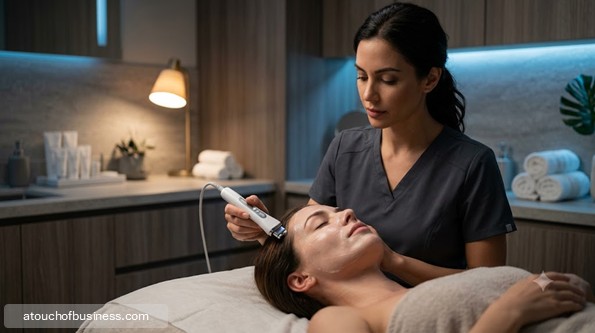
What to Expect From This Guide to Starting a Facial Spa Business
This guide walks you through the key decisions and practical steps involved in starting a facial spa business, from evaluating fit and business models to licensing, market research, funding, facility setup, service pricing, client systems, and opening preparations. These points preview several important areas within the full discussion.
Inside the guide, you will find:
- Startup roadmap: Follow an ordered path through fit, operating models, demand, costs, funding, registration, compliance, location, equipment, systems, pricing, and opening.
- Industry interviews: Learn from estheticians and spa founders discussing training, financing, niche selection, client development, staffing, service design, and gradual growth.
- Startup FAQs: Find answers about owner and practitioner licenses, medical spa differences, treatment rooms, product lines, staffing models, permits, and pricing.
- Business model: Compare solo, employee-based, room-rental, expanded spa, purchase, and franchise options while assessing local demand and positioning.
- Financial planning: Work through startup costs, operating reserves, appointment break-even math, retail revenue, staffing expenses, packages, and slower periods.
- Licensing and facility: Review location-dependent practitioner and establishment rules, zoning, permits, accessibility, sanitation, insurance, build-out, and equipment needs.
- Opening systems: Prepare booking, payments, intake records, supplies, staff, treatment flow, a soft opening, and the first-client approach.
Start with the fit, licensing, and business-model choices that determine the spa’s cost structure and operating demands.
Running a facial spa means working close — close to clients’ skin, close to their self-image, and close to their trust. As a licensed esthetics professional or the owner of a team of them, you perform skin analysis, facial treatments, and professional skincare consultations inside a dedicated physical location. Clients come to you for results they can see, a space they feel comfortable in, and an experience consistent enough to bring them back.
Before you start mapping out your treatment room, think honestly about whether this is the right business for you right now.
Do you hold a valid state esthetician license — or are you planning to hire people who do? If you haven’t completed an esthetics program yet, that timeline needs to be factored into your plan before anything else moves forward.
Beyond licensing, this is a physically demanding job. You’ll bend over clients for hour-long treatments, stand for much of your shift, and work with precision in close proximity to people’s faces, often back to back for an entire day.
It’s also a relationship business. Clients trust you with their skin and their confidence. The esthetician who makes them feel cared for and seen earns loyalty. The one who feels rushed or distracted loses it.
Think through the financial side honestly before you commit. A new facial spa typically runs below break-even while you build a client base. Can your household cover living expenses during that ramp-up period? Does your family understand what you’re getting into?
Income during the early months will be uncertain. Startup costs are real and front-loaded. Some spas close before they ever reach a steady rhythm — not because the owner wasn’t talented, but because the capital ran out first.
One of the best things you can do early is talk to estheticians who own their own facial spas in markets where you won’t compete with them. Ask them what they wish they’d known, what surprised them about running the business side, and whether they’d do it again. Those conversations are worth more than any market research report.
If those conversations leave you energized rather than deflated, keep reading. The startup process is manageable — but it rewards people who plan carefully before they spend.
Red Flags Before You Start
A few warning signs are worth addressing before you invest significant time or money.
Thin operating capital is the most common reason new spas close. If you can’t fund at least three to six months of fixed expenses — rent, utilities, insurance, software, and supplies — beyond your initial startup costs, pause and reassess before signing a lease.
An oversaturated local market is a real obstacle. If your target area already has multiple established facial spas and franchise chains running membership pricing, you need a clear reason clients would choose you. Entering without a differentiator is a slow grind.
Licensing gaps are a harder stop. If you plan to perform treatments yourself, you need a valid state esthetician license before opening. If you plan to hire, every staff esthetician must be currently licensed. Operating without proper credentials exposes you to fines and forced closure.
Watch the build-out cost trap. A raw commercial space that lacks adequate plumbing, ventilation, or electrical capacity can require expensive renovation. If the build-out cost is disproportionate to your budget or lease term, find a different space — or negotiate a larger tenant improvement allowance before signing.
Franchise and membership-model spas compete directly on price. They can offer introductory rates that an independent operator can’t sustain. Plan to compete on quality, specialization, and client relationships — not on undercutting their pricing.
Finally, consider client portability. Clients in this industry tend to follow individual estheticians, not the spa itself. If a key staff member leaves and takes their clients, you lose both the revenue and the relationship. Think through how your business model addresses this before you build around a small team.
Step 1: Assess Your Fit and Talk to Other Spa Owners
Before you plan anything, get honest about whether this business fits your life at this moment.
A facial spa works best for owners who are genuinely drawn to skin care and comfortable working in the intimate, high-touch environment of a treatment room. If you’re picturing yourself mainly managing staff and running the business side, make sure you understand what that actually requires before opening day.
Talk to estheticians who own their own facial spas in markets where you won’t compete with them. Ask specifically about the financial realities: how long it took to reach consistent booking volume, what fixed costs caught them off guard, and whether they had enough operating capital to survive the ramp-up.
If you’re not yet licensed, factor your esthetics training program into your startup timeline. Licensing hour requirements vary significantly by state, and you’ll need to pass board examinations before you can legally perform services. Check with your state cosmetology or esthetics licensing board to confirm what’s required in your jurisdiction.
Step 2: Research Your Business Model Options
A facial spa can be structured in several ways, and the model you choose affects nearly every financial and operational decision that follows.
The four most common structures are:
- Solo owner-operator studio: You perform all treatments personally in one treatment room. Lower overhead, but your revenue ceiling is limited to your own available hours.
- Multi-room spa with employees: You hire licensed estheticians on salary or commission. More revenue potential, but higher fixed payroll costs and more complex staffing obligations.
- Room rental model: You lease individual treatment rooms to independent estheticians who run their own businesses and pay you rent. Some states prohibit this arrangement in cosmetology settings — verify with your state board before building your model around it.
- Expanded day spa: Facials offered alongside massage, body treatments, and waxing. Requires additional licensed practitioners and more space, which raises both startup and operating costs from day one.
Decide early whether you’ll be performing treatments personally, managing a team, or both. That decision shapes your space requirements, your equipment budget, your compliance obligations, and your path to break-even.
Also decide at this stage whether your services will stay within standard esthetician scope — facials, peels, waxing, microdermabrasion, LED therapy — or whether you want to offer advanced medical aesthetic procedures. Medical aesthetics such as injectables or laser treatments trigger a completely different regulatory framework, including physician oversight requirements in most states. This article covers the facial spa within standard esthetics scope.
Step 3: Consider Whether to Start, Buy, or Franchise
You don’t have to build a facial spa from scratch. Consider which path fits your situation.
Three realistic entry paths exist:
- Start from scratch: Full control over branding, services, and location. You build your client base from zero, which takes time and capital.
- Buy an existing spa: May include an existing client base, equipment, staff, and a lease already in place. Before committing, have a business attorney and accountant review the purchase — specifically the condition of equipment, the reason for the sale, remaining lease terms, staff license status, and whether clients are loyal to the business or to individual estheticians.
- Franchise: Facial and day spa franchise models exist, some focused specifically on facial services and skincare. Franchises offer brand recognition, training systems, and established service protocols, but come with ongoing royalty fees, territory restrictions, and reduced creative control. Review the franchise disclosure document carefully before committing.
The best path depends on your budget, your timeline, your tolerance for risk, and how much control you want over the experience you’re creating.
Step 4: Validate Local Demand and Market Conditions
Don’t commit to a location — or a business model — before you understand your local market.
Visit the facial spas, esthetics studios, and day spas already operating in your target area. Look at their services, pricing, client positioning, and apparent booking volume. What are they doing well? What are they missing?
Identify whether there’s an underserved niche. That might be a specific skin concern — acne, hyperpigmentation, men’s skincare — a demographic that’s being overlooked, or a service modality that no one nearby is offering well.
Consider the income demographics of the neighborhoods you’re evaluating. A facial spa’s pricing needs to cover real fixed costs. If the local market can’t support those prices, no amount of excellent service will make the math work.
Look at proximity to complementary businesses too. Hair salons, nail salons, fitness studios, and wellness centers can generate referral traffic for a nearby facial spa — especially in the early months before word-of-mouth builds.
For more on reading local supply and demand before you commit, see this guide on local supply and demand.
Step 5: Plan Your Service Menu Before Choosing a Location
Your service menu isn’t just a list of what you offer — it determines the size and layout of your space, the equipment you need to buy, how many staff you need, and your compliance category.
Core facial spa services within standard esthetician scope include:
- Classic cleansing facials, hydrating facials, anti-aging facials, and acne treatments
- Extractions, facial massage, and enzyme treatments
- Microdermabrasion, superficial chemical peels, and dermaplaning (where licensed)
- LED light therapy, high-frequency treatments, and galvanic or microcurrent facials
- Facial waxing for brows, lip, and chin
- Retail sales of professional-grade skincare products
If you plan to add complementary services — massage, lash extensions, permanent makeup — verify the licensing requirements in your state separately. Each may require additional credentials beyond a standard esthetician license.
A focused service menu is easier to manage, easier to train staff on, and easier to deliver consistently. Overextending too early adds costs, complexity, and risk before you’ve established a client base.
Retail product sales add a meaningful revenue layer and improve each client’s per-visit total. They also require a seller’s permit or retail permit in most jurisdictions — factor that into your compliance planning from the start.
Step 6: Run the Break-Even Math Before You Commit to Anything Expensive
Your facial spa generates revenue one appointment at a time. Before you sign a lease or order equipment, you need to understand how many appointments you’ll need each week just to cover your costs.
Work through these questions with real numbers:
- How many treatment rooms will you operate?
- How many appointments can each room realistically hold per day?
- What will you charge per facial — and what does each treatment cost you in products and labor?
- What are your total fixed monthly costs: rent, utilities, insurance, software, supplies, and payroll if applicable?
- How many appointments per week do you need to cover those fixed costs before you take any income?
Facials can carry strong gross margins per treatment — but only if your pricing actually reflects your real costs.
Retail product sales can meaningfully improve what you earn per client visit. A client who leaves with a professional cleanser and serum brings in more than one who leaves with just a facial, and your cost to generate that additional revenue is low.
Plan for a slow-season reality too. Personal care spending tends to soften in the weeks after major holidays and during summer travel periods. Your fixed costs don’t slow down with the booking calendar. Make sure your operating capital can bridge those gaps.
A written cancellation and no-show policy with a deposit requirement protects your income from empty appointment slots. Set this up before you open, not after the first few no-shows sting.
Step 7: Secure Funding and Build Your Operating Capital Reserve
A physical-location facial spa is front-loaded with costs. Your lease deposit, build-out, equipment, initial product inventory, licensing fees, and insurance all come due before you’ve earned your first appointment.
Common funding sources include:
- Personal savings
- SBA 7(a) small business loans or SBA microloans
- Business lines of credit for cash flow flexibility
- Equipment financing or vendor leasing programs
- Outside investors or business partners (requires formal agreements)
Beyond your startup costs, set aside a separate operating capital reserve — enough to cover at least three to six months of fixed monthly expenses.
Running out of operating money before your booking calendar is full is one of the most common reasons new spas close. That reserve is what keeps you open long enough to build a real client base.
Secure your funding before you sign a lease or commit to any major equipment purchase. Lenders will want to see a clear business plan, projected costs, and a realistic path to sustainable booking volume. See our guide on getting a business loan if you’re pursuing outside financing.
Step 8: Choose a Legal Structure and Register the Business
Most facial spa owners form a limited liability company (LLC) to separate personal assets from business liability. Given the hands-on nature of the services offered, that liability protection is worth the setup cost.
Register your entity with your state’s secretary of state office. Then obtain an Employer Identification Number (EIN) from the IRS — you’ll need it for your business bank account, payroll if you hire staff, and most supplier accounts.
If your spa will operate under a trade name different from your legal entity name, register a DBA (doing business as) through your local county or state office. You can learn more about registering a DBA here.
Open a dedicated business bank account immediately after your entity is formed. Keeping business and personal finances completely separate protects you legally and makes bookkeeping far cleaner. See our guide on opening a business bank account.
For a deeper look at choosing the right structure, see how to choose a business structure.
Step 9: Complete All Required Licensing and Compliance Steps
A facial spa operates under a layered compliance framework. Federal, state, and local requirements all apply — and the details vary significantly by jurisdiction.
At the federal level:
- OSHA Bloodborne Pathogens Standard: If your staff have reasonably anticipated contact with blood or other potentially infectious materials — which facial extractions can involve — OSHA’s bloodborne pathogen rules apply. This includes blood spill cleanup protocols, use of appropriate personal protective equipment, and staff training.
- OSHA Hazard Communication: Disinfectants and chemical treatments used in the spa require Safety Data Sheets on file, and employees must be trained on chemical hazards.
- EPA Disinfectant Rules: Every disinfectant you use must be EPA-registered and applied exactly as the label directs. Deviation from label instructions is a federal violation.
- ADA Accessibility: Commercial spaces open to the public must meet Americans with Disabilities Act accessibility requirements. Confirm compliance during your build-out planning.
At the state level:
- Individual esthetician or cosmetology licenses: Everyone performing treatments must hold a current, valid state license. Verify each practitioner’s status through your state board’s online portal — don’t rely on a copy they hand you.
- Spa establishment license: The physical spa location typically requires a separate establishment license from your state cosmetology or esthetics board. This usually requires a facility inspection before you can open. Apply early — inspections take time to schedule.
- Sales tax registration: Retail product sales are subject to sales tax in most states. Service charges for facials are exempt in most states, but some states tax personal services or have specific rules for bundled service-and-product packages. Register with your state’s department of revenue and verify the specific rules that apply to your service and retail mix.
- State employer accounts: If you hire employees, register for state unemployment insurance and income tax withholding accounts through your state’s labor or revenue department.
- Booth/room rental rules: Some states prohibit treatment room rental arrangements in cosmetology settings. Check with your state cosmetology board before building your business model around independent room renters.
At the city and county level:
- General business license from your city hall or county clerk
- Zoning approval confirming that personal service businesses are permitted at your address
- Certificate of occupancy once your build-out is complete
- Building permits for any structural, plumbing, or electrical renovation work
- Health department permit, if required in your jurisdiction
- Signage permit, if required locally
For a broader overview of business licensing requirements, see business licenses and permits.
Step 10: Find and Secure the Right Location
Your location does more than provide a place to work. It signals your positioning, affects your client base, and determines a substantial portion of your fixed costs from day one.
Verify zoning before you tour spaces. Personal service businesses — spas, salons, esthetics studios — are generally permitted in commercial and mixed-use zones, but not always. Check with your local planning or zoning department before spending time on spaces that might not qualify.
Evaluate each space against your operational requirements:
- Number of usable treatment rooms
- Adequate plumbing — facial bowls or facial sinks in or adjacent to each room
- Proper ventilation and sufficient electrical capacity for facial machines and equipment
- Hand-washing facilities accessible at each treatment station
- Space for a reception area, retail display, laundry facilities, and chemical storage
- ADA-accessible entry and restrooms
Some states specify minimum treatment room sizes — commonly 60 to 80 square feet per room — along with requirements for lockable doors and covered waste receptacles. Confirm your state’s requirements before finalizing a floor plan.
Foot traffic, parking availability, and proximity to complementary businesses all affect how easily clients find you, especially in the early months before word-of-mouth builds.
A former salon or spa space is worth prioritizing. Those spaces often already have the plumbing, electrical capacity, and layout that would otherwise require expensive renovation. A raw shell space that needs significant infrastructure work can push build-out costs dramatically higher than planned.
Negotiate the lease carefully. Seek a tenant improvement allowance to offset build-out costs. Understand the lease term and renewal options. Make sure the landlord’s timeline for any improvements aligns with your planned opening date.
For more on business signs and local permit requirements, see our guide on business signs.
Step 11: Complete Your Build-Out and Facility Setup
Once the lease is signed, the build-out begins — and unexpected costs here are where many spa owners first get surprised.
Get at least two or three quotes from contractors before committing to any construction work. The gap between quotes on a full spa build-out can be significant.
Treatment rooms should be private, soundproofed from adjoining spaces, and laid out to meet your state cosmetology board’s physical requirements. Plan your reception area, retail display space, restroom, laundry area, and chemical storage alongside the treatment rooms — not as afterthoughts.
Chemical storage is a compliance requirement, not just an organizational preference. Flammable chemicals must be stored in a nonflammable cabinet or properly ventilated room. Chemicals that could interact hazardously must be stored separately and clearly labeled per OSHA requirements.
Obtain all required building permits before construction begins. Have the build-out inspected and obtain a certificate of occupancy before you open to clients. Opening without it puts your establishment license at risk.
Step 12: Purchase Equipment and Initial Supplies
Buy equipment after your space is confirmed and your service menu is finalized. Equipment choices are driven by what you’ll actually offer — there’s no reason to buy machines for services you haven’t committed to.
Core treatment room equipment for a facial spa includes:
- Adjustable facial bed (electric or hydraulic)
- Esthetician stool and multi-shelf treatment cart
- Facial steamer
- Magnifying lamp and Wood’s lamp for skin analysis
- LED light therapy panel
- High-frequency machine and galvanic unit
- Microdermabrasion machine (if offered)
- Hot towel cabinet and wax heater
- Ultrasonic skin scrubber
Sanitation equipment is not optional:
- Wet disinfection unit at each station
- EPA-registered hospital-grade disinfectant
- Autoclave or dry heat sterilizer for reusable metal implements
- Blood spill cleanup kit at each treatment station
- Covered waste receptacles
- Hand-washing sink with hot and cold running water
For backbar (service) products, apply for professional accounts with licensed skincare distributors. They’ll want to see your esthetician license and spa establishment license before approving an order.
Open your retail inventory conservatively. Professional skincare products can expire, and slow initial client volume can leave you holding product you can’t move. Start with a focused retail selection and expand as your client base grows.
New vs. used equipment is a real cost decision. Used facial machines can reduce your upfront investment but may void manufacturer warranties and come with hidden maintenance needs. Equipment leasing reduces the initial capital requirement while adding a recurring monthly payment — factor that into your break-even calculation before you commit.
Step 13: Set Up Business Insurance
A facial spa working closely with clients’ skin carries real liability. Get coverage in place before your first appointment — not after your first claim.
Insurance to obtain before opening:
- Professional liability (malpractice/errors and omissions): Covers claims arising from your professional services — skin reactions, adverse treatment outcomes, and similar incidents.
- General liability: Covers bodily injury and property damage occurring on your premises, including slip-and-fall accidents.
- Product liability: Covers claims from products used during services or sold at retail.
- Business owners policy (BOP): Combines general liability and commercial property coverage — protects your equipment, furniture, and retail inventory from theft or damage.
- Workers’ compensation: Required in most states once you employ even one person. Verify your state’s requirements with your state’s labor or workers’ compensation board.
- Cyber liability: Worth considering if your booking software and point-of-sale system store client payment and personal information.
Many landlords require proof of general liability insurance before allowing you to open. Some professional skincare distributors require a certificate of insurance before establishing a wholesale account. Have your coverage documentation ready before you need it.
For a broader overview, see business insurance.
Step 14: Set Up Your Business Systems
Your spa’s back-end systems determine how cleanly the client experience runs from first booking to checkout. Set them up before you open.
Core systems you need before day one:
- Spa management and booking software: Handles online booking, appointment scheduling, treatment room allocation, client profiles and notes, staff scheduling, point-of-sale, and retail inventory. Manual scheduling in a multi-room spa leads to double-bookings, missed appointments, and revenue loss.
- Payment processing: Set up a merchant account or integrated payment processor that handles credit cards, gift cards, and prepaid packages. See our guide on setting up a merchant account.
- Client intake and consent forms: Every client needs to complete a skin assessment intake form and sign a consent/liability waiver before their first treatment. These protect you legally and help you tailor treatments appropriately.
- SOAP note templates: Maintain treatment records (Subjective, Objective, Assessment, Plan) for each client. These notes improve treatment consistency, document what was done, and protect you if a client later raises a concern.
- Cancellation and no-show policy: Write it, post it clearly in your booking system, and enforce it from the start. A deposit requirement on bookings gives you real financial protection against empty appointment slots.
Your basic business identity — professional business name, exterior and interior signage, phone line, email, and a website with your location, services, hours, and booking link — should all be in place before you open. First impressions form before clients walk through the door.
Step 15: Hire, Verify, and Train Your Staff
If you’re opening with employees or room renters, staffing decisions affect your compliance obligations, your cost structure, and your clients’ experience every single day.
Every esthetician performing services must hold a valid, current state license. Verify their status independently through your state cosmetology board’s online verification portal before anyone begins working with clients. Don’t rely on a copy they hand you — verify it directly.
The choice between employees and room renters is legally significant. Employees give you control over service standards, scheduling, and brand consistency. Room renters operate independently, set their own prices, and pay you rent. Misclassifying employees as independent contractors carries serious legal and tax consequences. Consult an employment attorney in your state before deciding — and remember that some states prohibit the room rental arrangement entirely in cosmetology settings.
If you’re hiring employees, register with your state’s labor department, set up payroll processing, and obtain workers’ compensation insurance before anyone starts working. For more on the hiring process, see how and when to hire.
Train all staff on your sanitation protocols, client consultation process, service standards, and emergency procedures before opening. The quality and consistency of the client experience depends on how well every person on your team understands those standards before the first client sits down.
Step 16: Set Your Pricing and Finalize Your Service Menu
Pricing is one of the financial decisions that bites hardest when it’s done wrong at the start.
Set prices that actually reflect your costs — the product consumed per treatment, your labor time or staff wages, and a proportional share of your fixed monthly overhead. Many new spa owners look at what nearby competitors charge and price at or just below that — without checking whether those prices cover their own cost structure. That’s how you stay busy and still lose money.
Know your numbers before you publish a single price:
- What does the backbar product cost you per treatment?
- What does your labor or esthetician commission cost per appointment?
- What share of your monthly fixed costs needs to be covered by each appointment slot?
Research local competitor pricing to understand what the market will support — then price based on your actual costs and quality level, not solely on what others are charging.
Keep your service menu focused and clearly described. A bloated treatment list confuses clients and strains your operational capacity. A well-organized, concise menu communicates confidence and makes it easier for clients to choose.
Consider whether to offer prepaid treatment packages or membership pricing. These structures improve revenue predictability and can smooth out slower booking periods — but they also create a liability on your books until the services are delivered.
For more guidance on pricing, see pricing your products and services.
Step 17: Run Pre-Opening Checks and Do a Soft Opening
Before you open to the public, work through a complete pre-opening confirmation.
Confirm all of the following are in place:
- State establishment license received and posted per board requirements
- All practitioner licenses current, verified, and posted
- General business license obtained
- Certificate of occupancy issued
- Health department permit obtained (if required in your jurisdiction)
- Sales tax account registered
- All facial machines tested and calibrated
- Sanitation stations stocked and operational
- Blood spill cleanup kits in place at each treatment station
- Backbar and retail products received and organized
- Linens laundered and in sufficient supply for a full day of appointments
- Booking software configured and tested end-to-end
- Payment terminal processing correctly
- Client intake and consent forms ready
- All insurance certificates active
- Staff trained and ready
Once everything checks out, run a soft opening before you welcome the general public. Invite friends, family, or a small group of trusted contacts for complimentary or discounted treatments.
Work through the full client flow — booking, arrival, intake, consultation, treatment, checkout, and retail recommendation — and identify anything that doesn’t run smoothly.
Fixing friction in the workflow before opening day costs you nothing. Fixing it in front of paying clients costs you their trust.
Step 18: Identify Your First Clients at Launch
The most likely first clients for a new facial spa are local residents interested in skin care and personal wellness, existing clients of the owner if you’ve been working as an esthetician and are bringing your clientele with you, referrals from nearby hair and nail salon owners, and employees of businesses in your immediate area.
At launch, satisfied clients who tell others about their experience are your most cost-effective source of new bookings. Introductory offers for first-time visitors are a practical way to earn initial reviews and generate word-of-mouth quickly.
Listing on Google Business Profile and relevant appointment booking platforms helps prospective clients find you with minimal setup cost and effort.
Business Plan
Your business plan is the document that forces you to pressure-test everything before you commit.
A solid plan for a facial spa covers your model, your financials, your compliance requirements, your equipment needs, and your path to sustainable bookings — all in one place.
Start with your business model decision. Solo owner-operator, multi-room spa with employees, or room rental model — each has different cost implications, staffing obligations, and revenue potential. That choice is the foundation everything else builds on.
Map out your startup cost categories in detail. These include your lease deposit, build-out and renovation, treatment room equipment, sanitation equipment, initial product inventory (both backbar and retail), software setup, signage, licensing and permit fees, insurance premiums, and professional fees for legal and accounting setup.
Then add your operating capital reserve — three to six months of fixed monthly expenses — on top of those startup costs. This reserve is separate from your startup budget. It’s what keeps you open while you build a client base.
On the revenue side, model your break-even math honestly. Calculate how many appointments per week you need to cover your fixed costs at your target price per facial. Factor in backbar product cost and labor cost per treatment.
Consider what percentage of your appointment slots will realistically be booked in the early months, and how long it will take to reach a consistent volume.
Account for retail product sales in your projections. Clients who purchase professional skincare products between visits improve your per-visit revenue without adding appointment slots — and they tend to see better results, which supports retention.
Plan for slow periods. Personal care spending softens after the holidays and during summer travel seasons. Your plan should identify how you’ll cover fixed costs during those months.
Document your compliance requirements: establishment license, individual practitioner licenses, sales tax registration, health department permits, and OSHA obligations. Include the timeline and expected cost for each.
Include your pricing structure and the logic behind it. Show that your prices cover your actual costs and are appropriate for your market. If you plan to offer packages or memberships, explain how you’ll manage that cash flow.
Use your plan to support any funding applications. Lenders will want to see your cost projections, your revenue assumptions, and your break-even logic. The more specific your numbers, the more credible your application.
For a guide on pulling all of this together, see how to write a business plan.
Financial Decisions That Bite Later
Some cost decisions look fine at the start and become painful later. These are the ones facial spa owners most often wish they’d handled differently.
Underestimating the build-out. Spaces that look close to move-in ready often aren’t. Plumbing for facial bowls, electrical upgrades for facial machines, ventilation improvements, and soundproofing between treatment rooms can add significantly to what looks like a minor renovation. Get contractor quotes that itemize every scope of work before you sign the lease.
Opening with too little operating capital. Startup costs and operating capital are two different budgets. Many new owners fund the build-out and equipment but don’t reserve enough to cover rent, payroll, and supplies while they’re building a client base. Plan for the ramp-up period before you open, not after you’re in it.
Pricing to compete rather than to cover costs. Setting prices based on what nearby spas charge — without checking whether those prices work for your own cost structure — is how a busy spa stays unprofitable. Every service on your menu should cover your product cost, labor cost, and a fair share of your overhead. If it doesn’t, you’re losing ground every time you fill that appointment slot.
Overstocking retail inventory at launch. Professional skincare products expire. A retail selection that outpaces your initial client volume ties up capital in product that may not move in time. Start conservatively and expand your retail assortment as booking volume grows.
Buying equipment you don’t need yet. Every machine you add without corresponding client demand is capital sitting idle. Launch with the equipment that supports your core services, then add modalities as client demand and revenue support it.
Choosing a space based on rent alone. A lower rent in a low-visibility, hard-to-park, hard-to-find location can cost you more in missed bookings than a slightly higher rent in an accessible, well-trafficked area. Location affects not just your fixed costs but your ability to reach break-even in a reasonable timeframe.
Opening-Day Red Flags
Even when the build-out is done and the schedule is set, a few specific issues can derail your first week.
Missing licenses or postings. Your state establishment license and each practitioner’s individual license must be posted in visible locations per your state cosmetology board’s requirements. Opening without them means you’re already in violation — even if the license itself was issued.
Sanitation setup that isn’t complete. Every treatment station needs a wet disinfection unit stocked and operational, an EPA-registered disinfectant in use, and a blood spill cleanup kit on hand. State board inspectors look for all of these. Clients notice a space that doesn’t feel clean and controlled.
Booking system misconfiguration. A system that allows double-booking, doesn’t allocate rooms correctly, or sends clients to the wrong appointment type will create chaos in your first week. Test every booking scenario — new client, returning client, package redemption, and gift card — before you open.
Intake forms not in place. Every client needs a completed skin assessment intake form and signed consent/liability waiver before their first treatment. If these aren’t ready and integrated into your booking flow from day one, you’ll be scrambling to collect them at the chair — and skipping them creates real legal exposure.
Staff licenses not independently verified. If you’re opening with employees, confirm each person’s license status through your state board’s verification portal — not just by reviewing a copy they provided. A single unverified lapsed license puts your establishment license at risk.
Retail inventory not priced or displayed. If your retail display isn’t set up and priced before you open, you’ll miss retail sales in your first weeks. Clients who receive a product recommendation and can immediately purchase it are far more likely to buy than clients who are told to look it up later.
No cancellation policy in effect from day one. Empty appointment slots with no compensation are a revenue problem that compounds quickly. Your cancellation policy should be visible in your booking system, communicated at booking, and enforced from your very first client.
Frequently Asked Questions
Do I need to be a licensed esthetician to own a facial spa?
In most states, you don’t need to hold an esthetician license yourself to own the business — but every staff member who performs treatments must hold a current, valid state license.
If you plan to perform treatments yourself, you need a valid state esthetician or cosmetology license. Verify the ownership and practitioner requirements through your state cosmetology or esthetics licensing board.
What’s the difference between a facial spa and a medical spa?
A facial spa operates within the licensed scope of state-licensed estheticians and offers non-medical treatments: facials, microdermabrasion, superficial chemical peels, and waxing.
A medical spa offers procedures that require physician oversight — injectables, laser treatments, and medical-grade chemical peels — under a significantly different and more complex regulatory framework. These are separate business types with different compliance requirements.
How many treatment rooms do I need to start?
A new facial spa can launch with one treatment room if you’re operating solo. Most small spas open with two to four rooms to allow for growth without over-building ahead of demand.
Each room requires its own equipment setup and must meet your state’s minimum size and physical requirements. Scale your space to your realistic opening-day booking volume, not your eventual capacity goals.
What professional skincare lines should I carry?
Most professional skincare distributors require you to verify your esthetics license and spa establishment license before approving a wholesale account. The lines you choose will be used both during services (backbar) and sold as retail to clients.
Starting with one professional service line and one focused retail line simplifies inventory management, product training, and opening costs. Expand your product selection as your client base and buying patterns become clearer.
Should I hire employees or rent treatment rooms to independent estheticians?
Employees give you control over service standards, scheduling, and brand consistency but require payroll, workers’ compensation, and full employer compliance.
Room renters operate independently and pay you rent — but this arrangement is prohibited in some states. Misclassifying employees as independent contractors carries serious legal and tax consequences. Consult an employment attorney in your state before deciding on a staffing model.
Do I need a separate health department permit in addition to my state cosmetology board license?
It depends on your location. Some states and local jurisdictions require a health department permit and inspection for esthetics establishments in addition to the state board establishment license. Check with both your state cosmetology board and your local health department before opening.
Do I need any additional permits if I sell retail skincare products?
Yes, in most jurisdictions. Retail product sales are subject to sales tax in most states, and you’ll need to register for a seller’s permit or retail permit with your state’s department of revenue.
Service charges for facials are exempt from sales tax in most states, but bundled service-and-product packages can have different tax treatment depending on how they’re priced and invoiced. Verify the specific rules in your state before your first sale.
How should I set prices when I first open?
Set prices that cover your actual costs: product consumption per treatment, your labor time or staff wages, and a proportional share of your fixed monthly overhead. Research local competitor pricing to understand what the market will support — then price based on your cost structure and quality level, not solely on what others are charging.
Pricing below your costs to attract early clients is a common mistake that’s hard to undo. A written cancellation policy with a deposit requirement protects your income from empty appointment slots from the very beginning.
Practical Advice From Experienced Facial Spa Professionals
These interviews share practical lessons from estheticians and facial spa founders who built careers, opened studios, attracted clients, and developed distinct service experiences.
Readers can use their advice to evaluate training needs, test demand, define a target market, plan finances, and create a facial spa experience clients will trust.
Interview With Angela Caglia, Celebrity Esthetician and Brand Founder
Angela Caglia discusses her training, her first industry job, opening a small spa, and the knowledge needed to provide professional facial treatments.
Her experience shows why strong technical training, ingredient knowledge, and a thoughtful client experience should come before opening a facial spa.
Advice From a Serial Entrepreneur: Shama Patel of Clean Your Dirty Face
Shama Patel explains how she pursued financing, evaluated business ideas, attracted her first customers, refined her concept, and hired qualified estheticians.
This interview is useful for planning customer acquisition, testing whether the concept is viable, and starting with a manageable operating model.
Renée Rouleau on 25 Years as a Successful Skin-Care Founder
Renée Rouleau discusses opening her first business with a mentor, managing payroll, building a team, and balancing client services with business responsibilities.
Her lessons can help a future owner understand cash flow, staffing decisions, mentorship, and the demands of being both an esthetician and an operator.
Inside L.A.’s Gender-Affirming Facial Studio
Leola Davis explains how she created a facial studio for an underserved audience through specialized treatments, detailed intake questions, and an inclusive environment.
This interview demonstrates how a clear niche and carefully designed client experience can distinguish a new facial spa from general competitors.
Interview With Scrub Me’s Owner
Katherine Stribakos describes her esthetics education, spa employment, product experiments, local promotions, family support, and eventual move into her own studio.
Her story offers an example of testing a concept gradually while earning experience, using personal funds carefully, and building local awareness.
This Skin-Care Studio Is All About Minimalism and Luxury
Shani Darden discusses building her clientele through referrals, operating from a small home studio, and moving into a commercial space as demand increased.
Her experience can help readers think about starting with limited space, earning referrals, and expanding only when the client base supports the added expense.
Related Articles
- How To Start a Beauty Salon
- How To Start an Eyelash Extension Business
- How To Start an Eyebrow Threading Business
- How To Start a Laser Hair Removal Business
- How To Start a Foot Massage Business
- How To Start a Massage Therapy Clinic
Sources:
- ASCP (Associated Skin Care Professionals): Esthetician Liability Insurance
- American Med Spa Association: Spa Sales Tax Compliance
- Beauty Schools Directory: Booth Rental Business Model, Opening an Independent Spa
- Booksy Business Blog: Salon Licensing in the US, Esthetician Supplies and Equipment Checklist, Employee vs Booth Renter vs Contractor
- California Skincare Supply Blog: Esthetician Equipment Checklist
- ClinicSense Blog: Licenses to Open a Spa
- Elite Beauty Society: Starting an Esthetician Business, Esthetician Insurance Guide
- Esthetician Edu: Renting Space vs Commission
- Financial Models Lab: Skin Care Studio Startup Costs, Day Spa Profit Margins and Operations
- GEICO Business Insurance: Esthetician Insurance Types
- Indeed Hiring: Hiring an Esthetician
- Insureon: Personal Care Business Insurance
- Lucas Products: Federal and State Salon/Spa Requirements
- Mindbody: Spa Booking Software Overview
- Nexus by State: Sales Tax for Beauty Salons and Spas
- Pabau Blog: Spa Licenses and Permit Requirements, Client Intake Form Requirements
- Smart Start Consulting: Facial Room Supply List
- Square The Bottom Line: Salon and Spa Sales Tax
- StartPermit: Spa and Massage Business Permits
- Virginia Law (State Regulation Example for Esthetics Sanitation): Esthetics Spa Sanitation Standards
- WorldHealth.net: OSHA Guidelines for Beauty Industry
- Zenoti The Check-In: Spa Business Profitability, Spa License Requirements
- Zolmi: Spa Licensing Requirements