
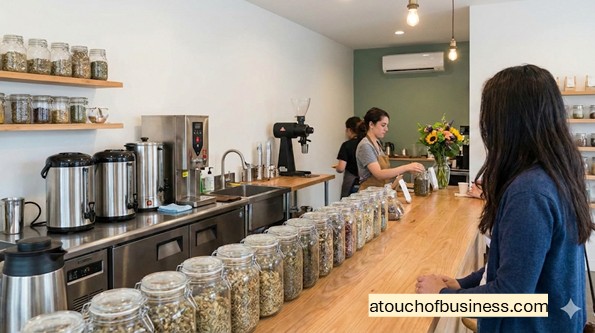
What to Expect From This Guide to Starting an Herbal Tea Business
This guide walks you through the key decisions and practical steps for starting an herbal tea business, from checking your fit to preparing for your first sales day. The bullets below highlight selected areas, not everything inside.
Inside the guide, you will find:
- Startup steps: Follow 20 numbered steps that move from choosing a sales channel and testing demand through permits, equipment, suppliers, and pre-opening checks.
- Business fit: Weigh your motivation, skills, daily tasks, pros and cons, and red flags before you commit time or funds.
- Labels and claims: Learn how food-versus-supplement positioning, allergen rules, and Nutrition Facts decisions can affect your labels and packaging.
- Financial planning: Estimate startup costs, plan operating capital, explore funding options, and test break-even logic before major purchases.
- Local requirements: Find which registrations, permits, and inspections may apply, plus the offices to contact for your location.
- Industry interviews: Hear founders of herbal and specialty tea companies discuss funding, pricing, sourcing, and building their businesses.
- Common questions: Get answers on Food and Drug Administration registration for home and wholesale sellers, organic claims, and supplement-style labels.
Start with what an herbal tea business involves, then decide whether it fits your skills, time, and risk comfort.
Herbal Tea Business Overview
As an herbal tea business owner, you source dried botanicals, blend them into recipes, and package the blends for sale.
Some owners add brewed-to-order tea through a tea bar, pop-up, or event service, which changes permit needs and workspace requirements.
You can often start small and solo if you focus on dry blending and packaged goods in an approved space.
A public-facing drink service makes a dedicated location, added equipment, and staffing help more likely sooner.
How an Herbal Tea Business Earns Revenue
Revenue usually comes from packaged tea sold direct to customers, sold wholesale to retailers, or sold at markets and events.
Brewed tea adds individual drink sales, but that option often brings local food service rules.
Choose a revenue path that matches your time, your budget, and how quickly you can meet local requirements.
Products You Can Offer at Opening
Keep your opening product line small, because too many options slow down labeling, sourcing, and setup.
Common opening products include:
- Loose dried herbal blends, either a single blend or a small set
- Single-herb products meant for infusion
- Tea bags or sachets, if you have a suitable filling and sealing setup
- Sampler packs and gift sets
- Brewed tea service, only if you pursue the local approvals for serving the public
Who Your Customers Are
Your herbal tea customers usually include a mix of direct shoppers and business buyers, depending on where you sell.
Customer type shapes your packaging choices, label design, and pricing.
Common customer types include:
- Online shoppers buying for home use
- Specialty retailers such as gift shops and natural food stores
- Food service accounts such as cafés, restaurants, and hotels
- Event and gifting customers who want custom bundles
Is an Herbal Tea Business a Good Fit for You?
An herbal tea business fits best when you enjoy precise, repeatable production, can handle documentation and compliance steps, and can accept uncertain income.
Before you worry about labels, suppliers, or packaging, start with yourself.
Ask whether owning a business suits you, and whether this business suits your skills, time, and risk comfort.
Motivation matters more than most people expect. Ask yourself: “Are you moving toward something or running away from something?”
Starting mainly to escape a job or a financial bind may not sustain your motivation when stress builds.
Passion isn’t hype. It keeps you solving problems when something breaks, a permit takes longer than expected, or a supplier’s product changes.
Without passion, people tend to look for a way out instead of solutions.
Be honest about the tradeoffs: uncertain income, long hours, difficult tasks, fewer vacations, and full responsibility.
Confirm that your family or support system is on board and that your household can cover living expenses while sales build.
Do you have the skills to start and operate, or can you learn them? Then secure enough funds to begin.
Accept that a startup can fail, and decide how much risk you can tolerate before you commit.
Think about who your first customers will be and why they would choose your tea over similar products.
If you haven’t done a general reality check, start with Points to Consider Before Starting Your Business.
Then read How Passion Affects Your Business to test your motivation.
For a grounded view of what ownership can feel like, use Business Inside Look.
Skills You Need (and How to Close Gaps)
You don’t need every skill on day one, but you do need a plan to close the gaps.
You can learn what’s missing, or you can work with professionals so critical setup steps are done correctly.
Useful skills include:
- Supplier evaluation and documentation tracking
- Accurate weighing, batching, and recordkeeping
- Basic label planning and review
- Quality control for dry botanicals, including storage conditions
- Pricing and basic financial tracking
- Clear writing for product descriptions without risky claims
Pros and Cons of Starting an Herbal Tea Business
An herbal tea business offers several ways to start, but compliance and product consistency demand attention.
Weigh both sides before you commit.
Pros include:
- Multiple ways to start, including online, wholesale, and markets
- Shelf-stable packaged products that can support shipping
- A product line you can expand gradually
Cons include:
- Labeling and claim risk that can create delays
- Supplier quality and documentation that demand attention
- Humidity and storage control that matter for dried botanicals
What Running the Business Looks Like Day to Day
A typical day in an herbal tea business mixes receiving ingredients, producing batches, and handling orders.
This guide focuses on startup, but picturing the daily flow helps you judge whether it fits your personality and time.
A typical day can include:
- Checking inventory levels and the day’s orders
- Receiving and logging ingredients with supplier lot details
- Inspecting packaging condition and storing botanicals in controlled conditions
- Weighing and blending batches with batch records, then running final checks
- Packaging, sealing, labeling, and lot coding finished products
- Picking, packing, and shipping orders, if you sell online
- Responding to retailer questions and reviewing what to buy for the next production run
- Maintaining cleaning routines that match your facility expectations
Running a tea bar or sampling at events adds setup and public-service tasks, longer days, and tighter coordination with local requirements.
Learn From Owners Who Aren’t Competitors
Talk only with owners in the same line of work whom you will not compete against.
Owners in a different city, region, or service area make good conversation partners.
Prepare your questions before each conversation, and focus on permits, labeling, and supplier lessons.
Each owner’s journey differs, but their experience still gives you a realistic view of startup.
Smart questions to ask experienced owners:
- “What surprised you most during setup—permits, space needs, labeling, or suppliers?”
- “If you had to start over, what would you do sooner to avoid delays before your first sales day?”
- “Which sales channel was easiest to start with, and why?”
Red Flags Before You Start
Pause, change your plan, or reconsider starting if any of these decision-stage warning signs apply to you.
Verify or fix these before you spend on packaging or space:
- You can’t get lot tracking details or consistent documentation from your suppliers. Reconsider those suppliers or change your sourcing plan.
- Your storage area can’t stay dry and protected from pests. Change your space or your production model.
- Your product idea depends on disease-related claims or vague health promises. Rework the concept before you invest further.
- Prices for comparable products can’t cover your ingredient, packaging, labeling, labor, and shipping costs plus your own pay. Change your model or pause.
- You can’t fund both startup purchases and your first months of operating expenses. Delay major purchases until funding is in place.
Step 1: Choose Your Sales Channel and Time Commitment
Decide how you will sell first: online, at markets, wholesale, or through a storefront tea bar.
Each sales channel changes your space needs, your permit path, and how quickly you can start.
Decide whether this will be full time or part time. A part-time start can work for packaged goods with a small product line.
Serving brewed tea to the public demands more coordination and time.
Decide who is involved. Solo is common at the start.
Partnerships can help when one person brings sourcing skills and another handles sales or compliance.
Investors are more common when you’re building a larger space or expanding production quickly.
Also decide whether you will sell only sealed packaged tea or add brewed tea and samples, since serving the public usually adds local health requirements.
Step 2: Test Demand and Profit Potential
Demand alone isn’t enough; you also need enough margin to cover expenses and pay yourself.
List your ingredient costs, packaging, labels, labor time, shipping materials, and platform fees if you sell online.
Look at comparable products in your chosen channel. What do similar packages sell for?
Break-even is the sales volume where your revenue covers your fixed and recurring costs.
Calculate it with your own numbers: your monthly costs, your prices, and the margin left after ingredients and packaging.
Ask how many units you would need to sell each month to cover your bills and pay yourself.
Plan for slow months and no-sale periods, when costs continue but sales dip.
The U.S. Small Business Administration’s startup cost page includes a break-even calculator.
For a simple framework to check demand, use this supply and demand guide.
Also identify your first customers and why they would choose your tea over similar products.
Step 3: Decide How Your Tea Is Positioned
Herbal tea is often sold as a conventional food product, but supplement-style positioning or health-related claims can bring different rules.
Decide the line you won’t cross before you name blends or write descriptions.
Health-related advertising must be truthful, not misleading, and supported by appropriate evidence.
The Federal Trade Commission’s guidance is a practical starting point: Health Products Compliance Guidance.
If you plan structure/function claims for dietary supplement positioning, review the Food and Drug Administration’s overview: Structure/Function Claims.
If your product is treated as a dietary supplement and uses covered claims, the Food and Drug Administration also describes notification expectations: Structure/Function Claim Notifications.
Step 4: Build Your Supplier List and Traceability Plan
Choose suppliers that can provide lot-level details and basic product documentation for your botanicals.
Botanicals can vary by harvest, region, and processing, so you need consistency and documentation.
Ask your supplier contacts about:
- Allergen handling and shared equipment, so you can plan cross-contact controls and label statements
- Testing information for heavy metals, pesticides, and microbes, when available
- Lead times and minimums, confirmed in writing rather than by verbal promise
- Document requirements and longer lead times, if you import ingredients
If you can’t get answers about lot tracking or product handling from a supplier, expect opening delays.
Set up a simple system that tracks which supplier lots went into which finished batches.
Lot tracking helps you respond to a quality concern, so set it up before your first sale.
Keep a master ingredient register listing each herb, your approved suppliers, and your minimum documentation requirements.
Write a specification sheet for each blend listing exact ingredients by weight, target net weight, packaging type, and intended sales channel.
Record recipes by weight rather than by scoop so every batch measures the same.
Limit your first product line to a few blends so you can source consistently and finalize labels faster.
Create a simple lot and batch coding system before you produce your first sellable batch.
Lot-code every sellable unit, even in small batches, so you can isolate issues if a customer reports a problem.
Keep a batch record showing the date, formula, input lots, net weights, and who produced the batch.
Hold a small sealed sample from each batch so you can compare later if quality questions come up.
Confirm lead times and minimums with packaging and label vendors before you promise an opening date.
Step 5: Decide Where Production and Storage Happen
Your production and storage space affects cleanliness, storage conditions, pest control, and whether your setup meets local requirements.
For dry blending and packaging, your options may include:
- A shared commercial kitchen
- A permitted small production space
- Another approved facility option in your area
Serving brewed tea to the public means dealing with local retail food rules and inspections.
Confirm zoning and approvals before you sign a lease or buy equipment that assumes a certain setup.
If you plan a physical location, check foot traffic at different times of day before you commit to a lease.
Use the Food and Drug Administration’s state links to find your state’s retail and food service rules.
Start with State Retail and Food Service Codes and Regulations by State.
Store dried botanicals cool, dry, and sealed, and buy a hygrometer so you catch humidity problems quickly.
Moisture control is a product safety issue, so avoid production areas with persistent humidity swings.
Step 6: Plan Label Compliance Before You Order Packaging
Confirm your label requirements before you order packaging. If a label change comes after the order, you can lose time and cash.
Build your first label from the Food and Drug Administration’s detailed reference: Food Labeling Guide.
Mock up your label before you finalize packaging, and confirm it shows product identity, ingredient list, net quantity, and your business contact information.
Choose food-contact packaging that protects your tea against moisture and light.
Review allergen requirements as part of your ingredient decisions.
Sesame is a major food allergen under federal law. It matters if you use sesame as an ingredient or share handling areas.
Start with the Sesame Allergen Update.
Treat any formula change as a new product for labeling and recordkeeping, and review your label whenever a supplier changes.
If you use date coding, base your best-by approach on supplier data or testing, since aroma and flavor fade over time.
Step 7: Decide Whether You Need Nutrition Facts
Nutrition labeling is commonly required for packaged foods, including packaged herbal tea, unless an exemption applies.
Confirm your situation before you finalize label print runs, because the details matter.
The Food and Drug Administration’s small business guide explains exemption pathways and when notices are required: Small Business Nutrition Labeling Exemption Guide.
Step 8: Estimate Startup Costs Based on Scale
Startup costs for an herbal tea business depend on what you’re building.
Packaged goods can often start with a simpler setup, especially with small batches.
A tea bar, a dedicated production space, or higher-volume packaging equipment can raise costs quickly.
List every essential you need before your first sales day: ingredients, packaging, labeling, basic equipment, and workspace requirements.
Then price each item so you’re working with real quotes, not guesses.
Also price these items where they apply:
- Permit, license, and registration fees in your area
- Insurance quotes
- Shipping materials and platform fees
- Packaging and label minimums from vendors
To build a structured estimate, use this startup cost guide.
Step 9: Plan Operating Capital and Funding
Plan operating capital for your monthly expenses until sales cover them, on top of your one-time startup purchases.
One-time expenses include major equipment, design work, permits, licenses, and fees.
Monthly expenses repeat and include costs such as ingredients, packaging, insurance, and any loan payments.
Add both together to see how much capital you need and when you need it.
Then estimate how many months your sales might take to cover costs, and hold enough reserve to bridge that gap.
Running out of operating capital is one of the main reasons startups close.
Also plan your own living expenses during the startup period, since sales may build slowly.
Funding options to explore before you commit to major purchases:
- Personal savings and other personal funds
- Small business loans, including SBA-guaranteed loans made through lenders
- Microloans provided through intermediary lenders
- Investors, who take an ownership stake in exchange for capital
- Crowdfunding from backers who support your product
USAGov notes that federal grants are not available for starting a business, so plan around loans, personal funds, or investors.
Lenders and loan programs each set their own eligibility requirements, so ask any lender for the full list.
The U.S. Small Business Administration outlines funding paths in Fund Your Business.
Match your funding source to your plan before you make major purchases, lease commitments, or inventory commitments.
Step 10: Choose a Legal Structure and Register the Business
Many owners start an herbal tea business as a sole proprietorship because the setup is simple.
As the business grows, some owners form a limited liability company for added structure and separation.
Your choice depends on risk, plans, and how you will operate.
Registration happens through your state, usually through the Secretary of State or a similar office.
For a plain-language walkthrough, see how to register a business. Then verify the actual filing steps on your state’s official site.
Step 11: Get an Employer Identification Number and Set Up Tax Accounts
An Employer Identification Number is often used for tax administration and banking when you set up your herbal tea business.
The Internal Revenue Service provides the direct application: Get an Employer Identification Number.
Next, confirm your state tax registrations, including sales and use tax if it applies to your product and sales channel.
If you sell wholesale, ask your state tax agency about resale documentation and tax handling.
Keep records that match your invoices and deposits.
If you will hire employees, you also need employer accounts at the state level before payroll begins.
Step 12: Identify Licenses, Permits, and Food-Related Registrations
Permits are location-based, so confirm each requirement for your herbal tea business with the agency that enforces it before you open.
The Small Business Administration offers a federal overview of where permits can come from: Apply for Licenses and Permits.
If you operate a facility that manufactures, processes, packs, or holds food, you may need Food and Drug Administration food facility registration.
When registration applies, it must happen before production begins and be renewed every other year.
Start with the Food Facility Registration Overview.
The agency’s guidance also answers common exemption questions: Questions and Answers Regarding Food Facility Registration.
Sampling and brewed-to-order service can trigger retail food rules even when packaged goods bring most of your revenue.
Expect local health department approvals and inspections if you plan a tea bar or sampling to the public.
Use the Food and Drug Administration’s state list from Step 5 to find your local path.
Rules differ by state, county, and city, so verify locally before you commit to a lease, order bulk packaging, or announce an opening date.
Check these offices for your location:
- Business registration: your state Secretary of State or business filing office
- Sales and use tax: your state Department of Revenue or taxation agency
- Local business license: your city or county business licensing office
- Zoning and home occupation: your city or county planning and zoning department
- Building approval and certificate of occupancy: your city or county building department, for commercial spaces
- Food permits and inspections: your local health department and your state’s retail food rules list
Questions to ask the office:
- “If I only sell sealed packaged tea, what permit path applies here?”
- “If I also serve brewed tea or samples, what approvals change?”
- “Can production or storage happen at home in this zoning area, and what conditions apply?”
Step 13: Set Up Banking and Your Financial Records
Open business accounts for your herbal tea business at a financial institution before you sell anything.
Keep business transactions separate from personal ones so your records stay clean and show how your business is performing.
You don’t need to become an expert in everything at once.
If accounting systems aren’t your strength, learn the basics and work with a qualified professional to set up your books correctly.
Use simple bookkeeping categories that match your decisions: ingredients, packaging, permits, and shipping.
Step 14: Lock In Your Business Name and Domain
Choose a tea brand name you can register, with a domain you can claim and social handles you can use.
Names create practical issues, not just branding issues.
Work through a methodical name selection process, then confirm availability in your state records and online.
A helpful walkthrough is selecting a business name.
Step 15: Prepare Your Brand Assets and Basic Sales Materials
At a minimum, your herbal tea brand needs a logo, basic design elements for labels, and simple sales materials that match your channel.
If you’re building a website, start with an overview of developing a business website.
If you will attend events or meet wholesale accounts in person, you may also want business cards and a basic corporate identity package.
Step 16: Set Pricing and Sales Policies Before You Go Live
Base your tea prices on your costs, your sales channel, and the margin you need to cover expenses and pay yourself.
Start your pricing worksheet with actual unit cost: ingredients, packaging, labels, and time, plus shipping and discounts.
Set prices for each product size and format, then decide basic sales policies such as returns and shipping terms.
If you sell wholesale, set clear terms for case packs, reorder timing, and payment timing.
For a framework, use pricing your products and services as a starting point.
Step 17: Plan Insurance and Risk Coverage
Insurance needs for your herbal tea business depend on what you do and where you sell.
A common starting point is general liability coverage, plus other coverage based on your risk, such as product-related coverage if it fits.
If you sell at markets, events, or through a venue, organizers may require proof of coverage before you can set up.
Ask organizers about coverage requirements in advance.
For a plain-language overview, see business insurance.
Step 18: Acquire Equipment and Set Up a Clean Workspace
Your tea workspace should support accurate weighing, clean handling, controlled storage, and consistent packaging.
A consistent workspace makes repeatable batches easier.
For packaged products only, your space needs are often simpler than for a beverage service setup.
A public-facing tea bar lengthens your equipment list and adds more involved location approvals.
If you plan a tea bar, ask your local health department whether rules require a dedicated handwashing sink and other facility features before build-out.
The lists below cover core equipment for dry blending and packaged products.
To support clean receiving, storage, and basic quality control of dry botanicals, gather:
- Receiving table or cart
- Food-grade ingredient bins with tight lids
- Shelving racks with cleanable surfaces
- Hygrometer and thermometer for the storage area
- Container labels for ingredient name, supplier lot, and received date
For accurate weighing that supports consistent batches and packaging, gather:
- Precision scale for small-quantity ingredients
- Higher-capacity scale for bulk ingredients and finished packages
- Calibration weights for routine scale checks
- Measuring tools dedicated to your handling process
For dry blending, choose tools that are cleanable and sized for your batch plan:
- Food-grade mixing tubs or bowls
- Stainless steel or other cleanable work tables
- Sifters or mesh screens, if used for size control
- Mixing tools such as paddles and spatulas
Packaging needs depend on whether you sell loose tea, sachets, or both, so choose food-contact packaging intended for your product:
- Pouches, tins, or jars intended for food contact
- Heat sealer for pouches, if used
- Induction sealer for compatible containers, if used
- Tamper-evident seals, if used
- Funnels and dosing tools
If you sell tea bags or sachets, your setup must support consistent filling and secure sealing:
- Manual or semi-automatic filling tools suited to your format
- Heat sealer compatible with your materials
- Food-safe funnels and portioning tools
Batch tracking is easier when you build it into your label workflow from the start:
- Label printer for small runs, or a printed label inventory
- Lot or batch coding method, using a printer or label system
- Label application tools, as needed for speed and accuracy
Your exact requirements depend on your facility approval path, but you still need these sanitation basics:
- Cleaning supplies appropriate for food-contact surfaces
- Sanitizing supplies appropriate for food-contact surfaces
- Trash and recycling bins with lids
- Pest prevention basics for storage, such as sealed containers and tight lids
If you ship products, plan your packing flow before you accept orders:
- Shipping scale
- Packing table
- Shipping label printer
- Mailers or cartons and void fill
Choose shipping materials that prevent crushing and keep products dry so customers receive packages that match your label claims.
Organize the workspace to reduce mix-ups and contamination:
- Zones for receiving, storage, blending, packaging, and finished goods
- Clear shelf labels separating incoming ingredients, approved ingredients, and finished product
- Finished goods stored off the floor and away from strong odors
- Short cleaning steps between batches so herb dust doesn’t contaminate other blends
Keep your batch record form at the workstation so you record data as you work.
Step 19: Finalize Suppliers, Place Orders, and Build Backup Options
Place initial orders for ingredients and packaging once you have validated your blends and your label plan.
Size your first run to what you can sell and store properly.
What happens if a key botanical becomes unavailable or changes quality?
A backup supplier path for your key herbs prevents last-minute product changes before you open.
Step 20: Complete Your Pre-Opening Checklist and Schedule Your First Sales Day
Confirm that every registration, approval, label, and system is ready before you schedule your first sales day.
Your go-live checklist should show that:
- Required registrations and approvals are active
- Your labels match your final formulas
- Your packaging and batch tracking system are ready
- A pilot run with your real packaging confirmed seals, net weights, and label fit
- Two people checked the first label run, one verifying ingredient list and net quantity and the other verifying placement
- Banking, payment setup, and insurance are in place
- Permits, registrations, supplier documents, and label proofs sit in one folder or binder
Then decide how you will reach your first customers.
Online sales may rely on search and social channels, while markets rely on visibility and event selection.
If you’re opening a physical location, use grand opening ideas to plan a simple opening event.
Business Plan
A business plan helps you stay focused while you juggle suppliers, compliance steps, packaging decisions, and opening timelines, even if you’re not seeking funding.
A plan isn’t about impressing anyone.
Turn your startup steps into one plan that connects your costs, funding, pricing, and break-even numbers.
Your plan should cover:
- Your sales channel and product line
- Your startup budget and operating capital needs
- Your funding sources
- Your pricing and the margin it leaves after ingredients, packaging, labels, and shipping
- Your break-even sales volume, based on your own local costs
- Your permit, registration, and labeling checks, with target completion times
- Your pre-opening checklist and first sales day
- How you will reach your first customers
Use your break-even numbers to decide whether to move ahead before you commit to leases, equipment, inventory, or hiring.
Test whether your plan survives slow or no-sale periods.
Lenders and investors compare your expected costs to projected revenue, so a plan also supports any funding request.
For a simple guide, start with how to write a business plan.
Opening-Day Red Flags
Delay your first sales day if any of these pre-opening checks fails.
Fix or verify these before you open:
- You can’t explain how you will trace ingredient lots to finished batches.
- Your labels are missing key basics covered in the Food and Drug Administration’s labeling guidance.
- You printed a large label run before finalizing your formula, net weight, and required label elements.
- Your product descriptions or labels drift into disease-related language or vague health promises.
- You plan to sell “organic” without confirming certification and labeling rules.
- You are relying on verbal supplier promises instead of written lead times and lot identification details.
- You plan to serve brewed tea or samples before your local health department confirms which approvals and inspections apply.
Pause opening until you fix each item or verify it with the relevant agency, supplier, or professional.
Frequently Asked Questions
Do I need to register with the Food and Drug Administration if I blend and pack tea at home?
Usually not, if your space meets customary expectations for a private residence.
The Food and Drug Administration says a private residence used to make food need not register as a food facility.
A building on your property that operates as a production facility, not a customary part of your home, generally must register unless another exemption applies.
Federal registration rules don’t replace local zoning, home occupation, and food permit requirements, so verify those with your city or county.
Does selling wholesale change whether I must register with the Food and Drug Administration?
It can, because the retail food establishment exemption depends on where most of your sales go.
A retail food establishment is exempt when the annual value of its direct-to-consumer sales exceeds its sales to all other buyers.
Businesses don’t count as consumers, so a wholesale-heavy sales mix can put you inside the registration requirement.
Selling to consumers online may qualify you as a retail food establishment if you meet the rest of the definition.
Review the agency’s registration guidance for your sales mix before you set wholesale terms.
Do I need to pay a service to register my facility with the Food and Drug Administration?
No. The Food and Drug Administration charges no fee to register or renew.
You register through the agency’s own online system, so be wary of private businesses that suggest an FDA affiliation.
Confirm you need to register first, because registering when exempt can create unnecessary inspections and confusion.
Can I call my tea organic if I buy certified organic herbs?
Not on the front of the package, unless your operation is certified.
Without certification, you may only identify certified organic ingredients as organic on the information panel, along with their percentage.
A small-sales exemption from certification exists, but exempt operations still can’t use the USDA organic seal, and other organic rules still apply.
Confirm the current limit and labeling rules with the United States Department of Agriculture National Organic Program before you print packaging.
How does my label change if my tea counts as a dietary supplement?
Yes, several label details change.
The statement of identity must include the term dietary supplement or a descriptive alternative such as herbal supplement.
Botanical ingredients follow standardized common names, and the label states the plant part, such as root or leaves.
Verify current labeling rules in 21 CFR Part 101 before you print packaging.
Interviews With Herbal Tea Business Founders
Hear directly from founders who built herbal and specialty tea companies and shared how they made startup decisions.
These interviews describe real experiences, and each owner’s path differs from yours.
Allison Ullo, Founder of Leaves of Leisure
Allison Ullo founded the herbal tea brand Leaves of Leisure. This Buffer Open Books interview covers her pricing advice, hiring choices, and funding.
Prospective owners see how one founder bootstrapped a product business while working other jobs, and what she learned about cost-based pricing.
Steve Schwartz, Founder and CEO of Art of Tea
Steve Schwartz founded Art of Tea, which began with blending in his living room. His Kara Goldin Show episode covers sourcing, funding, and staffing.
Listeners hear how he grew without outside investors, filled gaps in his own skills, and handled agricultural supply challenges such as organic certification delays.
Related Articles
- Starting a Bubble Tea Shop
- Launch Your Aromatherapy Business
- How to Start a Coffee Roasting Business
- Start an Acai Bowl Cafe
- How to Launch a Nutrition Business
- Start a Subscription Box Business
- Dried Fruits Business FAQs
- Acupuncture Clinic Startup Guide for New Owners
- Starting an Olive Oil Business
- Starting a Chocolate Business
- How to Start a Bakery
- How to Launch a Water Refilling Business
Sources:
- eCFR (Electronic Code of Federal Regulations): 21 CFR Part 101, 21 CFR Part 117
- FDA (Food and Drug Administration): Food facilities registration, Online food facility registration, Food facility registration Q&A, Facility registration fact sheet, Registration data advisory, Food labeling guide, Small business nutrition guide, State retail food codes, Structure/function claims, Claims notification rules, Sesame allergen update
- FTC (Federal Trade Commission): Health products compliance, Health products guidance (PDF)
- IRS (Internal Revenue Service): Get employer identification number
- SBA (U.S. Small Business Administration): Apply for licenses permits, Fund your business, Calculate startup costs
- USAGov: Start and fund a business
- USDA AMS (Agricultural Marketing Service): Organic certification accreditation, Labeling organic products
- Buffer: Open Books: Allison Ullo
- The Kara Goldin Show: Steve Schwartz episode