
What to Expect From This Guide to Starting an eBike Dealership
This guide walks you through the key decisions and practical steps involved in starting an eBike dealership, moving from owner fit and market validation to brand selection, compliance, storefront setup, safety systems, and pre-opening checks. The highlights below represent only part of the article’s detail.
Inside the guide, you will find:
- Startup roadmap: Move through an ordered sequence covering business format, market research, legal setup, suppliers, location, insurance, inventory, and final checks.
- Industry interviews: Hear retailers and industry professionals discuss service training, product safety, supplier stability, warranties, customer trust, and dealership pressures.
- Startup FAQs: Find answers about dealer licensing, product certification, safety reporting, mechanic skills, store formats, space, online competition, and service departments.
- Product safety: Understand supplier documentation, recall monitoring, eBike classes, local riding laws, lithium-ion battery handling, and test-ride procedures.
- Financial planning: Examine startup costs, operating reserves, break-even sales, service margins, accessory income, seasonal demand, and financing choices.
- Store operations: Prepare test-ride access, assembly and service areas, serial-number tracking, payment systems, battery storage, staff training, and showroom inventory.
- Risks and warnings: Recognize direct-to-consumer pressure, unstable brands, weak infrastructure, missing compliance records, inadequate insurance, and unsafe opening conditions.
Start with the fit and market sections before committing money to brands, inventory, or a storefront.
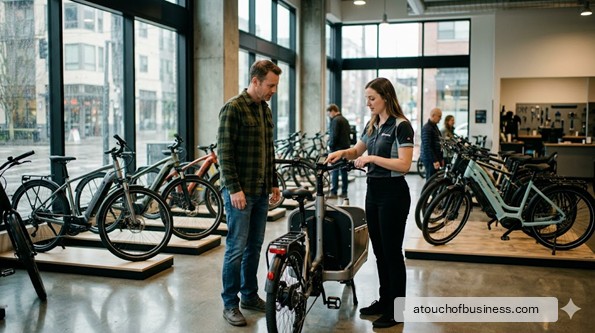
As an eBike dealer, you run a specialty retail store where customers come in to see, touch, and test ride electric bicycles before they buy.
You stock eBikes, accessories, and replacement parts, and you handle assembly, safety checks, and warranty service for the brands you carry.
The storefront is the heart of the model. A customer who test rides an eBike is far more likely to buy than one who only browses online.
That in-person experience is your clearest structural advantage over the direct-to-consumer brands selling the same category on the internet.
But this is also a capital-intensive retail business. You’re buying large, expensive inventory before you sell a single unit. You’re paying rent, insurance, and utilities before your first customer walks through the door. And you’re competing against a large number of brands that bypass dealers entirely and sell straight to consumers online.
None of that means the model doesn’t work — it does, when it’s planned carefully. But risk lives in every phase of this startup, from the brands you choose to the lease you sign to the insurance coverage you arrange. This guide walks you through each decision in the order it needs to happen.
Is This Business a Good Fit for You?
Before you research locations or contact brand reps, be honest with yourself about fit.
You’ll spend every day on the sales floor explaining eBike technology to people who have never ridden one. You’ll assemble bikes in the back room, troubleshoot battery issues, and handle warranty paperwork.
You’ll also manage inventory, track serial numbers, and monitor federal safety recalls. Does that sound like a day you want to live?
This business demands financial patience. Startup costs are high, and the path to break-even is not short. Can your household manage a period of little or no income while you build your customer base and reputation?
Talk to eBike shop owners before you commit — but only owners in markets where you won’t compete. Ask them what they wish they had known before opening. Ask how long it took to become profitable, and what their biggest early mistakes were.
You’ll learn more in one conversation with an experienced owner than in hours of online research.
Think about your entry path, too. Starting your own independent store from scratch gives you the most flexibility, but it puts every decision on you.
Some eBike brands offer structured dealer programs — including initial inventory, training, territory agreements, and ongoing support — that can reduce uncertainty.
And if an existing eBike or bicycle shop is for sale in your target market, buying a going concern may give you immediate inventory, existing lease terms, and an established customer base.
Each path has tradeoffs. Which one fits your budget, your timeline, and your tolerance for uncertainty?
For a broader look at these entry paths, see starting from scratch vs. buying a business.
Red Flags Before You Start
The eBike retail market has real structural challenges. Understand them before you spend anything.
The direct-to-consumer threat is built into this market. A large share of eBike brands sell exclusively or primarily online, bypassing dealers entirely. Your advantage is the in-person test ride, local service, and warranty support — but your entire business model needs to be built around that advantage, because you can’t win on price alone.
Several prominent eBike brands have gone bankrupt or exited the North American market. A dealer who built their business around one of those brands was left with orphaned inventory, no parts supply, and vehicles they couldn’t service. Evaluate every brand’s financial stability before signing a dealer agreement or placing a large opening order.
Margins on new eBike sales are under structural pressure. Industry data from the National Bicycle Dealers Association (NBDA) shows that operating expenses consume most of the gross profit a single-store operation generates from bike sales alone. Service revenue and accessory sales are not optional extras — they are essential margin contributors from day one.
eBike demand is seasonal in cold climates. Months of low or no sales will arrive while rent and insurance payments don’t stop. If you’re opening in a northern market, model a full seasonal cycle before you commit to a lease.
Lithium-ion battery fires are a documented safety issue. The Consumer Product Safety Commission (CPSC) has identified battery-related products as a disproportionate share of recent recalls and safety warnings.
Storing multiple eBike batteries in your retail space creates a fire risk that a standard small-business property policy may not cover. This is a structural risk of the business that requires specific planning and appropriate insurance before you open.
Finally, the eBike technology landscape moves fast. Models can become outdated within a product cycle. Carrying slow-moving inventory while newer models arrive ties up capital and creates write-down risk. Keep your opening assortment tight and prioritize brands with proven parts support.
Step 1: Assess Owner Fit and Motivation
Fit comes before planning.
Ask yourself whether you have genuine interest in cycling and electric mobility — not just in the business opportunity. You’ll be explaining motor types, battery ranges, and riding class restrictions to curious customers every day. Enthusiasm for the product helps you do that well.
Assess your risk tolerance honestly. High inventory costs, fixed rent, and seasonal revenue swings make eBike retail one of the more financially demanding specialty retail businesses to start.
Do you have the practical skills to run the floor and the back room? Basic bicycle assembly and mechanical competence aren’t optional — you’ll be assembling every bike you receive before it goes on the floor. If you’re not there yet, plan how you’ll close that gap before opening.
Step 2: Understand the Business Model and Market Environment
Deciding how to structure your dealership is a financial decision, not just a branding one.
Two common store formats to consider:
- eBike specialty store — focused primarily or entirely on electric bicycles, accessories, and service. Tighter assortment, deeper product knowledge, clearer positioning.
- Full-service bicycle shop with eBikes — carries traditional bikes alongside eBikes and a broader range of accessories. More complexity, more inventory, more staffing demands.
You need to make this format decision before you approach brands, choose a location, or plan your floor space.
You also need to understand the brand relationship structure before you commit capital. Some brands offer formal dealer programs with defined opening orders, territory protection, and training. Others operate as multi-brand independent relationships where you negotiate terms on your own.
A structured program can reduce early uncertainty — but it also ties you to one brand’s products, pricing policies, and financial health.
The direct-to-consumer environment shapes everything. Many of the brands your customers recognize sell primarily or exclusively online. You can’t out-price them. You compete by offering a test ride, local service, and a knowledgeable person standing next to the bike. Build your model around that reality from the start.
Step 3: Validate Your Market and Research Your Location
Before you sign a lease or contact a brand rep, confirm that the market can support the business.
Look at local cycling infrastructure. Proximity to bike lanes, multi-use trails, and commuter corridors is a demand signal. eBike dealerships perform better in communities where cycling is already part of daily life or actively growing.
Identify your primary customer segments before you build your inventory plan. Urban commuters, recreational riders, older adults seeking low-impact mobility, and cargo users are common eBike buyer profiles.
Pick one or two primary segments and build around them. Trying to serve everyone with a generic assortment is one of the most common early mistakes in specialty retail.
Survey local competition. Which eBike brands are already being carried nearby? What price points are being served? What service and warranty support do competitors offer? Gaps in local service quality are often more valuable to exploit than gaps in product selection.
Check whether your state or local government runs an eBike incentive program. Some programs require participating retailers to be enrolled or to carry certified models.
Being a qualifying dealer in an incentive program can drive meaningful foot traffic from day one — verify with your state’s energy, transportation, or consumer protection agency whether enrollment is available and what it requires.
For a disciplined way to think through local supply and demand, see this guide on evaluating local market conditions.
Business Plan
Your business plan is the financial reality check that should happen before you commit to a lease, a brand agreement, or a large opening order.
Map out every startup cost category: lease deposit, build-out and fixtures, opening eBike inventory, accessories and parts inventory, service tools, point-of-sale and inventory systems, permits and licenses, insurance premiums, and signage.
Then add an operating capital reserve — money set aside specifically to cover fixed costs during the months before sales reach break-even. Running out of operating capital before sales stabilize is one of the primary reasons specialty retail stores close.
Model your break-even honestly. Calculate your total monthly fixed costs. Estimate the gross profit you expect to earn on each revenue stream — bike sales, accessories, and service labor.
Determine how many bikes you need to sell each month, at what gross margin, alongside what accessory and service volume, to cover all fixed costs plus your own compensation.
The margin picture in eBike retail requires clear-eyed planning. Gross margins on new eBike sales are under continuous downward pressure from online pricing.
Service labor, by contrast, can carry significantly higher gross margins — industry guidance from the NBDA targets around 60% gross margin for service work. Accessories sit between the two.
A financially viable eBike dealership typically depends on all three revenue streams working together, not on bike sales alone.
Factor in seasonality. In cold-weather markets, revenue can drop sharply during winter months while fixed costs continue unchanged. Your operating capital plan needs to cover the full seasonal trough, not just the months when sales are strong.
Think through funding before you commit to major expenses. Personal capital, small business loans, SBA programs, and some brand dealer financing arrangements are all worth exploring.
Understand what you can access and what it costs before you sign anything. For guidance on business loans, see how to get a business loan.
A useful overview of estimating profitability before launch is available at estimating revenue and profitability for a new business.
Step 4: Choose Your Entry Path and Legal Structure
Three realistic entry paths exist for an eBike dealership.
Three common entry paths:
- Start from scratch — build your own independent store, choose your own brands, design your own layout.
- Enter a structured brand dealer program — some eBike companies offer defined opening packages with inventory, training, and territory agreements. Not technically a franchise in every case, but structured like one.
- Buy an existing bicycle or eBike shop — gives you immediate inventory, an existing lease, and a customer base. Verify all supplier agreements, inventory condition, and brand transferability before committing.
The right path depends on your budget, timeline, need for support, and what’s available in your market.
Once you’ve chosen a path, form your legal entity. A limited liability company (LLC) is the most common structure for small eBike retailers because it separates your personal assets from business liability — important when you’re selling battery-powered vehicles to the public.
Consult an attorney or accountant to confirm the right structure for your situation.
If you plan to operate under a trade name different from your legal entity, file a doing business as (DBA) registration as required in your state.
Apply for your Employer Identification Number (EIN) through the IRS. You’ll need it for your business bank account, tax setup, and hiring.
Step 5: Understand Product Safety Rules Before You Choose Brands
This step belongs before brand selection — not after — because compliance obligations affect which suppliers are safe to work with.
eBikes that qualify as low-speed electric bicycles under federal law — a motor under 750 watts, a maximum motor-assisted speed under 20 mph, and fully operable pedals — are subject to a mandatory federal bicycle safety standard: 16 CFR Part 1512.
This standard covers mechanical safety requirements including braking performance, frame integrity, and reflectors. Manufacturers and importers bear primary responsibility for certifying compliance, but as a retailer, you should obtain a copy of the General Certificate of Conformity (GCC) for each eBike model you carry.
Beyond the mechanical standard, the CPSC and the NBDA strongly urge that eBike electrical systems — the battery, motor, controller, and charger, tested as an integrated unit — comply with UL 2849, the Standard for Electrical Systems for eBikes.
Some local jurisdictions have made this mandatory. Verify whether UL 2849 compliance is required where you plan to operate before finalizing your brand lineup.
You also have an affirmative legal duty as a retailer. Under Section 15(b) of the Consumer Product Safety Act, you’re required to report to the CPSC within 24 hours if you obtain information that reasonably suggests a product you sell creates a substantial risk of injury, contains a defect, or fails to comply with an applicable standard.
This obligation is triggered by information suggesting a hazard — not by confirmed injury. Civil penalties for failing to report are serious.
Before you open, sign up for CPSC recall alerts at SaferProducts.gov. Federal law prohibits selling any product subject to a CPSC-ordered recall. You need a system in place to catch those notices and pull affected inventory promptly.
Understand the three-class eBike system before you build your floor assortment. Class 1 bikes provide pedal assistance only, up to 20 mph. Class 2 bikes add a throttle, also up to 20 mph. Class 3 bikes provide pedal assistance up to 28 mph.
Local laws govern where each class may be ridden — and those laws vary significantly by state and locality. You need to know which classes are legal for which uses in your market, both for inventory decisions and to advise customers accurately at the point of sale.
For a broader overview of business licenses and compliance, see business licenses and permits.
Step 6: Choose Your Brands and Suppliers
Brand and supplier selection is one of the highest-stakes decisions in an eBike dealership. Get it wrong and you’re stuck with inventory you can’t support and customers you can’t serve.
Before approaching any brand, research their dealer program requirements. Some brands require a minimum physical store size — 800 square feet is a common threshold. Others require minimum opening orders, impose pricing restrictions, or sell direct-to-consumer in the same market they ask you to serve.
Find out whether a brand sells directly to consumers in your area before agreeing to carry them.
When you contact each brand’s dealer program, ask these questions in writing:
- What is the minimum opening order and how is it structured?
- How does the warranty claims process work, and what is the typical parts turnaround?
- Do you sell direct-to-consumer in my market, and at what price points?
- What territory protection, if any, is offered?
- What training is required to perform warranty service?
Request compliance documentation for every model you plan to carry. Ask for the current certificate of compliance from a nationally accredited testing laboratory for 16 CFR Part 1512 and for UL 2849, on a per-model basis.
If a supplier can’t provide this documentation, that is a serious warning sign.
If a brand can’t clearly explain its parts availability or warranty process, move on. A customer whose eBike sits unserviced for weeks while you chase a supplier for a replacement part becomes your problem — not the brand’s.
Also establish an account with a quality bicycle products distributor. Major distributors often require a physical storefront and may have minimum order requirements, but they give you access to accessories, parts, and components across many brands — which matters when a customer needs something you don’t stock from your primary brand suppliers.
Keep your brand lineup tight at launch. Carrying two or three brands well — with deep product knowledge, parts in stock, and a clean warranty process for each — is worth more than carrying six brands you can’t fully support.
Step 7: Find and Secure Your Location
Location is a strategic and financial decision, not just a real estate one.
You need a space that gives you visibility from the street, retail zoning, and practical access for customers arriving by car, bike, or on foot. You also need enough square footage for a meaningful floor display, a service area in the back of the store, secure overnight storage for high-value inventory, and a receiving zone where shipments can arrive without blocking your sales floor.
eBikes are large. A showroom with only a handful of bikes feels thin. Most viable eBike dealerships need at least 800 to 1,200 square feet — and some brand programs specify a minimum. Confirm space requirements with each brand before you lease.
Test rides are not optional — they are your primary sales tool. Before signing a lease, confirm there is a safe place for customers to test ride within easy reach of the storefront: a quiet side street, a parking area, a nearby path, or designated outdoor space.
A store with nowhere practical to test ride will struggle to close sales.
Verify zoning before you sign anything. Confirm in writing with your city or county planning office that the specific address is zoned for retail bicycle sales and service activity. A lease signed before zoning confirmation is a financial commitment made without knowing whether you can legally operate.
Once zoning is confirmed, review the full lease carefully. Pay attention to lease length, rent escalation clauses, build-out responsibilities, who pays for tenant improvements, and what happens if the landlord sells the building.
A long lease is a major fixed obligation. If early sales are slower than expected, you’re still on the hook for every month.
Think through parking. Customers often arrive to pick up large eBikes by car or truck. Easy, visible parking adjacent to the store is part of the customer experience.
Exterior signage should be clearly visible from the street. Verify whether a sign permit is required from your local government before installation.
After any build-out, most jurisdictions require a certificate of occupancy confirming the space meets building codes and safety standards before you open. Coordinate with your local building department early so inspections don’t delay your opening date.
Step 8: Complete Legal and Tax Setup
Get the legal and tax foundation in place before you open a business bank account or purchase inventory.
Register your business entity with your state — typically through the Secretary of State’s office. If you’re operating under a trade name, file the required DBA registration.
Apply for a state sales tax permit — sometimes called a seller’s permit or resale certificate — through your state’s Department of Revenue or equivalent agency. You need this before your first retail sale.
It also lets you purchase inventory from suppliers without paying sales tax, since you’ll collect tax from customers when you sell. Most wholesalers require a valid resale certificate before they’ll open an account with you.
Apply for a general business license from your city or county if one is required in your jurisdiction. Requirements vary — contact your local licensing authority to confirm.
If you plan to hire employees, register with your state’s labor or workforce agency for withholding and unemployment insurance accounts. Check your state’s requirement for workers’ compensation coverage — most states require it once you have employees on payroll.
Step 9: Open Business Banking and Set Up Payments
Open a dedicated business checking account and keep it completely separate from your personal finances.
For guidance on opening an account, see how to open a business bank account.
Set up a point-of-sale payment system capable of handling high-value transactions without unusual holds or processing delays. Confirm that your processor can handle large single-transaction amounts smoothly.
Consider whether you’ll offer consumer financing at point of sale. Many eBike buyers are weighing a significant purchase decision. A third-party financing option at checkout can meaningfully increase your close rate on premium models. If you plan to offer it, establish the financing partnership before opening day.
Set up your inventory management system before your first shipment arrives. Track every bike by serial number, model, and SKU from the moment it comes off the truck. You need this for warranty tracking, recall compliance, and theft recovery.
For an overview of merchant accounts and payment setup, see setting up a merchant account.
Step 10: Insurance and Risk Planning
eBike retail has a risk profile that standard small-business insurance programs often underserve. Don’t assume a generic policy covers what you need.
Work with a broker who has experience in specialty retail or product liability. Ask specifically and directly: does this policy cover lithium-ion battery fires in a retail space? Does it cover product liability claims arising from eBikes sold in your store?
Get clear written answers before you bind any policy.
Core coverages to evaluate:
- General liability with product liability — covers third-party injury or property damage claims, including claims tied to products you sell
- Commercial property — covers the store, fixtures, and inventory; verify that lithium-ion battery fire events are included, not excluded
- Business interruption — covers lost income if the store is forced to close after a covered event, such as a battery fire
- Workers’ compensation — required in most states once you have employees; verify your state’s rules
- Product recall coverage — worth evaluating given the eBike industry’s active recall history
- Umbrella or excess liability — adds coverage above your base limits; worth considering for a business selling battery-powered vehicles to the public
Test rides create a specific liability exposure. Before any customer rides a store bike, have them sign a test ride liability waiver. Ask your attorney or insurance broker to review the waiver form before you use it.
For a broader overview of small business insurance, see business insurance.
Step 11: Set Up Inventory and Prepare the Store
Place your opening inventory order early enough to allow time for receiving, inspecting, assembling, and safety-checking every bike before your opening date. eBikes ship partially assembled in boxes. The preparation work between receiving a shipment and putting a bike on the floor takes time — plan for it.
When each shipment arrives, inspect every unit for shipping damage before signing off on delivery. Assemble each bike per the manufacturer’s instructions.
Run a functional safety check — brakes, motor engagement, battery charge, display, lights, and charging function — on every bike before it goes on the showroom floor. Log every serial number in your inventory system at this stage.
Your showroom layout matters. eBikes are visually striking products, but a crowded floor or disorganized display undercuts the experience. Display bikes at appropriate heights with clear information about class, motor type, range, and key features.
Customers new to eBikes need guidance. Good product presentation and prepared staff do some of that work before a conversation even starts.
Stock a meaningful accessories assortment at launch: helmets, locks, lights, racks, bags, spare batteries, chargers, and replacement parts. Accessories carry higher gross margins than new bikes and contribute meaningfully to store profitability from the first week.
Set up your battery charging and storage area before any inventory arrives. Designate a well-ventilated charging area, follow manufacturer guidance on the number of units charged simultaneously, and keep overnight battery storage in a fireproof container or cabinet rated for lithium-ion storage.
Post your safe-charging protocol in the service area.
If you’re hiring staff, complete that process before opening. An eBike-knowledgeable person on the floor — or a qualified mechanic in the back room — dramatically increases what you can offer customers from day one.
For guidance on building your team, see how and when to hire.
Train yourself and any staff on every brand’s product features, the three-class riding system and local class laws, the test ride orientation process, and the test ride waiver procedure. Staff who can’t answer basic questions about motor class, range, or local riding rules will lose sales to a well-informed online competitor.
Step 12: Complete Pre-Opening Checks
Don’t open until everything on this list is confirmed.
Legal and permits:
- Legal entity formed and registered with your state
- EIN obtained from the IRS
- DBA filed if operating under a trade name
- State sales tax permit obtained
- Resale certificate obtained for purchasing inventory tax-exempt
- Local general business license obtained
- Zoning confirmed in writing for retail bicycle sales and service
- Certificate of occupancy obtained after build-out
- Signage permit obtained if required
- Local battery storage rules verified with the fire marshal
Product safety and supplier compliance:
- GCC (General Certificate of Conformity for 16 CFR Part 1512) received in writing from each supplier, per eBike model
- UL 2849 compliance documentation received per SKU from each supplier
- CPSC recall alert subscription active at SaferProducts.gov
- Current recall status verified for all models in opening inventory
- Warranty claims process confirmed in writing with each brand
Store and inventory:
- All bikes received, inspected, assembled, and safety-checked
- All serial numbers logged in inventory system
- Battery safe-charging and storage protocols posted in service area
- Fire extinguisher appropriate for lithium-ion fires accessible on premises
- Test ride waiver forms prepared and reviewed by attorney or broker
- Staff trained on product features, class laws, and test ride safety protocol
Financial and systems:
- Business bank account open and operational
- Point-of-sale and inventory system set up and tested
- Payment processing tested on high-value transactions
- All insurance policies bound and coverage confirmed in writing
Consider running a soft opening or invite-only preview before your public launch. Testing the full customer journey — from receiving and assembly to test ride, point-of-sale transaction, and waiver process — with a small group reveals gaps before they affect paying customers on opening day.
Opening-Day Red Flags
These are signs that something important isn’t ready. Don’t open if any of these are true.
- You don’t have written compliance documentation (GCC, UL 2849 certificate) for every eBike model on the floor.
- You haven’t verified the current recall status of your opening inventory at SaferProducts.gov.
- Your commercial property or general liability insurance doesn’t explicitly cover lithium-ion battery fire risk or product liability for eBikes.
- You don’t have a test ride waiver form reviewed by an attorney or insurance broker.
- You haven’t confirmed in writing that your storefront address is legally zoned for retail bicycle sales and service.
- You haven’t confirmed your battery safe-charging and storage protocols in writing and posted them in the service area.
- You haven’t received the certificate of occupancy from your local building department.
- Staff can’t clearly explain the difference between Class 1, 2, and 3 eBikes and what local laws govern where each can be ridden.
- You haven’t confirmed a warranty claims process in writing with each brand you’re carrying.
- Any bike on the floor hasn’t been assembled and safety-checked per the manufacturer’s instructions.
Red Flags Before You Spend
These warning signs should stop spending before a single commitment is made.
Your target market has weak cycling infrastructure. No bike lanes, no trail access, no visible commuter culture — these are signs that eBike demand will be thin regardless of how well you execute. Validate the market before you validate the business.
The brand you want to anchor around sells direct-to-consumer in your market. If your primary brand undercuts your retail price online, your margin structure is broken before you open. Verify every brand’s direct-to-consumer activity in your specific geography before committing to a dealer agreement.
You can’t identify a brand’s owner, financial backing, or parts supply chain. Several eBike companies have exited the market suddenly. An unknown or opaque brand history is a warning sign. Ask questions about ownership, financial stability, and where parts come from before placing an opening order.
Your operating capital only covers inventory and the first month’s rent. eBike retail takes time to build momentum. If you don’t have enough capital to cover fixed costs through a realistic ramp-up period — including a potential seasonal slow period — you’re starting undercapitalized. Don’t sign a lease until your capital plan includes a genuine operating buffer.
You haven’t been able to get compliance documentation from a supplier. If a brand or distributor can’t provide certificates of compliance (GCC for 16 CFR Part 1512, UL 2849 documentation) in writing before your opening order, don’t place that order. Selling noncompliant eBikes exposes you to product liability and CPSC enforcement risk.
Frequently Asked Questions
Do I need a special license specifically to sell eBikes?
There is no national eBike-specific retail dealer license required at the federal level. You need the standard retail setup: a state sales tax permit, a general business license where required locally, and zoning confirmation for retail bicycle sales. Your primary product-specific obligation is obtaining CPSC compliance documentation from each supplier before putting any eBike model on the floor.
Do I need to verify that the eBikes I sell are UL 2849 certified?
You’re not universally required by federal law to sell only UL 2849-certified eBikes, but the CPSC and NBDA strongly urge it, and some jurisdictions have made it mandatory.
Selling non-certified products with known electrical safety risks creates product liability exposure. Request certificates of compliance per model in writing from each supplier before placing orders — not after.
What is my obligation if a customer reports a safety problem with an eBike I sold?
Under Section 15(b) of the Consumer Product Safety Act, you must report to the CPSC within 24 hours of obtaining information that reasonably suggests a product you sold creates a substantial risk of injury or contains a defect.
The duty is triggered by information suggesting a hazard — not by a confirmed injury. Contact the manufacturer promptly as well. Consult cpsc.gov for the current reporting process.
Do I need to be a licensed bicycle mechanic to open an eBike store?
No universal state licensing requirement exists for bicycle mechanics. But practical competence in eBike assembly and basic service work is essential for a storefront dealer.
Customers expect it, and many brand programs require brand-specific service training before you can perform warranty work. Confirm each brand’s training requirements before you agree to carry them.
What is the difference between a structured dealer program and an independent multi-brand store?
A structured brand dealer program provides a defined entry: a set opening order, training, possible territory protection, and ongoing support — in exchange for tying your store to that brand’s products and policies.
An independent multi-brand store gives you product flexibility and lets you build your own assortment, but requires you to establish each brand relationship on your own. The right path depends on your capital, your tolerance for uncertainty, and the specific brands available in your market.
How much space does an eBike dealership need?
Most viable eBike dealerships need at least 800 to 1,200 square feet to accommodate a meaningful showroom display, a service and assembly area, and secure back-of-house storage.
Some brand programs specify a minimum space requirement. Confirm each brand’s requirements before signing a lease. Test ride access — a quiet side street, a parking lot, or a nearby path — is a practical necessity and should be evaluated alongside the square footage.
How do eBike dealers compete with brands that sell directly to consumers online?
Your structural advantage is the in-person experience. A customer who test rides an eBike before purchasing is significantly more likely to buy than one who only browsed online.
You also provide local assembly, fitting, service, and warranty support that online sellers can’t replicate. Focus on service quality, staff knowledge, and post-sale reliability. That is the position worth defending — not price.
Should I add a service department from day one?
Yes. Service capability isn’t a phase-two addition — it’s a day-one requirement. Every bike you sell must be assembled and safety-checked before it leaves the store. Many brands require in-store warranty service.
Service labor also carries higher gross margins than new bike sales, making it a meaningful profit contributor. If you can’t perform service work yourself, plan for a qualified staff member before opening — not after the first customer asks for a repair.
Expert Advice From People in the eBike Industry
These interviews share practical lessons from e-bike retailers, bike shop owners, trade leaders, and industry insiders who understand the sales, service, safety, and customer trust issues behind this business.
Readers can use the advice to think through product selection, workshop training, after-sales support, legal e-bike concerns, supplier relationships, and the real demands of serving e-bike customers before opening a dealership.
Interview with Michael Pasquali on Launching CEBA to Help Train Dealers to Service eBikes
This interview covers Michael Pasquali’s experience as the owner of Electric Avenue E-bikes and his work training dealers to service e-bikes through CEBA.
It is useful because it explains why service training, diagnostics, and technical confidence can become major advantages for an eBike dealership.
E-bike Positive: Jonathan Harrison, Scott Longstaff & Peter Eland | The BikeBiz Podcast #5
This podcast interview discusses legal e-bikes, unsafe modified bikes, customer trust, retailer concerns, and the E-Bike Positive Trustmark.
It is useful because a new dealer needs to understand safety standards, legal product selection, and how illegal e-bikes can affect customer confidence.
Local Bike Shop Week Awards Finalist Interview: A&S Cycles
This interview covers how an independent bike shop adapts to changing customer habits, modern technology, e-bike growth, and the need for trusted service.
It is useful because it shows how honesty, workshop investment, training, and service repairs can support a dealership as products become more technical.
Local Bike Shop Week Awards Finalist Interview: Mike Vaughan Cycles
This interview covers the realities of running a long-standing independent bike shop, including e-bike diagnostics, staff training, warranties, and customer support.
It is useful because it shows how e-bike repairs can require extra time, software knowledge, manufacturer communication, and careful labour pricing.
Electric Lady’s Alex Kostelnik on Why He’s Closing the Central District E-Bike Shop
This interview covers the challenges of running an e-bike showroom, including supplier instability, customer fit, industry pressure, and community positioning.
It is useful because it gives a candid warning about the difference between selling e-bikes and building a dealership model that suits the owner and market.
Related Articles
- How To Start a Bicycle Repair Business
- How To Start an Electric Scooter Rental Business
- How To Start a Bike Rental Business
- How To Start a Golf Cart Dealership
- How To Start an ATV Dealership
- How To Start a Motorcycle Dealership
Sources:
- CPSC: Bicycle Requirements Business Guidance, Duty to Report Overview, Duty to Report FAQ, Retailers Product Safety, Micromobility Safety Page
- FEDERAL REGISTER: Low-Speed eBike 16 CFR 1512
- eCFR: 16 CFR Part 1512 Full Text
- UL SOLUTIONS: UL 2849 Certification Overview
- SGS USA: UL 2849 FAQ
- NBDA: eBike Resources for Retailers, Margins and Pricing Guide, NBDA Connects Resources, NBDA Membership Benefits
- BICYCLE RETAILER: CPSC UL 2849 Letter, NBDA UL 2849 Statement, NYC eBike Law Retailer Impact, US Retailer Outlook Brutal Truths
- NATIONAL LAW REVIEW: Retailer CPSC Obligations
- COMPLIANCEGATE: US Bicycle Regulations Overview
- VELOTRIC: eBike Laws by State 2026
- PEOPLEFORBIKES: eBike Market Insights 2024
- PEZ CYCLING NEWS: DTC Brand Shift Analysis
- UPCOUNSEL: Retail Business License Requirements
- SHOPIFY: Seller’s Permit Guide
- BUSINESSDOJO: Bike Shop Space Requirements
- ZENSURANCE: eBike Retailer Insurance Types
- ECOM.INSURE: Lithium Battery Insurance Guide
- MUNICH RE: eBike Risks and Requirements
- GLOBE AND MAIL: eBike Industry DTC Shakeout
- EBIKE ESCAPE: UL Certified eBikes List
- CALIFORNIA CDTFA: CA Seller’s Permit FAQ