
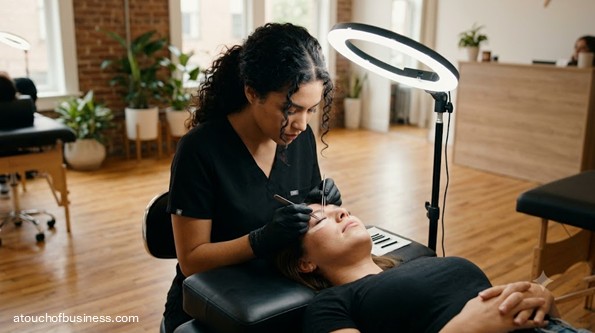
What to Expect From This Guide to Starting an Eyebrow Threading Business
This guide walks you through the key decisions and practical steps involved in starting an eyebrow threading business, from assessing personal fit and licensing rules to choosing a location, planning finances, setting up the studio, and preparing to accept clients. The points below highlight several major areas it covers.
Inside the guide, you will find:
- Startup roadmap: Follow an ordered path from personal assessment and licensing research through registration, studio setup, pricing, business planning, and final checks.
- Industry interviews: Compare first-hand experiences from threading founders discussing locations, training, costs, customer education, staffing, and operating models.
- Startup FAQs: Review concise answers about licenses, facility requirements, client-building timelines, sanitation, insurance, and other setup concerns.
- Business fit: Consider precision, physical stamina, repetitive service demands, household finances, and the patience needed to build repeat appointments.
- Demand and finances: Assess competition, location traffic, appointment volume, pricing, break-even needs, and the cash reserve required during slower months.
- Compliance and setup: Verify local rules, zoning, occupancy, establishment permits, sanitation procedures, insurance, equipment, booking, and payment systems.
- Opening preparation: Use detailed checks and a soft opening to test the station, supplies, customer flow, payments, and reset routine.
Begin with the fit and licensing decisions that determine whether this business is practical in your location and circumstances.
How to Start an Eyebrow Threading Business
Threading specialists use a length of twisted cotton thread to remove unwanted facial hair with precision — pulling individual hairs from the follicle without chemicals, wax, or heat.
The result is a clean arch that many clients prefer over waxing, especially those with sensitive skin or skin that reacts to topical treatments.
As the owner of a physical threading location, you earn revenue appointment by appointment. Each service takes five to 15 minutes.
Your income depends on how consistently clients book, how well your location attracts walk-ins, and how quickly you build a base of repeat customers who return every two to four weeks.
That model can work very well. Threading has among the lowest supply costs of any beauty service — the consumable is cotton thread. But the business still requires a real location, real fixed costs, and real patience while the client base builds.
Before you commit to anything, take an honest look at the fit. Threading is physical work done in a repetitive posture for hours at a stretch.
Does that match your physical capacity and daily stamina? Are you prepared to handle slow weeks early on, when appointments are sparse and rent is still due?
Talk to people who are already running threading businesses — in markets where you won’t compete. Ask how long it took to build a stable client base, what licensing path they navigated, and what they would do differently.
Firsthand insight from experienced owners is worth more than any online guide, including this one.
Threading can support a profitable, low-overhead business at a physical location. It rewards owners who are precise about location, compliant on licensing, and financially prepared to survive the ramp-up period.
Red Flags Before You Start
Threading has real advantages — but it also has real traps. Check these before spending anything.
Your state may require a full esthetician license before you can legally charge for threading. Some states exempt threading from licensing entirely. Others require a cosmetology or esthetician license, which can take months to complete. Find out now, before you sign a lease or order equipment.
The local market may already be saturated. Threading is available at dedicated salons, nail salons, medspas, and mall kiosks in most U.S. markets. If the area is well-served by established, well-reviewed providers, building a client base will be slow. Research competition before choosing a location.
Threading is a low-ticket, high-volume service. The per-appointment revenue is modest. If your fixed costs are high — particularly rent — you’ll need a large number of appointments per week just to break even. Run the math with your actual rent number before signing anything.
A solo threading operation stops generating revenue the moment you’re unavailable. Illness, injury, or a personal absence directly pauses income. If you’re the only technician, your business has no buffer. Plan for this reality before you open.
Poor location will quietly undermine this business. Threading clients don’t drive across town for a brow appointment. Visibility, foot traffic, and access to the right demographic matter enormously. A low-cost space that nobody can find is not a bargain.
Step 1: Assess Fit, Motivation, and Household Readiness
Threading rewards precision and consistency. Your results need to be repeatable across different brow types, hair densities, and face shapes — day after day, client after client.
Ask yourself honestly: Can you sustain fine-motor work for a full shift? Do you handle repetitive tasks well without losing focus or quality?
Beyond skill, think about the financial reality. A new threading location starts with zero repeat clients. Building that base takes months.
Can your household cover personal living expenses for at least six to 12 months without relying on the business to pay you?
Talk to threading business owners in non-competing markets before making any financial commitment. Prepare real questions — about licensing, about how long client-building took, and about what they wish they had known at startup.
Each owner’s path is different, but the patterns matter.
If you’re not yet certain this business fits your life, that’s important information. Thinking through pre-startup considerations before you spend anything is exactly the right move.
Step 2: Verify Your State’s Licensing Requirements First
This step comes before everything else that costs money. Your state’s licensing rule determines how long it takes before you can legally open — and whether you need to complete formal training first.
Threading licensing varies significantly across the U.S.:
- Some states require a full esthetician or cosmetology license, which can involve several months of education
- Some states have a threading-specific license, registration, or short certificate path
- Some states exempt eyebrow threading from practitioner licensing entirely
Contact your state’s cosmetology board or barber board directly. Ask specifically about threading — not esthetics in general. The rules have changed in many states, and secondhand information is often outdated.
Even if your state exempts the practitioner from licensing, the physical facility where services are performed may still require a cosmetology establishment license or a local health department permit. Verify both.
Trap to avoid: Assuming threading is unregulated everywhere. Many owners discover this gap after signing a lease. Make the call to your state board before spending a dollar on the business.
Step 3: Decide Whether to Start from Scratch, Buy, or Franchise
You have three realistic paths into this business.
Starting from scratch gives you full control — over your location, your service menu, your pricing, and your brand. The trade-off is that you begin with zero clients and build everything yourself.
Buying an existing threading business can transfer a client base, an established lease, and trained staff — but you need to verify actual revenue, real client retention, the honest reason for the sale, and any compliance history before signing anything.
Comparing starting from scratch versus buying an existing business is worth reading before you decide.
Threading franchise options exist in the U.S. — concepts built around threading salons that offer brand recognition, training systems, and operational support in exchange for franchise fees and ongoing royalties.
If the structure and support appeal to you, investigate the specific franchise’s requirements, costs, and track record carefully.
The right path depends on your budget, your timeline, your tolerance for building from zero, and what’s actually available in your target market.
Step 4: Validate Local Demand and Study the Competition
Threading works at a physical location when the surrounding market can generate enough consistent appointment volume to cover your costs. That requires verification before you commit.
Survey your target trade area. Look for every provider already offering threading: dedicated threading salons, nail salons with threading add-ons, medspas, full-service salons, and mall-based brow bars.
Threading is a mainstream service in most U.S. markets. In many areas, it’s already well-covered.
Study client reviews for existing providers. Patterns in negative feedback — long wait times, inconsistent results, poor booking experience — show where a gap exists that you could fill.
Who are your likely first clients? People who want regular brow maintenance and need a convenient location. People who prefer threading to waxing because of sensitive skin or topical medications. Walk-in clients drawn by visibility and signage at a high-traffic location.
Check local supply and demand before choosing a location. If the market is already well-served, a poorly differentiated new entry will struggle regardless of skill level.
Step 5: Choose and Evaluate the Physical Location
Location is one of the most consequential decisions you’ll make. Threading is a fast, affordable, impulse-friendly service — which means where you put it determines how many people find it.
Your main physical setup options:
- Salon suite rental: Typically the lowest-cost entry point; often furnished; lower overhead than a standalone storefront
- Booth or chair rental inside an existing salon: Minimal commitment, but a shared environment with potential service conflicts
- Mall kiosk or inline space: High built-in foot traffic; impulse walk-ins are the core customer; mall lease terms are complex and carry specific operational requirements
- Standalone storefront: Maximum control over environment and service menu; highest fixed cost commitment
Foot traffic is not optional. Threading clients don’t travel far for a brow appointment. You need to be visible and accessible to the right demographic — people who already prioritize personal grooming and are likely to walk by your location regularly.
Evaluate any candidate space for pedestrian and vehicle traffic volume, parking access, proximity to complementary businesses like gyms and hair salons, and whether the surrounding demographic fits your service.
Confirm zoning before signing. Personal services and cosmetology use require commercial zoning.
Some addresses that look appropriate aren’t properly zoned for the specific use. Check with your city’s planning or zoning department before any lease commitment.
Many cities also require a certificate of occupancy confirming that the space is approved for personal services before you can legally operate. Verify this with your city’s building department — especially if the space is being converted to a new use or has never held a cosmetology establishment.
Have a commercial lease reviewed by an attorney before signing. Pay attention to lease term length, rent escalation clauses, tenant improvement allowances, and any percentage-of-revenue provisions in mall leases.
If you’re considering a mall kiosk, also confirm which utilities are available at the proposed location. Some kiosk spots have plumbed water; others require a portable water and waste tank system.
State or local health rules may specify what’s acceptable for your setup type.
Step 6: Build Your Startup Plan and Confirm Funding
Threading is low-cost to supply — the consumable is cotton thread — but opening a physical location still involves real upfront spending.
Build a complete list of every cost item before you commit to any lease or purchase.
Your startup cost list should include:
- Licensing and training costs (if your state requires a license)
- Business entity formation fees
- Local and state business license fees
- Salon establishment license fees (if required)
- Local health department permit fees (if required)
- Lease deposit and first month’s rent
- Space build-out or customization, if needed
- Client chairs, technician stools, workstation carts, and mirrors
- Task lighting at each threading station
- Threading supplies and initial consumables
- Sanitation supplies and EPA-registered disinfectants
- Point-of-sale system and card reader
- Salon booking software
- Signage (exterior, interior, and required regulatory displays)
- Insurance premiums
- Operating reserve — at minimum three to six months of fixed costs
Price each item individually. Don’t estimate in a lump sum. Pricing line by line reveals trade-off opportunities — new versus used equipment, salon suite versus storefront — before you’ve spent anything.
The operating reserve is not optional. You need to sustain fixed costs during the client-building period, before repeat bookings become reliable.
Running out of operating capital before the business stabilizes is one of the most common reasons new locations close. Exploring business loan options early gives you more choices than waiting until you’re short.
Open a dedicated business bank account before incurring any business expenses. Keep business and personal finances separate from day one.
Step 7: Form Your Business Entity and Complete Registration
Choose a legal structure before opening. The two most common choices for a threading location are a sole proprietorship and a limited liability company (LLC).
A sole proprietorship is simple and low-cost but offers no personal liability protection.
An LLC provides a layer of separation between your personal assets and business liabilities — which matters in a client-contact service where disputes about results, skin reactions, or facility incidents can arise.
Review the differences between an LLC and sole proprietorship with a certified public accountant before deciding.
If you form an LLC, file with your state’s secretary of state. Filing fees and annual reporting requirements vary by state.
Register a DBA (doing business as) name if you operate under a trade name that differs from your legal business name, where your state or county requires it.
Obtain an Employer Identification Number (EIN) from the IRS. It’s free, takes minutes, and is required for business banking and any hiring. Apply at IRS.gov.
Register for state sales tax if you plan to sell retail products — brow pencils, aftercare items — at the counter.
Threading services themselves may or may not be subject to sales tax depending on your state. Check with your state’s Department of Revenue.
Step 8: Set Up the Physical Space
Once you’ve signed a lease or confirmed a salon suite agreement, work through the physical setup methodically. The threading environment needs to work for the client and for you as the technician.
Lighting is not decoration — it’s a functional requirement. Threading is precision work performed close to the face.
Inadequate lighting directly affects the quality and consistency of your results. Each station needs strong, directional task lighting positioned to illuminate the brow area clearly.
Many state cosmetology or health regulations specify minimum facility standards even for small threading locations.
Common requirements include: accessible handwashing facilities, covered waste receptacles at each station, covered storage for clean supplies, and separate storage for soiled items. Confirm what your state and local rules require for your specific setup.
For mall kiosk setups, work with mall management on utility hookups. Confirm whether a plumbed sink is available or whether a portable water system is required — and whether your local health authority accepts the portable system for a threading-only service.
Install required regulatory signage before your first client: practitioner license display, establishment license, and any health notices required by your state or local health department.
Step 9: Source Supplies and Build a Sanitation Protocol
Threading has a short supply list. That’s one of its structural advantages. But sanitation is not optional — it’s a regulatory requirement and a hygiene responsibility to every client who sits in your chair.
Your core supplies include:
- Professional-grade cotton thread spools
- Cotton rounds, pads, and disposable tissues
- Headbands or clips to hold client hair away from the brow area
- Soothing aftercare product (aloe gel or gentle toner) for post-threading application
- EPA-registered surface disinfectant
- Hand soap at an accessible sink or handwashing station
- Paper towels or single-use towels
- Covered waste receptacle with liners at each station
- Gloves as needed per your protocol or state rule
- A blood spill clean-up kit
Thread is single-use. Discard it after each client — never reuse thread between appointments.
Write your sanitation protocol before opening and follow it every single time. The protocol should cover handwashing or gloving before each client, surface disinfection between appointments, proper disposal of used materials, and a station reset routine that prepares the space for the next client.
EPA-registered disinfectants must be used according to their label instructions. The correct dilution, contact time, and disposal method are all regulated. Using a disinfectant in a way that contradicts the label is a federal compliance violation — not just a best-practice miss.
Maintain a safety data sheet (SDS) binder for every chemical product in the facility. This is required under OSHA’s Hazard Communication Standard.
If you have employees, evaluate whether OSHA’s Bloodborne Pathogen Standard (29 CFR 1910.1030) applies. Threading can cause minor skin abrasion.
If employees have reasonably anticipated contact with blood or other infectious materials, you’re required to have a written exposure control plan, provide training, and make personal protective equipment available.
Step 10: Obtain Insurance Before You Open
Purchase insurance before your first paying client walks in. Your landlord or salon suite operator will almost certainly require proof before allowing you to operate.
The coverage you need:
- General liability: Covers incidents at the premises — a client slip-and-fall, property damage, advertising injury. Most commercial leases require this with the landlord named as an additional insured.
- Professional liability (treatment liability): Covers claims arising from the service itself — skin irritation, abrasion, or a disputed result. General liability policies typically exclude professional services claims. You need both.
- Workers’ compensation: Required by most states as soon as you hire any employees. Verify your state’s specific rule.
Specialty insurers focused on beauty and esthetics — including providers that offer combined general and professional liability packages — are often better suited to a threading business than general small-business insurers.
Look for a provider that explicitly covers threading and related brow services. Reviewing your business insurance options before opening is worth the time.
Step 11: Plan Staffing Carefully
Most threading locations launch as a solo owner-operator. That’s usually the right call.
Threading quality is highly personal. Inconsistent results across a new team — during the most critical period for building a reputation — can generate negative reviews that take months to overcome.
Starting solo lets you establish a consistent standard, refine your sanitation routine, and confirm actual demand before adding labor cost.
Add a second technician only after appointment volume shows consistent demand that you can’t service alone.
If you do hire, verify that any employee performing threading holds the required practitioner license or certificate for your state, if one applies. Confirm employer tax registrations at both the federal and state level before the first paycheck.
The distinction between an employee (W-2) and an independent contractor (1099) matters significantly for taxes, benefits, and liability. Getting clear on hiring requirements before you bring anyone on protects you from classification errors that carry real penalties.
Step 12: Set Your Service Menu, Pricing, and Payment Systems
Finalize your service menu before opening. Start simple.
Core threading services:
- Eyebrow threading and brow shaping
- Upper lip threading
- Chin threading
- Cheek and sideburn threading
- Forehead threading
Some locations also offer eyebrow tinting, henna brows, or brow lamination. Before adding any of these, confirm that your state license scope covers them.
Some require additional certification beyond basic threading or esthetics credentials.
Set prices based on local competitor research and your actual cost structure. Threading is a volume service.
Your pricing needs to reflect how many appointments per hour are realistically achievable and what each hour of services must generate to cover your fixed costs.
Research what competitors charge in your specific market before settling on a rate. Understanding how to price services will help you think through the logic before you commit.
Set up your payment processing and point-of-sale system before opening. Threading clients expect card payment as standard.
They also expect easy online booking — implement salon scheduling software with an accessible booking link before your first appointment.
Business Plan
Threading is a lean business model in terms of supplies and equipment. But it’s not a lean business model in terms of time and financial patience. Your plan needs to account for both.
Start with the break-even calculation. Take your total monthly fixed costs — rent, insurance, software, and any other recurring expenses — and divide that by your planned revenue per appointment.
That tells you how many appointments per week you need just to cover costs before paying yourself anything. Is that number achievable given your location, your hours, and the local competition?
Answer that question before signing a lease.
Threading clients return every two to four weeks. That repeat cycle is the foundation of the revenue model — but you have to build the base first.
A new location starts at zero repeat clients. Plan to operate below your break-even threshold for at least the first few months. Your operating reserve is what keeps the business alive during that period.
Threading has among the lowest supply costs of any beauty service. The gross margin on supplies is strong. But margin on supplies doesn’t pay rent. Volume does.
Your plan should answer: How many clients can you realistically serve per day at this location? Is the location capable of generating that volume through walk-ins, online bookings, or both?
Demand can vary by month. Some periods are slower than others. Build a conservative projection — not an optimistic one — and make sure your reserve can absorb a slow month without forcing you to skip a fixed payment.
Use your business plan to document your licensing path, cost list, pricing rationale, location decision, funding sources, and the break-even math.
It keeps the decision-making clear and gives lenders or investors something concrete to evaluate. Thinking through profitability and revenue before opening is one of the most useful exercises you can do.
Step 13: Complete the Pre-Opening Checklist
Don’t take your first paying client until every item on this checklist is confirmed. A compliance gap discovered after opening is far more disruptive — and costly — than one caught before.
Pre-opening confirmation list:
- State practitioner license confirmed and in hand — or threading exemption confirmed in writing from the licensing board
- State cosmetology establishment license confirmed and displayed (if required)
- Local business license or business tax certificate issued
- Local health department permit obtained and displayed (if required)
- Certificate of occupancy confirmed for personal services use at the address
- Zoning verified for cosmetology or personal services use
- Business entity registered with the state
- EIN obtained from the IRS
- Business bank account open
- Sales tax registration completed (if selling retail products)
- All stations set up: chair, stool, workstation, mirror, task lighting
- EPA-registered disinfectants on hand; label instructions confirmed
- Covered waste receptacles in place at each station
- SDS binder assembled for all chemical products
- Blood spill kit on hand
- General liability insurance active; landlord certificate provided
- Professional liability insurance active
- Workers’ compensation active (if any employees)
- POS system tested; card payments confirmed working
- Booking software configured; booking link accessible
- Service menu finalized; pricing confirmed
- Sanitation protocol documented and practiced
- Soft opening completed with invited guests to test timing and workflow
Run the soft opening before accepting public walk-ins or paid bookings. Invite friends and family to test the full client flow from arrival to payment.
Confirm your station reset routine works between appointments. Find the friction points while the stakes are low.
Opening-Day Red Flags
These are signs that something isn’t ready — even if opening day feels close.
You don’t have written confirmation that your space is legally approved for personal services. A certificate of occupancy, zoning confirmation, and any required health department permit should all be in hand before your first client. Verbal assurances from a landlord aren’t enough.
Your sanitation disinfectant doesn’t have an EPA registration number on the label — or you haven’t confirmed the correct dilution and contact time. Using an unregistered product or ignoring label instructions is both a regulatory violation and a real sanitation gap.
You can’t accept card payments. Threading clients expect card payment as standard. If your payment system isn’t set up and tested before opening, you’ll lose appointments from the first hour.
The lighting at your threading station is inadequate. If you can’t clearly see fine brow hairs under your working light, your results will be inconsistent. Inconsistent results end client relationships before they start.
You haven’t provided your landlord or suite operator with an insurance certificate. Most commercial leases and salon suite agreements require proof of active general liability coverage before allowing you to operate. If you haven’t confirmed this, you may not be authorized to open under your lease terms.
Frequently Asked Questions
Do I need a license to perform eyebrow threading in my state?
It depends entirely on your state. Some require a full esthetician or cosmetology license. Others have a shorter threading-specific registration or certificate path. Others exempt threading from practitioner licensing altogether because it uses no chemicals, heat, or sharp implements.
Contact your state’s cosmetology board directly. Don’t rely on secondhand information — the rules vary significantly and have changed in many states.
Do I need a salon establishment license even if I’m renting a salon suite?
Possibly. Some states require the physical space where threading is performed to hold its own establishment license, separate from the individual practitioner’s credential.
In some suite buildings, the operator holds the establishment license and renters operate under it. In others, each renter needs their own. Confirm this with your state cosmetology board and your suite operator before assuming you’re covered.
How long does it typically take to build enough clients to cover costs?
For a new physical location starting from zero, it usually takes three to six months — or longer — to build enough repeat clients to cover fixed costs comfortably.
High-traffic locations like mall kiosks can build faster through impulse walk-ins. Lower-visibility studio locations depend more on referrals and appointment bookings and may take longer. Have operating reserves in place that account for the full ramp-up period.
Can I start with just eyebrow threading and add services later?
Yes — and that’s usually the smarter approach. Starting with threading keeps your service scope focused, your compliance checklist manageable, and your equipment needs minimal.
Before adding tinting, henna brows, or brow lamination, confirm that your state license scope covers those services. Some involve chemicals or techniques that require additional certification.
What equipment do I actually need to open?
At minimum: a client chair, a technician stool at the correct ergonomic height, strong directional lighting at the service station, a workstation with mirror and storage, thread and consumable materials, EPA-registered disinfectant, a covered waste receptacle, a card payment terminal, and salon booking software.
Threading requires far less equipment than waxing, lash, or nail services. Quality lighting and seating will have the most direct impact on your results.
What insurance do I need before opening?
At minimum, obtain general liability insurance and professional liability insurance. General liability covers premises incidents like a client slip-and-fall. Professional liability covers claims arising from the service itself — skin irritation, abrasion, or a disputed result.
Most landlords and suite operators require proof of general liability before move-in. If you hire employees, most states also require workers’ compensation coverage.
What’s the most common compliance mistake new threading owners make?
Assuming threading is unregulated everywhere. Even in states where the practitioner is exempt from licensing, the physical facility may still require a cosmetology establishment license or local health department permit.
Also common: using disinfectants without following label instructions on dilution and contact time. Both are compliance violations — and the second is also a real sanitation problem.
Should I launch solo or hire staff from the beginning?
Most threading locations launch solo, and that’s usually the right call. Threading quality is personal, and inconsistent results across a new team during your most critical reputation-building period can generate negative reviews that take months to overcome.
Start solo, establish a consistent standard, confirm demand is stable, and add a second technician only when appointment volume genuinely requires it.
Advice From Successful Eyebrow Threading Business Owners
These interviews share practical lessons from threading salon founders and brow specialists. They discuss testing demand, choosing a location, training employees, attracting clients, and building trust.
Use their experiences to compare business models, identify startup challenges, and decide how you will position and operate your eyebrow threading business.
Why You Need a Genuine Business Purpose
Riz Syed explains how he researched threading, found insurance, opened a basic kiosk, educated customers, and developed a large chain of brow bars.
This interview is useful for learning how a simple setup, customer education, and a clear business purpose can support growth.
The Woman Who Took Brow Threading Mainstream Reveals How She Got Her Big Beauty Break
Blink Brow Bar founder Vanita Parti discusses finding a gap in the market, starting with one chair, recruiting therapists, buying equipment, and generating publicity.
Her experience shows how a small service concept can be tested while maintaining strong training and service standards.
Interview With Sumita Batra, Founder of Ziba Beauty
Sumita Batra describes how her family opened a small salon with limited funds, used secondhand equipment, and turned traditional threading services into a recognized beauty brand.
This interview offers perspective on controlling setup costs, recognizing overlooked opportunities, and adapting the business during difficult periods.
Exclusive Q&A Interview With Vas Maniatis, Co-Founder of Seva
Vas Maniatis explains how Seva researched the threading market and developed a store-within-a-store model focused on foot traffic, convenience, and client privacy.
The interview can help prospective owners evaluate locations, recurring customer needs, and alternatives to a traditional salon storefront.
Brow Business: We Interviewed “That Brow Girl”
Brow studio owner Fatima Hussain discusses specializing in eyebrow services, displaying her results on social media, building client trust, and choosing appointments over walk-ins.
Her advice is useful for developing a focused service offer, creating a visual portfolio, and selecting an appointment system that protects service quality.
Meet Newrain Ghimire of Newrain Threading Salon
Newrain Ghimire shares lessons about learning local licensing rules, educating clients, building trust, working long hours, hiring skilled employees, and developing training systems.
This interview provides a realistic view of the owner’s workload and the importance of compliance, consistent service, and reliable staffing.
Related Articles
- How To Start an Eyelash Extension Business
- How To Start a Facial Spa Business
- How To Start a Beauty Salon
- How To Start a Bridal Makeup Business
- How To Start a Makeup Artist Business
- How To Start a Laser Hair Removal Business
Sources:
- Institute for Justice: Threading licensing state overview
- CSOR WVU: Threading licensing policy brief
- Booksy: Beauty services license exemptions
- Newrain Franchise: Threading salon profitability numbers
- Bookeo: Start brow business equipment training
- OSHA: Bloodborne pathogens overview, Nail salon biological hazards
- Virginia Admin Code: Salon sanitation safety standards
- Lucas Products: Salon federal state requirements
- MoneyGeek: Salon insurance requirements overview
- The Ins Alliance: Salon liability insurance guide
- Insure Body Work: Salon insurance types explained
- Elite Beauty Society: Eyebrow technician insurance coverage
- Franchise.com: Threading salon franchise options
- Franchise Conduit: Newrain threading salon franchise
- Bloodborne Certification: Bloodborne risks cosmetology businesses
- Join BLVD: Brow business plan strategy