
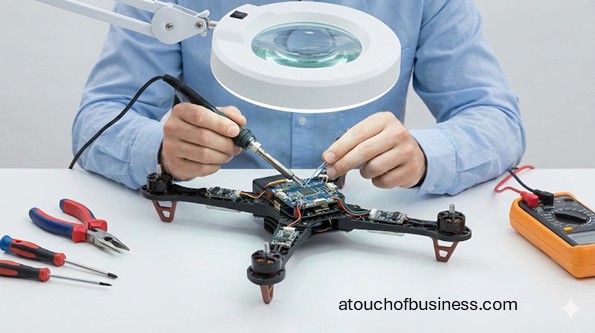
Drone Repair Business Overview
A drone repair business diagnoses, fixes, and tests unmanned aircraft systems and related components for customers who don’t want to replace an entire drone after damage or a malfunction.
Most startups begin as a solo bench-based service—often from a home workshop or a small commercial unit—with the option to expand into a larger repair depot later.
Is This the Right Fit for You?
Start with you—not tools, not parts, not a logo. You’re deciding two things: whether business ownership fits you, and whether drone repair fits you.
If you’re unsure where to begin, review these startup considerations first. They help you slow down and look at the full commitment.
Passion matters more than most people admit. Repair work can be repetitive, detailed, and sometimes frustrating. Without real interest in the work, people often look for an exit instead of solutions. If you want a reality check, read how passion affects your business.
Now ask yourself this exact question: “Are you moving toward something or running away from something?”
If this is mainly an escape from a job or a short-term cash issue, motivation can fade fast once the hard parts show up.
Think about the flip side. Income can be uncertain. Hours can get long. You may handle difficult tasks, fewer vacations, and full responsibility for decisions.
Also ask: do you have the skills (or can you learn them) and can you secure funds to start and operate?
Before you commit, talk to people already in this line of work—only if they are not direct competitors. Only talk to owners you will not be competing against.
If you want a structured way to do this, use Business Inside Look as your guide.
Here are smart questions you can ask:
- What repairs show up most often, and which ones do you refuse because risk is too high?
- What did you underestimate before opening—space, tools, parts sourcing, paperwork, or compliance?
- What would you do differently if you had to start again with limited cash and no staff?
Step 1: Define What You Will Repair and What You Will Refuse
Drone repair can mean quick, simple fixes or deep electronics work. Decide your initial scope so you don’t promise work you can’t safely complete.
Write a clear “yes list” and “no list” before you advertise. This becomes part of your policies, quotes, and customer expectations.
Step 2: Confirm Demand and Confirm Profit Potential
You need two confirmations: customers actually want the repairs you plan to offer, and the margin is enough to cover expenses and pay you.
Start by comparing local and mail-in options in your region. Look at what competitors repair, how they position turnaround times, and what they refuse to work on.
Step 3: Decide Your Business Model and Scale
Most drone repair startups can begin as a solo owner-operator with a focused service menu and a controlled flow of work.
If you plan a larger operation—multiple technicians, inventory-heavy parts stocking, or enterprise contracts—plan for more capital, more space, and formal roles.
Decide how you will structure ownership:
Solo ownership is common at launch. Partnerships can work when responsibilities are clearly separated. Investors usually expect reporting, controls, and growth targets.
Also decide staffing: do most tasks yourself at first and hire later, or hire early for technical or customer-facing work. If you’re unsure, learn the basics of how and when to hire so you don’t rush that decision.
Step 4: Choose Your Service Format: Drop-Off, Mail-In, Mobile, or Hybrid
Drop-off service is location-dependent. Mail-in expands your market but adds shipping risk and rules around batteries. Mobile service can reduce overhead but adds travel logistics and limitations on what you can safely repair onsite.
Pick one primary format for launch. You can add the others later once your process is stable.
Step 5: Plan Skills Gaps and How You Will Cover Them
You don’t have to be good at everything. But you do need a plan to cover what you don’t know—through learning, professional services, or contractors.
Common gap areas include electronics diagnostics, micro-soldering, battery safety, documentation, legal forms, and basic accounting.
Step 6: Decide Whether You Will Fly Drones as Part of Repairs
If you will test-fly customer drones or do any outdoor flight testing tied to repairs, you may be conducting a non-recreational operation (often under Part 107), even if you are not separately paid for the flight.
Use the Federal Aviation Administration resources for commercial drone operators and how to become a certificated remote pilot to confirm what applies to your situation.
Step 7: Decide on Location and Workspace Requirements
If you’re doing bench work, you need a clean, controlled workspace with safe storage for batteries, tools, and parts.
If you use a storefront or commercial space, customer convenience matters. Learn the practical tradeoffs in choosing a business location before you sign a lease.
Step 8: Build Your Essential Startup Items List Before You Price Anything
Make a detailed list of everything you need to launch—tools, test gear, safety items, workspace needs, software, and office basics.
Only after the list is complete should you price each item. This is how you avoid missing major categories and underestimating cash needs. A helpful guide is estimating startup costs.
Step 9: Write a Business Plan That Keeps You on Track
Even if you never show it to a lender, a business plan helps you define your scope, pricing logic, target customers, and startup budget.
If you want a simple framework, use how to write a business plan and keep it focused on launch.
Step 10: Set Up Funding and Your Financial Institution Accounts
You need startup funds for tools, parts, and compliance, plus runway to cover early months when work is inconsistent.
Common funding sources include personal savings, small loans, and supplier terms once you have a track record. If you explore lending, review how to get a business loan.
Choose a financial institution and set up accounts that separate business activity from personal activity. It makes bookkeeping and taxes cleaner from day one.
Step 11: Legalize the Business and Handle Core Registrations
Many small businesses start as sole proprietorships. In that structure, there is no state formation filing by default, though licenses and a Doing Business As name may still apply. Many later form a limited liability company for liability and structure, which can also help with banking and partnerships.
If you want a guided overview of the process, see how to register a business and then verify requirements with your state and local offices.
For federal tax registration, the Internal Revenue Service provides guidance on starting a business and how to get an Employer Identification Number when you need one.
Step 12: Confirm Battery Shipping Rules if You Offer Mail-In Repairs
If you ship drones or standalone lithium batteries, packaging, marking, and carrier rules may apply. This is a high-risk area to “assume” your way through.
Start with the Pipeline and Hazardous Materials Safety Administration guidance on transporting lithium batteries.
If you or your staff prepare shipments that meet the definition of hazardous materials, training requirements can apply. Review the Pipeline and Hazardous Materials Safety Administration page on hazardous materials training requirements and the regulatory reference at 49 CFR 172.704 training requirements.
If you handle returns and “backhaul” shipments, review the Pipeline and Hazardous Materials Safety Administration reverse logistics brochure to understand how exceptions may apply and when they do not.
Step 13: Set Insurance Coverage and Risk Controls Before You Open
At launch, many repair businesses look at general liability first, then add coverage that fits their risks (tools and equipment, property, and other business-specific needs).
Requirements can also come from landlords, events, or client contracts. Use business insurance as a starting point, then confirm coverage with an agent who understands electronics repair risks.
Step 14: Build Pricing, Policies, and Proof Assets
Pricing needs to cover labor, parts, rework risk, and overhead. Set your pricing rules before you accept work so you don’t negotiate every job.
Use pricing your products and services as a framework.
Draft your core policies: diagnostic fees, deposits, parts approval, turnaround targets, abandoned property, and warranty terms on your work. For legal language, use an attorney so your documents match your state rules.
Proof assets matter before launch. Create a simple portfolio of repair examples, a clear list of services, and a clean process description so customers know what happens next.
Step 15: Create Your Name, Online Presence, and Basic Brand Assets
Pick a name you can register, then secure a matching domain and social handles (as available). A practical guide is selecting a business name.
Then build the basics: a website, business cards, and any signage you need. Use developing a business website, what to know about business cards, business sign considerations, and a corporate identity package overview to keep your branding consistent.
Step 16: Set Up Your Physical and Administrative Systems
Before you open, your process should be repeatable: how you document a device, how you store parts, how you track approvals, and how you accept payment.
If you plan a storefront, plan your layout for safety and customer flow. If you are home-based, keep business property organized and separated so you can scale without chaos.
Step 17: Pre-Launch Marketing and Opening Push
You don’t need a big campaign to start, but you do need a clear way to get your first customers: local search listings, partnerships with drone retailers, and relationships with photography or inspection professionals.
If you will run a storefront, learn how to get customers through the door and consider grand opening ideas that fit your space and local rules.
Products and Services Offered by a Drone Repair Business
Your exact list depends on your skill level, parts access, and whether you work on consumer models, enterprise models, or both.
Common pre-launch service categories to plan for include diagnostics, mechanical repairs, electronics repairs, controller repairs, and post-repair testing.
Examples of services to define on your menu:
- Damage assessment and diagnostics (physical inspection, error codes, flight log review when available)
- Frame, arm, landing gear, and shell repair or replacement
- Motor and propeller system replacement
- Gimbal and camera repair or replacement
- Controller and accessory troubleshooting (chargers, antennas, cables)
- Firmware update support and calibration steps tied to repairs
- Water exposure assessment and corrosion inspection (with clear disclaimers about limits)
- Post-repair function checks and test protocols (including flight testing only when compliant and appropriate)
How Does a Drone Repair Business Generate Revenue?
Revenue usually comes from paid diagnostics, labor charges, parts, and service packages built around common repairs.
Some businesses also add shipping and handling fees for mail-in service, and convenience fees for expedited turnaround when possible.
Common revenue lines to plan for:
- Diagnostic fee (credited or not credited toward repair, based on your policy)
- Labor charges (flat-rate by repair type or time-based)
- Replacement parts and consumables (with clear markup rules)
- Return shipping and packaging kits (for mail-in service)
- Service plans for organizations (only if you can document and deliver consistent terms)
Types of Customers for a Drone Repair Business
Your customer mix affects everything—pricing, turnaround expectations, and what you should repair first.
Define your primary customer group before launch so your marketing and service menu match.
- Hobbyists and consumer drone owners
- Real estate photographers and videographers
- Construction, roof, and infrastructure inspection operators
- Agriculture operators using drones for field work
- Industrial and energy inspection providers
- Public safety organizations (often procurement-driven and documentation-heavy)
- Drone retailers and resellers needing repair partners
Pros and Cons of Owning and Operating a Drone Repair Business
This is a skill-based business. If you like problem-solving and precision work, that’s a real advantage. If you dislike detailed diagnostics and documentation, it can be draining.
Think about the tradeoffs before you commit resources.
Pros:
- Can start small as a solo operator with a controlled service scope
- Repeatable repairs can lead to standardized quotes and processes
- Demand can come from both consumers and commercial operators
Cons:
- Some repairs are high-risk (battery damage, water exposure, hidden internal faults)
- Parts availability and model variety can complicate quoting and timelines
- Shipping and handling rules can be complex when lithium batteries are involved
- Quality expectations are high because failures can be expensive for the customer
Essential Equipment and Startup Items
This is a detailed starter list. Your exact list depends on which drone families you will support and how deep you go into board-level work.
Build your own checklist first, then price each item to estimate startup costs and cash needs.
- Workstation and Safety Setup
- Sturdy workbench and task chair
- Bright adjustable task lighting
- Fire-resistant battery storage container(s) suited to lithium batteries
- Safety glasses and protective gloves suitable for electronics work
- Class ABC fire extinguisher (verify local requirements and suitability for your workspace)
- First aid kit
- Electrostatic Discharge Protection
- Grounded anti-static mat and ground cord
- Anti-static wrist strap
- Anti-static parts containers or bags for sensitive components
- Guidance for setting up an ESD-safe workspace (see Electrostatic Discharge and the EOS/ESD Association ESD fundamentals)
- Hand Tools
- Precision screwdriver set (including common micro fastener types)
- Plastic pry tools and spudgers
- Precision tweezers
- Flush cutters
- Small needle-nose pliers
- Hex and Torx drivers as required by the models you support
- Threadlocker compatible with fasteners you install (use only when appropriate)
- Electronics Test and Repair Tools
- Digital multimeter
- Bench power supply (as needed for electronics diagnostics)
- Soldering station with temperature control
- Desoldering tools (pump and wick)
- Magnification (loupe or microscope)
- Hot air rework station (only if doing board-level work)
- Heat-resistant work surface or silicone mat
- Software and Device Interfaces
- Computer suitable for vendor software and documentation
- USB cables and adapters commonly used by your target drone models
- Secure storage for customer files and photos (local or cloud, based on your policy)
- Basic office software for quotes, invoices, and records
- Parts Handling and Organization
- Parts bins and labeled containers
- Small parts trays and magnetic mats for screws
- Label printer or labeling system
- Camera or phone for before/after documentation
- Cleaning and Inspection
- Compressed air or electronics-safe blower
- Soft brushes suitable for electronics
- Isopropyl alcohol appropriate for electronics cleaning
- Microfiber cloths
- Shipping and Receiving (If You Offer Mail-In)
- Shipping scale
- Boxes, padding materials, and internal bracing to prevent movement
- Labels and documentation storage for shipments
- Battery shipping compliance references (start with Transporting Lithium Batteries)
- Business Setup Basics
- Phone number and email for the business
- Website and domain
- Payment processing method to accept payment
- Customer authorization forms and disclaimers (attorney-reviewed)
Skills Needed to Run a Drone Repair Business
Some skills are technical. Others are about process and documentation. Both matter because your work needs to be repeatable and defensible.
If you don’t have a skill yet, you can learn it or cover it with help. The key is being honest about gaps before customers find them for you.
- Mechanical repair skills (fasteners, torque awareness, careful reassembly)
- Electronics diagnostics (multimeter use, continuity checks, recognizing faults)
- Soldering and rework skills (if offering board-level repairs)
- Battery safety and handling awareness
- Documentation and photo-based condition reporting
- Quoting and approval handling (clear scope, written authorization)
- Basic compliance awareness for shipping and test flights
- Customer communication (explaining limits and risks in plain language)
Day-to-Day Activities Once You Are Open
Even though this guide focuses on startup, you should understand the daily workflow you’re building toward. It affects the tools, space, and policies you set up now.
A typical day is a cycle of check-in, diagnosis, approvals, repair work, testing, and documentation.
- Receive drones (drop-off or shipped), record condition, and document serial numbers when available
- Diagnose the issue and identify required parts
- Send quotes and get written approval before starting repair work
- Perform repairs and document each major change
- Run post-repair checks and controlled tests
- Package and return devices safely, including battery considerations when shipping
- Maintain records for taxes, warranties on your work, and dispute prevention
A Day in the Life for the Owner
Picture a normal weekday after launch. You start by reviewing incoming jobs, parts status, and anything waiting on customer approval.
Then you rotate between hands-on bench work and short bursts of admin work: quotes, updates, ordering parts, and packaging returns.
If you’re solo, the day often ends with documentation. Photos, notes, and invoices may not feel like “repair work,” but they protect you and keep the business stable.
Varies by Jurisdiction
Licensing, zoning, and some tax registrations change by state, county, and city. Don’t guess—verify locally before you open or sign a lease.
Use this checklist to confirm requirements in your area:
- Entity and name registration: Check your state Secretary of State site. Search: “Secretary of State business entity search” and “file a limited liability company.”
- Employer Identification Number: Use the Internal Revenue Service Employer Identification Number page to confirm when you need one.
- State tax registration: Check your state Department of Revenue (or Taxation) site. Search: “sales and use tax registration” and “withholding tax account” (varies by jurisdiction).
- City or county business license: Check your city or county business licensing portal. Search: “business license application” plus your city or county name (varies by jurisdiction).
- Zoning and home occupation rules: Check your city or county planning or zoning office site. Search: “home occupation permit,” “zoning verification,” and “Certificate of Occupancy (CO)” if leasing commercial space (varies by jurisdiction).
- Fire and safety requirements: If storing or handling multiple lithium batteries, confirm local fire code expectations with your fire marshal (varies by jurisdiction).
- Waste handling: For discarded batteries and electronics, start with the Environmental Protection Agency overview of universal waste, then confirm your state environmental agency rules (often more specific).
Smart questions to ask local offices:
- If I run this as a home-based repair service, what home occupation limits apply (signage, customer visits, storage)?
- If I lease a unit, will I need a Certificate of Occupancy (CO) or inspections before opening?
- Do you treat lithium battery storage or disposal as a special category for permits or fire safety?
Red Flags to Watch for Before You Start
Some red flags are business-related. Others are repair-risk related. Catching them early helps you avoid expensive problems and reputation damage.
Use these as “stop and verify” signals while planning.
- Unclear repair scope: You can’t explain what you repair, what you refuse, and why.
- No plan for batteries: You plan mail-in service but have not reviewed lithium battery shipping guidance from PHMSA.
- No plan for test flights: You plan to fly customer drones but have not reviewed Federal Aviation Administration guidance for commercial drone operations.
- Parts access problems: You don’t have a reliable parts sourcing strategy for your target models.
- Weak documentation habits: You aren’t prepared to document condition, approvals, and repair outcomes.
- Warranty conflicts ignored: You don’t check manufacturer policies that can exclude unauthorized disassembly or modification from warranty coverage (examples include DJI after-sales policy language and Autel warranty policy language).
Pre-Opening Checklist
This is your final run-through before you take on your first paid repair.
Keep it simple: compliance, tools, policies, and marketing are ready.
- Business registration, tax accounts, and local licenses confirmed (varies by jurisdiction)
- Workspace approved for your location type (home-based or commercial), including any Certificate of Occupancy (CO) needs
- Tooling and safety setup complete, including ESD controls
- Parts sourcing plan tested with at least a few common repairs
- Quotes, approvals, and policy documents ready (attorney-reviewed if needed)
- Payment method set up to accept payment
- Website and local listings live with clear services and contact method
- If offering mail-in: packaging process tested and battery shipping rules reviewed
- If offering flight testing: Federal Aviation Administration requirements reviewed and documented
101 Everyday Tips for Running Your Drone Repair Business
These tips cover different parts of running a drone repair business.
Use them like a menu—pick what fits your situation and ignore the rest for now.
To keep it simple, try applying just one tip at a time and revisit this list when you’re ready for the next improvement.
What to Do Before Starting
1. Before you spend on tools, decide which drone types you will accept (camera drones, racing drones, industrial platforms) and write down what you will refuse.
2. Pick your launch service menu and keep it tight—diagnostics, modular part replacement, and basic calibration checks are easier to standardize than deep board repairs.
3. Decide whether you will perform test flights as part of your repair services; if yes, confirm you meet Federal Aviation Administration (FAA) requirements for non-recreational operations (often Part 107), including any needed Remote Pilot Certificate and operating rules.
4. If you plan mail-in work, build your shipping rules around lithium battery requirements before you advertise “send it in.”
5. Create a check-in process that captures customer contact details, device model and serial number, observed damage photos, and the reported problem in plain language.
6. Draft a written authorization step so no repair starts until the customer approves scope, parts, and the price range.
7. Build a complete startup item list (bench, lighting, tools, test gear, software, storage, packaging supplies) and then price each line to estimate startup cash needs.
8. Line up at least two parts sources for your core models and confirm lead times, return rules, and whether parts are genuine or third-party.
9. Decide how you will handle drones that may still be under manufacturer warranty, and tell customers in writing that third-party work may affect manufacturer coverage.
10. Choose a workspace based on safety and workflow first; then confirm zoning rules, home occupation limits, and Certificate of Occupancy requirements if you lease commercial space (state and local rules vary).
11. Get insurance quotes early so you know what coverage costs and what documents landlords or commercial clients may require.
12. Run a practice week before opening: process a few test repairs end-to-end, including documentation, parts ordering, and packaging a return shipment.
What Successful Drone Repair Business Owners Do
13. Treat every repair like it could come back; take “before” photos, “after” photos, and write a short summary of what you changed.
14. Use a standard diagnostic checklist so you don’t skip basics when you’re busy.
15. Keep a known-good test setup (battery, controller, cables) to rule out “customer accessories” as the problem quickly.
16. Label every removed screw and part during teardown; mixed fasteners are a top cause of rework on small devices.
17. Quote ranges, not guesses; include what changes the price (hidden internal damage, parts availability, water exposure).
18. Track repeat failure patterns by model and create “common fixes” playbooks that speed up quoting and reduce mistakes.
19. Set a clear turnaround promise you can hit with parts delays, not the ideal time you wish you could hit.
20. Keep a quarantine area for damaged or swollen batteries and don’t store them with customer drones.
21. Separate “customer communication time” from “bench time” each day so updates don’t interrupt precision work.
22. Test the same way every time: basic power checks, sensor and calibration checks where supported, and a controlled functional test.
23. Build relationships with local drone retailers, camera shops, and training schools; they can become steady referral sources.
24. Review your pricing quarterly against actual time spent and rework rates so you stay profitable as models change.
Running the Business (Operations, Staffing, SOPs)
25. Use a ticketing system (even a simple spreadsheet) that assigns each job an ID, status, parts needed, and promised date.
26. Set “no parts on the bench” rules: keep each job’s parts in a labeled bin so nothing drifts into another repair.
27. Create a clean bench standard: wipe surfaces daily, control dust, and keep liquids away from open electronics.
28. Use electrostatic discharge controls for open boards: grounded mat, wrist strap, and non-static storage for sensitive parts.
29. Calibrate and maintain your tools; replace worn driver bits before they strip screws on a customer drone.
30. Keep a fastener torque reference for the models you service; overtightening plastic mounts creates cracks that look like shipping damage later.
31. Standardize your estimates: diagnostic fee policy, labor calculation method, parts markup rule, and shipping charges when applicable.
32. Make payment terms explicit before work starts, including deposits for special-order parts and when final payment is due.
33. Decide how you will handle unclaimed property and storage fees, and make the timeline part of your written terms (state rules vary).
34. Store customer drones securely with controlled access; treat them like high-value electronics, not generic packages.
35. Separate roles even if you are solo: schedule time for repairs, ordering, admin, and marketing so one area doesn’t quietly collapse.
36. If you hire, train new technicians on your diagnostic process and documentation standards before you let them touch customer property.
37. Use a two-step quality check on completed repairs: one person completes, another person verifies, or you take a break and re-check with fresh eyes.
38. Keep a “known issues” log for each model family and update it whenever you see a new failure mode.
39. Audit inventory monthly: core consumables (tape, fasteners, solder, cleaning supplies) and top replacement parts for your main models.
40. Keep shipping supplies on hand that prevent movement inside the box; most shipping claims fail when packaging looks improvised.
41. Photograph packaging for mail-out jobs so you can support a carrier claim if the item is damaged in transit.
42. If you accept customer data (flight logs, account access, memory cards), set a minimal-access policy and delete what you don’t need.
43. Use basic cybersecurity hygiene on your shop computer: unique passwords, two-factor authentication, and regular software updates.
44. For business clients, offer a simple service agreement template that defines turnaround, documentation, and responsibility for test flights.
45. Build a simple training plan for yourself: dedicate time weekly to a repair skill you want to add (connector repair, gimbal work, board diagnostics).
46. Keep records for taxes, warranty questions, and disputes; save estimates, approvals, and test notes for each job.
What to Know About the Industry (Rules, Seasons, Supply, Risks)
47. If your business includes test flights tied to repairs, follow Part 107 requirements and confirm when airspace authorizations or night rules apply.
48. Document your “no-fly” alternatives (propellers off tests, tethered checks, indoor sensor checks) for cases where a legal flight test is not possible.
49. For mail-in jobs, treat lithium battery shipping as a compliance project, not a convenience feature; start with Pipeline and Hazardous Materials Safety Administration (PHMSA) guidance and use the scenario that matches your shipment.
50. Train anyone who prepares regulated shipments on hazardous materials employee training requirements; this is not optional when it applies.
51. If you receive damaged batteries, follow Environmental Protection Agency (EPA) universal waste handling standards and your state program rules for containment and disposal.
52. Keep Safety Data Sheets for chemicals you use (solvents, cleaners, adhesives) and follow Occupational Safety and Health Administration (OSHA) hazard communication requirements if you have employees.
53. Expect parts supply shocks when a popular model is discontinued; plan how you will quote “parts unavailable” repairs.
54. Watch for counterfeit parts, especially propellers, batteries, and motors; source from suppliers with traceable packaging and clear return policies.
55. Assume water exposure is a different category of job; corrosion can create delayed failures even after a “successful” fix.
56. Set a policy for customer-modified drones (aftermarket wiring, nonstandard batteries); these jobs often take longer and carry higher risk.
57. Know that firmware updates and vendor account locks can limit what you can test; build this into your customer messaging.
58. Plan for seasonal spikes tied to holidays, travel, and local events; adjust staffing and parts stocking before the rush.
59. Create a response plan for battery incidents: isolation, evacuation steps, and who to contact; review it with anyone in the workspace.
60. Track regulatory updates that can affect you—Part 107 changes, lithium battery shipping updates, and state waste rules—and schedule a monthly review.
Marketing (Local, Digital, Offers, Community)
61. Claim and fully fill out your local business listings with accurate categories, service area, hours, and clear photos of your workspace.
62. Put your most common repair types on your website as separate pages so search engines and customers can match problems to solutions.
63. Show your process, not just your prices: explain check-in, approval, testing, and return so customers feel safer handing over equipment.
64. Use before-and-after photos (with permission) to demonstrate repair quality; keep identifying customer information out of images.
65. Build referral relationships with real estate photographers, roof inspectors, and video creators who rely on drones for paid work.
66. Offer business-to-business priority service for commercial operators who need predictable turnaround, and price it to match the commitment.
67. Post short educational clips that prevent common damage (prop care, transport cases, battery storage); helpful content builds trust without discounting.
68. Track where each new customer came from and double down on the channels that produce repeat work.
69. Sponsor or attend local drone clubs and aviation meetups; being present where drone owners gather beats generic advertising.
70. When you run promotions, tie them to slow periods and limit them to services you can deliver quickly (like diagnostics or minor repairs).
Dealing with Customers (Trust, Education, Retention)
71. Start every job by confirming the customer’s goal—back to flight, safe for resale, or data recovered—because the goal changes the repair approach.
72. Explain uncertainty early; hidden damage is common, so customers aren’t surprised when a second issue appears after teardown.
73. Use plain-language estimates that separate labor, parts, and shipping, and note what would trigger a revised quote.
74. Get written approval before ordering non-returnable parts; it prevents disputes when a customer changes their mind.
75. If a drone looks tampered with or heavily modified, say so politely and set expectations for longer diagnostic time.
76. Protect customer privacy: do not keep account credentials, and avoid viewing memory card content unless the customer asks you to.
77. Set a pickup deadline and communicate it at check-in; cluttered storage quickly turns into lost items and tense conversations.
78. Teach customers simple prevention steps at pickup (case use, prop removal, battery storage), and you reduce repeats from avoidable damage.
79. For business clients, ask about deadlines and critical jobs; a “rush” repair is different when it affects a contract.
80. If you can’t repair a unit safely, say no and explain the reason; refusing risky work protects your reputation.
Customer Service (Policies, Guarantees, Feedback)
81. Publish a clear warranty on your labor (time period and what it covers) and spell out what is excluded, such as new crash damage.
82. Set a status-update cadence you can maintain, like “update at check-in, update after diagnosis, update at completion.”
83. Use a consistent checklist for final delivery: verify functions, clean the exterior, include notes on what was replaced, and confirm the customer’s next steps.
84. Handle complaints with data: pull the job notes, photos, and test results before you respond.
85. Make returns easy when you made a mistake; fast rework is cheaper than a bad review that lasts for years.
86. Ask for feedback when the customer picks up a working drone, and invite them to share specifics you can improve.
87. Set an “accessory handling” policy: list what you will accept (batteries, props, memory cards) and what you will return separately, and document it on the check-in form.
88. If you get a negative review, respond with calm facts and a resolution offer; never argue publicly about blame.
Sustainability (Waste, Sourcing, Long-Term)
89. Keep a dedicated container for spent batteries and label it according to your state’s universal waste program rules.
90. Do not throw lithium batteries in regular trash; use an approved recycler or collection program and document where you send them.
91. Reuse packing materials only if they still protect the drone; damaged boxes create repeat shipping losses.
92. Choose parts suppliers that provide clear origin information and consistent quality; lower failure rates reduce waste and rework.
93. Use inventory controls to avoid ordering parts “just in case” that become obsolete when models change.
94. When possible, salvage non-safety-critical parts from your own test units for training, not for customer installs.
Staying Informed (Trends, Sources, Cadence)
95. Set a monthly compliance check: Federal Aviation Administration updates, PHMSA lithium battery updates, and state waste program changes.
96. Subscribe to manufacturer service notices for the models you support, and log firmware changes that affect diagnostics.
97. Follow a basic cybersecurity cadence using National Institute of Standards and Technology (NIST) small business guidance, especially if you store customer contact data.
98. Keep a short “skills sprint” list and pick one topic each month to study, like gimbal calibration or connector repair.
What Not to Do
99. Do not accept a swollen or leaking battery as “just another part”; isolate it and follow your battery handling and disposal process.
100. Do not ship drones with lithium batteries unless you have confirmed the correct shipping scenario, packaging, and marking requirements for that exact configuration.
101. Do not perform test flights tied to your repair work until you meet the remote pilot requirements that apply to your operations under Part 107.
Keep your repair work consistent, your paperwork clear, and your risk controls strict.
When you’re unsure, slow down and verify requirements before you act—especially for batteries, shipping, and flight testing.
FAQs
Question: Do I need a Federal Aviation Administration remote pilot certificate to run a drone repair business?
Answer: You may need it if your business includes test flights or any non-recreational flying tied to your work. If you never fly and only do bench tests, it may not apply to your repair workflow.
Question: What is the biggest compliance risk for a drone repair shop?
Answer: Lithium battery handling and transportation can create safety and legal risk fast. Build your rules early, especially if you plan mail-in repairs or ship batteries.
Question: Do I need hazardous materials training to ship drones with lithium batteries?
Answer: Training can be required if you or staff prepare regulated hazardous materials shipments. The rules depend on how the battery is shipped and how it is packaged and marked.
Question: How should I store damaged or swollen lithium batteries in my workspace?
Answer: Treat damaged batteries as a special safety category and isolate them from devices and flammable materials. Use a clear internal process for containment, labeling, and disposal based on your state program rules.
Question: What licenses or permits do I need to open a drone repair business?
Answer: Many requirements depend on your state, city, and county. Start with your state business portal and local licensing office, and confirm zoning rules for your address.
Question: Can I start from home, or do I need a storefront?
Answer: Many owners start from home if local zoning and home occupation rules allow repair activity. If you lease a commercial space, confirm any inspection needs and Certificate of Occupancy requirements before signing.
Question: Should I start as a sole proprietor or a limited liability company?
Answer: Many small businesses start as sole proprietorships because setup is simple, but they still must follow licensing and tax rules. Many later form a limited liability company for liability and structure, especially when handling higher-value equipment or business clients.
Question: Do I need an Employer Identification Number?
Answer: You may need one based on your business structure, payroll plans, and certain banking needs. The Internal Revenue Service provides official guidance on when and how to get an Employer Identification Number.
Question: What insurance should a drone repair business owner look into before opening?
Answer: Start with general liability, then consider coverage for tools, equipment, and customer property in your care. Requirements can also come from landlords or commercial clients, so ask for their insurance terms early.
Question: What equipment do I need to open a drone repair shop?
Answer: At minimum, plan for a clean bench, strong lighting, precision hand tools, electronics test tools, and safe storage for batteries. If you will do board-level work, add soldering and rework tools and proper electrostatic discharge controls.
Question: How do I estimate startup costs for a drone repair business?
Answer: List every startup item first, then price each line item using current sources. Costs depend heavily on your scope, whether you stock parts, and whether you do advanced electronics work.
Question: How do I choose which drone models to support at launch?
Answer: Pick a narrow set of popular models you can source parts for and learn deeply. Expanding too fast across many model families increases rework, delays, and customer conflict.
Question: How do I find reliable parts suppliers and reduce counterfeit risk?
Answer: Use suppliers with clear origin information, consistent packaging, and traceable invoices. Keep at least two sources for high-failure parts so you are not stuck when one vendor runs out.
Question: How should I set up pricing as a new owner?
Answer: Start with a clear diagnostic policy, a labor method (flat-rate or time-based), and a consistent parts markup rule. Build pricing to cover rework risk and documentation time, not just the “hands-on” minutes.
Question: What paperwork should I have ready before I take my first job?
Answer: Use a check-in form with photos, a written approval step for scope and parts, and a simple warranty statement for your labor. Keep copies of approvals and test notes for every job.
Question: What is a simple workflow I can run every day?
Answer: Use a standard flow: check-in and photos, diagnosis, written approval, repair, testing, and closeout notes. A repeatable workflow cuts errors and makes it easier to train help later.
Question: What metrics should I track to know if the business is healthy?
Answer: Track turnaround time, rework rate, parts lead time delays, and profit per job category. Also track how customers find you so you can focus on the channels that produce repeat work.
Question: When should I hire a technician or admin help?
Answer: Hire when your backlog and customer communication load start hurting quality and turnaround. Start by documenting your workflow so the first hire can follow your process instead of inventing their own.
Question: How do I manage cash flow when parts and repairs are unpredictable?
Answer: Use deposits for special-order parts and require written approval before ordering non-returnable items. Keep a cash buffer for slow weeks and avoid tying too much money up in niche inventory.
Question: What are common mistakes that cause rework and bad reviews?
Answer: Skipping documentation, mixing parts between jobs, and not testing consistently are major triggers. Many problems also come from unclear scope and weak customer approvals.
Question: How do I keep customer and business data safe as a small repair shop?
Answer: Store only what you need, restrict access, and use strong passwords with two-factor authentication where possible. Follow a simple cybersecurity plan designed for small businesses and update your systems regularly.
Related Articles
- How to Start a Drone Racing Business: Step-by-Step Guide
- Guide to Starting an Electronics Repair Business
- How to Start a Profitable Phone Repair Business Now
- Start Your Computer Repair Business: Step-by-Step
- Launch a Data Recovery Business: Startup Checklist & FAQ
- How to Start an e-Waste Recycling Business: Complete Startup Guide
- Start a Battery Recycling Business with Confidence
Sources:
- A Touch of Business: Drone repair guide
- Autel Robotics: Remote Control Drone Warranty
- Cornell Law School: Hazmat Training Rules
- DJI Support: Agriculture After-Sales Policy
- eCFR: Hazmat Training Requirements (49 CFR), Universal Waste Standards (40 CFR)
- EOS/ESD Association: ESD Fundamentals Part 3
- Federal Aviation Administration: Certificated Remote Pilots, Become Certificated Pilot
- Internal Revenue Service: Starting a business, Get employer ID number
- NIST: Small Business Cybersecurity
- OSHA: Hazard Communication Standard
- Pipeline and Hazardous Materials Safety Administration: Transporting Lithium Batteries, Hazmat Training Requirements, Reverse Logistics Brochure, Lithium Battery Shipper Guide
- U.S. Small Business Administration: Register your business, Apply licenses permits
- US EPA: Universal Waste, Used Lithium-Ion Batteries
- iFixit: Electrostatic Discharge